
Short answer: Neither account is universally better. A Traditional IRA may suit you if you want a possible upfront deduction and expect a lower tax rate in retirement. A Roth IRA may suit you if you prefer tax-free qualified withdrawals later, expect a similar or higher future rate, or want to avoid lifetime required minimum distributions (RMDs). For 2026, the IRS sets a combined IRA contribution limit of $7,500 ($8,600 if age 50+), with separate income phase-outs for Roth contributions and Traditional deductions when you are covered by a workplace plan.
This guide compares Roth IRA vs Traditional IRA using 2026 IRS limits, tax timing, RMDs, and a simple checklist—so you can match the account to your situation rather than chase a one-size slogan.
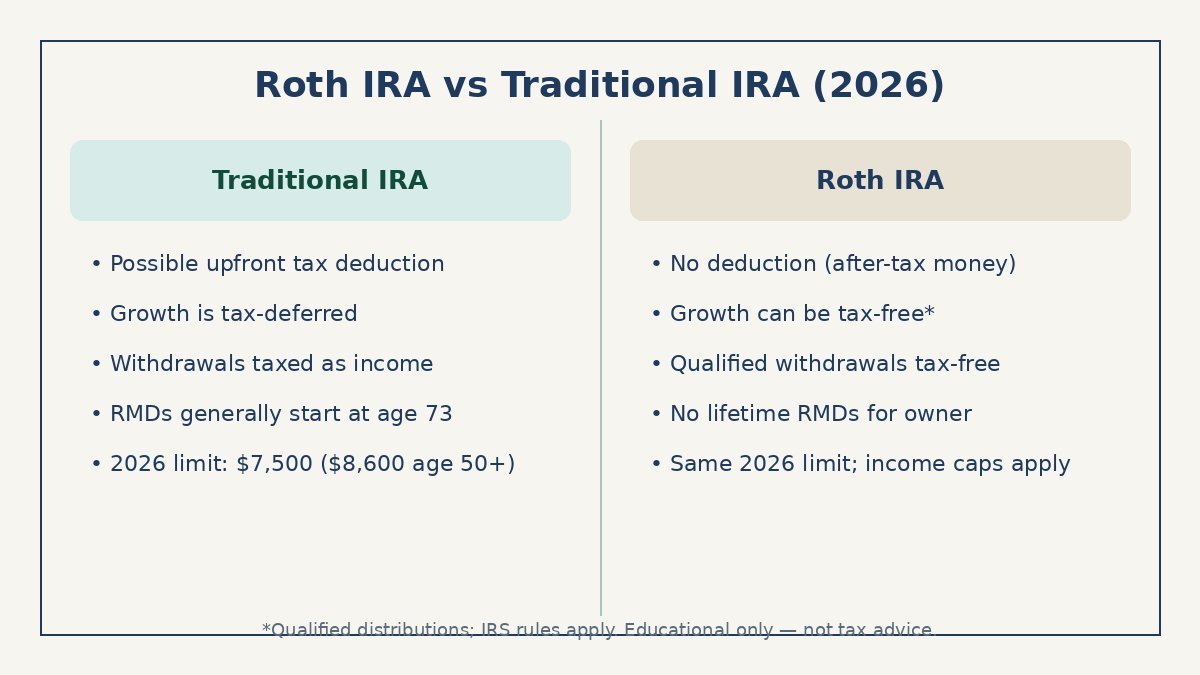
Quick Comparison Table
| Feature | Traditional IRA | Roth IRA |
|---|---|---|
| 2026 contribution limit | $7,500 combined ($8,600 age 50+) | Same combined limit |
| Contributions | May be deductible | Not deductible (after-tax) |
| Growth | Tax-deferred | Tax-free if qualified |
| Qualified / typical withdrawals | Taxed as ordinary income | Tax-free if rules met |
| Lifetime RMDs (original owner) | Yes, generally starting at age 73 | No |
| Income limits to contribute | No (deduction may phase out) | Yes (MAGI phase-outs) |
Sources: IRS IR-2025-111, IRS Traditional and Roth IRAs, IRS RMD topics.
2026 IRA Contribution Limits
According to IRS IR-2025-111:
- Combined Traditional + Roth IRA contribution limit for 2026: $7,500
- Age 50 and older: $8,600 total (includes a $1,100 catch-up)
You can split that dollar amount between Traditional and Roth IRAs, but the total across both cannot exceed the annual limit. Per the IRS, you may contribute at any age if you have taxable compensation (and, for a Roth, if your income is under the applicable limits). See also the IRS overview on saving for retirement with IRAs.
How Traditional and Roth IRAs Differ on Taxes
Investor.gov describes IRAs as tax-advantaged investment accounts where you choose the financial institution and the investments (often mutual funds). The SEC does not regulate IRAs as a product category; the tax rules come from the IRS.
Traditional IRA (in brief)
From the IRS Traditional and Roth IRAs page:
- Contributions may be deductible, depending on income and workplace-plan coverage
- Earnings grow tax-deferred
- Withdrawals are generally taxed as ordinary income
- Taking money before age 59½ may trigger a 10% additional tax, unless an exception applies
Roth IRA (in brief)
- Contributions are not deductible (you fund with after-tax dollars)
- Qualified distributions can be tax-free
- Original owners are not required to take lifetime RMDs
Conversions (brief note)
Moving money from a Traditional IRA to a Roth IRA (a conversion) is generally taxable on untaxed amounts in the year of conversion. The IRS discusses this in its IRA FAQs. Conversion strategy is highly fact-specific; treat it as a tax decision, not a free upgrade.
2026 Income Phase-Outs You Need to Know
Roth IRA contribution MAGI phase-outs (2026)
From IRS IR-2025-111:
- Single / Head of Household: $153,000–$168,000
- Married filing jointly: $242,000–$252,000
- Married filing separately (lived with spouse): $0–$10,000
Below the start of the range, a full Roth contribution is generally allowed (subject to the dollar limit and compensation). Inside the range, the allowable Roth contribution is reduced. Above the top of the range, a direct Roth contribution is generally not allowed.
Traditional IRA deduction phase-outs if covered by a workplace plan (2026)
Also from IR-2025-111:
- Single: $81,000–$91,000
- Married filing jointly (contributor covered): $129,000–$149,000
- Married filing jointly (only spouse covered): $242,000–$252,000
- Married filing separately (covered): $0–$10,000
Important: If neither spouse is covered by a workplace retirement plan, Traditional IRA deduction phase-outs generally do not apply—you may still be able to deduct contributions even at higher incomes (subject to other tax rules).
Worked Example 1: Tax Timing on a $7,500 Contribution (Illustrative)
Label clearly: this is a simplified example, not tax advice. Assumptions: $7,500 2026 contribution; federal marginal rate 24% now and 22% in retirement; ignore state tax, investment returns, and Social Security taxation of benefits for clarity.
Traditional IRA (assume fully deductible now):
- Tax savings this year ≈ $7,500 × 24% = $1,800
- If you later withdraw the same $7,500 of previously untaxed money at 22%, tax ≈ $1,650
- Conceptual point: you get the break up front and pay later, possibly at a lower rate
Roth IRA:
- No deduction now → you effectively “pay” the $1,800 of tax elsewhere on the income used to fund the Roth
- A qualified withdrawal of that contribution (and earnings, if rules are met) can be tax-free later
If future rates are lower, Traditional can look attractive on tax timing alone. If rates stay the same or rise—or if you value tax-free withdrawals and no lifetime RMDs—Roth can look better. Real outcomes also depend on investment growth, state taxes, and when you withdraw.
Worked Example 2: Who Can Fully Contribute to a Roth in 2026?
Assume a single filer with taxable compensation and no other Roth complications:
- MAGI $140,000: Below the 2026 single Roth phase-out start of $153,000, so a full Roth contribution (up to $7,500, or $8,600 if age 50+) is generally allowed.
- MAGI $160,000: Inside the $153,000–$168,000 phase-out range, so only a reduced Roth contribution is generally allowed—not the full limit.
Always confirm MAGI with your tax preparer or software; side income, deductions, and filing status can move you across the line.
RMDs: Age 73 vs None for Roth Owners
Per the IRS RMD page:
- Traditional IRA: RMDs generally begin at age 73. The first RMD is typically due by April 1 of the year after you reach 73.
- Original Roth IRA owners: not required to take lifetime RMDs
That flexibility can matter if you do not need the cash and prefer to leave assets invested longer—or plan for heirs under current law (beneficiary RMD rules are separate and can change).
Market volatility also interacts with withdrawal timing. If you are thinking about sequence risk near retirement, see What to Do With Retirement Savings in a Market Sell-Off.
A Simple Checklist: Which May Fit You Better?
Lean Traditional IRA if you:
- Expect a meaningfully lower tax bracket in retirement than today
- Want a possible deduction now and are within (or not subject to) deduction phase-outs
- Are comfortable with future taxable withdrawals and lifetime RMDs
Lean Roth IRA if you:
- Expect a similar or higher future tax rate
- Prefer tax-free qualified withdrawals and no lifetime RMDs as the original owner
- Are under the 2026 Roth MAGI limits for a full or partial contribution
- Want more flexibility later for estate or cash-flow planning (still confirm beneficiary rules)
Many households use both: for example, maximize a workplace plan match first, keep a cash buffer, then split IRA room based on current vs expected future rates. Cash buffers still matter—see How Much Emergency Fund Do You Need?. When funding investments over time, compare approaches in Dollar-Cost Averaging vs Lump Sum.
FAQ
Is a Roth IRA always better than a Traditional IRA?
No. “Better” depends on your current and expected future tax rates, whether you can deduct Traditional contributions, whether you qualify for Roth contributions under MAGI limits, and whether you value avoiding lifetime RMDs. There is no universal winner.
Can I contribute to both a Roth and a Traditional IRA in 2026?
Yes, but the combined contribution cannot exceed $7,500 ($8,600 if age 50+). You still must meet Roth income rules and Traditional deduction rules separately.
When do Traditional IRA RMDs start?
Generally at age 73, with the first RMD due by April 1 of the following year, according to the IRS. Original Roth IRA owners do not face lifetime RMDs.
What happens if I convert a Traditional IRA to a Roth?
Untaxed amounts converted are generally taxable in the conversion year. See the IRS IRA FAQs. Get personalized tax help before converting large balances.
Do I need earned income to contribute?
Yes. The IRS states you can contribute if you have taxable compensation (and, for Roth, income under the limits). Age alone does not block contributions under current rules.
Bottom Line
For Roth IRA vs Traditional IRA decisions in 2026, start with the IRS numbers: $7,500 combined contribution limit ($8,600 age 50+), Roth MAGI phase-outs, and Traditional deduction phase-outs when a workplace plan covers you. Then compare when you want to pay tax—now (Roth) or later (Traditional)—and whether lifetime RMDs matter to your plan. Revisit the choice when your income, filing status, or tax outlook changes.
Related reading: What to Do With Retirement Savings in a Market Sell-Off · How Much Emergency Fund Do You Need? · Dollar-Cost Averaging vs Lump Sum
Not financial advice. This article is for educational purposes only. Tax rules depend on your filing status, income, workplace coverage, and other facts. Contribution and phase-out figures cited are from IRS publications for 2026 and can change in future years. Consult a qualified tax or financial professional before making IRA or conversion decisions.