
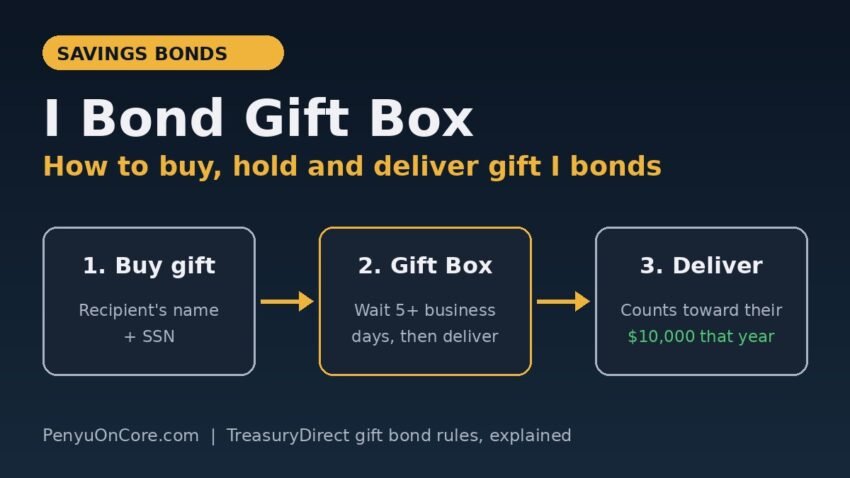
Quick answer: To deliver a gift I bond, log in to TreasuryDirect, open the Gift Box tab, select the bond’s confirmation number, click Deliver, and enter the recipient’s TreasuryDirect account number. You must wait at least five business days after buying, and the recipient needs their own TreasuryDirect account. The delivered amount counts toward the recipient’s $10,000 annual I bond limit in the calendar year you deliver it, not the year you bought it.
Gift I bonds are popular around the holidays, and they are also the basis of the so-called “gift box strategy” for putting more than $10,000 a year into I bonds. The mechanics are simple once you know them, but there are a few traps: the recipient’s own purchases, deliveries to children, and timing around January 1. This guide walks through how buying, holding and delivering actually work, based on TreasuryDirect’s own gift bond rules.
How gift I bonds work: two separate steps
A gift I bond is bought in one step and delivered in another. When you buy it, you register it in the recipient’s name using their full name and Social Security Number. TreasuryDirect then holds it in the Gift Box area of your account until you choose to deliver it.
- Electronic only. Gift savings bonds are issued only in electronic form. Since January 1, 2025, I bonds of any kind are electronic only.
- Issued fast, deliverable later. Gift purchases generally show up in your Gift Box within one business day, but you must wait at least five business days after the purchase date before you can deliver, so the payment can clear the banking system (TreasuryDirect “How Do I…?”).
- Individuals only. Gift bonds are not available in entity accounts (such as trusts or businesses) and cannot be delivered to one. Treasury marketable securities like T-bills and TIPS can’t be bought as gifts.
- Limbo while undelivered. A bond sitting in your Gift Box belongs to the person named on it, so it doesn’t count toward your purchase limit. TreasuryDirect says plainly that it is “not yours” (How much can I spend/own?). As The Finance Buff explains, you also can’t cash out a bond from your Gift Box.
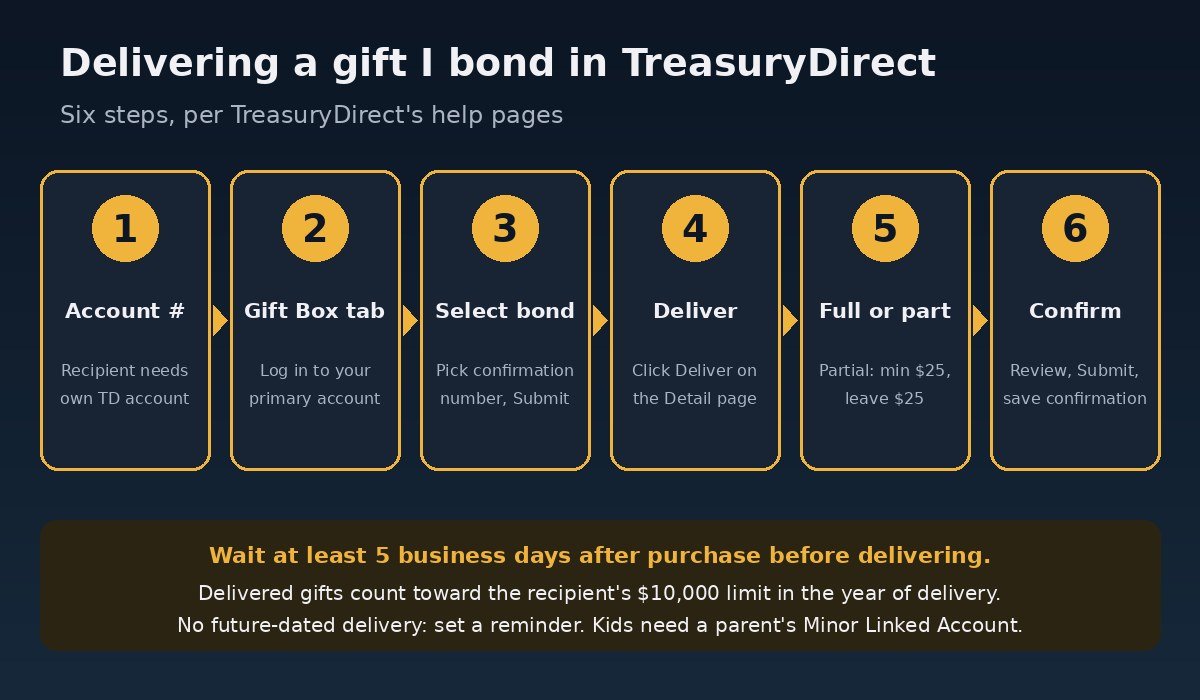
Step by step: how to deliver an I bond from your Gift Box
These steps follow TreasuryDirect’s published instructions. Menu labels can change when the site is updated, so if a button looks different, check the official help page.
- Get the recipient’s account number. The recipient must already have their own TreasuryDirect account. You need that account number to deliver.
- Log in to your primary TreasuryDirect account and click the Gift Box tab near the top right of the page.
- Select the bond. Choose the button next to the confirmation number of the bond you want to deliver and click Submit.
- Click Deliver on the Detail page.
- Choose full or partial delivery. To deliver the whole bond, enter the recipient’s account number and submit. For a partial delivery, choose “Deliver partial amount” and enter the dollar amount. You must deliver at least $25 and leave at least $25 in the bond.
- Review and confirm. On the Delivery Review page, click Edit to fix anything, or Submit to finish. Print or save the Delivery Confirmation page for your records.
After delivery, TreasuryDirect emails the recipient to say a gift bond has arrived. If you’d like to announce the gift yourself, TreasuryDirect also offers printable gift announcements. One practical note from The Finance Buff: you can’t schedule a delivery for a future date. You have to log in each time you want to deliver, so set yourself a calendar reminder.
How the $10,000 limit works with gift bonds
Each Social Security Number can buy up to $10,000 in electronic I bonds per calendar year. Here’s how TreasuryDirect applies that to gifts:
- Gift bonds count toward the recipient’s limit, not the giver’s.
- The gift counts in the year the recipient gets the bond, meaning the year it’s delivered (TreasuryDirect User Guide).
- Undelivered bonds in your Gift Box count against nobody’s limit yet.
- There’s no cap on the total amount of savings bonds a person can own.
| Situation | Whose $10,000 limit? | Which year? |
|---|---|---|
| You buy I bonds in your own name | Yours | Year of purchase |
| Gift bond bought, still in your Gift Box | No one’s yet | Not counted until delivery |
| Gift bond delivered to the recipient | The recipient’s | Year of delivery |
| Bonds in a child’s Minor Linked Account | The child’s | Year bought or delivered |
The trap: a delivered gift uses up the recipient’s room for that year. If someone receives $10,000 of gift I bonds in a year, they can’t also buy $10,000 for themselves that same year. Check with the recipient before you deliver, especially in January, when many people buy their own I bonds.
The “gift box strategy,” explained without the hype
Because undelivered gifts don’t count against anyone’s limit, some people buy gift bonds for a spouse or relative and deliver them over several future years. Investopedia and The Finance Buff both report that a gift bond’s rate and holding period are set when the bond is bought, not when it’s delivered. In other words, the bond locks in the fixed rate for the month of purchase and starts earning interest right away.
A simple hypothetical: two spouses each buy their own $10,000 this year, and each also buys gift bonds for the other. Next January, each delivers $10,000 from their Gift Box to the other. That uses the following year’s limit for bonds bought earlier.
Weigh the downsides before trying it:
- The money is locked up. You can’t cash out a bond from your Gift Box. The recipient can’t either until it’s delivered, and I bonds can’t be redeemed in the first 12 months. Cashing out before five years forfeits the last three months of interest (TreasuryDirect).
- It’s a real gift. The bond belongs to the person named on it. That’s fine within a marriage, but it’s a bigger decision with anyone else.
- Delivery capacity. Each year you can only deliver as much as the recipient’s remaining $10,000 limit allows, so a large stockpile could take many years to deliver.
- The fixed rate is the long-term driver. For I bonds issued November 1, 2026 through April 30, 2027, TreasuryDirect lists a composite rate of 5.51%, including a 1.40% fixed rate. The inflation part resets every six months and can go down. Only the fixed rate lasts for the life of the bond.
If you’re mainly looking for a safe place for cash you might need soon, I bonds’ 12-month lockup matters. Compare that with the options in our SGOV vs high-yield savings guide and our emergency fund guide.
Giving I bonds to a child
A child under 18 can’t open their own primary TreasuryDirect account. Before a gift can be delivered, the child’s parent or legal guardian must set up a Minor Linked Account inside their own TreasuryDirect account (TreasuryDirect gift PDF). Only a parent or the person providing chief support can open one. Bonds in that linked account belong to the child and count toward the child’s own $10,000 limit. When the child turns 18 and opens a primary account, the parent can de-link the bonds into it. If you’re a grandparent or other relative, ask the parent which account number to use before you deliver.
Taxes on gift I bonds
I bond interest is subject to federal income tax but exempt from state and local income tax. Bonds are also subject to federal gift and estate taxes. According to TreasuryDirect’s tax page, when you buy a bond but someone else is named as the only owner, the named owner owes the income tax on the interest, not you. For gift tax, the IRS annual exclusion is $19,000 per recipient for 2026. Gifts to a U.S.-citizen spouse are generally unlimited. If you’re giving large amounts or using the gift box strategy with someone other than your spouse, ask a tax professional when the gift counts for gift-tax purposes.
For more on state-tax-free Treasury income, see our money market fund state tax guide.
FAQ
Does the recipient need a TreasuryDirect account when I buy the gift?
No. To buy, you only need their full name and Social Security Number. They need an account before you can deliver it, and you’ll need that account number.
Can I deliver part of a gift bond?
Yes. Choose “Deliver partial amount.” You must deliver at least $25 and leave at least $25 in the bond.
How long can a gift bond stay in my Gift Box?
There’s no maximum stay, according to The Finance Buff’s review of the rules, and I bonds earn interest for up to 30 years. But while a bond sits undelivered, nobody can cash it, so don’t leave it there longer than you mean to.
Can I cash out a gift bond I haven’t delivered?
No. It belongs to the recipient, so it can only be redeemed after it’s delivered and has been held at least 12 months.
Can I deliver gift I bonds to a trust or LLC?
No. Gift bonds can’t be bought in entity accounts or delivered to them.
Disclaimer: This article is for general educational purposes only and is not financial, tax, or legal advice. TreasuryDirect rules, interest rates and IRS limits can change. Check the official sources linked above, and consider a qualified professional for your situation.