
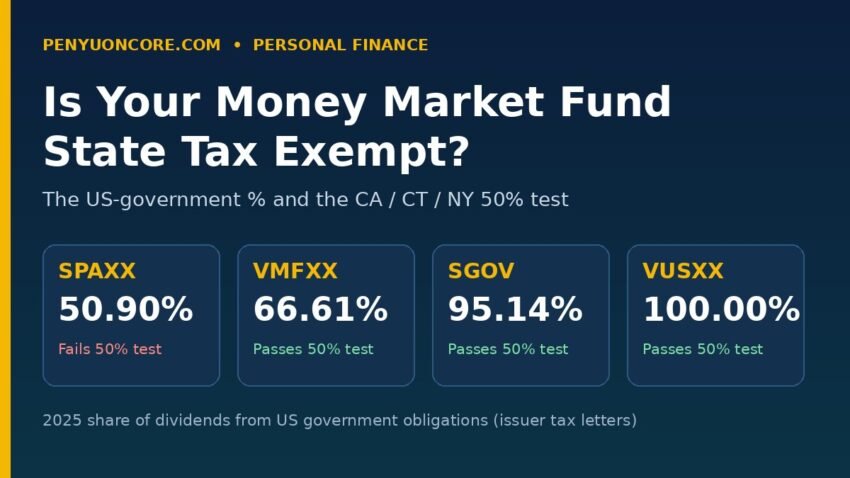
Short answer: Partly, and it depends on the fund and your state. Most states let you exclude the share of a money market fund’s dividends that came from U.S. government obligations, and each fund company publishes that percentage once a year. In California, Connecticut and New York, though, the exclusion only applies if the fund kept at least 50% of its assets in those obligations at the end of every quarter. That’s why a government fund like SPAXX can be about half exempt in most states and fully taxable in those three.
This guide covers how the exclusion works, the 2025 percentages for several popular money market funds and Treasury ETFs (taken from the fund companies’ own tax letters), and how to apply the number on your state return. It applies only to US taxpayers holding these funds in a taxable account. Dividends inside an IRA or 401(k) aren’t taxed each year, so the state exclusion doesn’t come into play there.
Why Treasury income can be state tax exempt
Federal law bars states from taxing interest on US government obligations. Under 31 U.S.C. § 3124, “stocks and obligations of the United States Government are exempt from taxation by a State or political subdivision of a State.” TreasuryDirect’s Treasury bills page puts it more simply: federal tax is due on the interest, but there are no state or local taxes.
A money market fund isn’t a Treasury bill, though. It pays you dividends, which your broker reports as ordinary dividends on Form 1099-DIV. Most states let the government-source part of those dividends “pass through” as exempt income. The catch is that a fund rarely earns 100% of its income from qualifying obligations.
Why “government” funds aren’t 100% exempt
Under SEC rules, a government money market fund invests 99.5% or more of its total assets in cash, government securities and/or repurchase agreements fully collateralized by cash or government securities. That’s a safety definition, not a tax definition. Only the income the fund company counts as coming from US government obligations goes into the state-exempt percentage. iShares, for example, says its figure includes Treasury bills, notes and bonds plus obligations of the Federal Home Loan Banks, Federal Farm Credit Banks and the Tennessee Valley Authority. A fund that holds a lot of repos or other assets can report a much lower percentage than its name suggests.
The two numbers that decide your exemption
Each year the fund company publishes a supplemental tax letter with two facts for each fund:
- The US government income percentage. Vanguard’s 2025 letter says to multiply the ordinary dividends in Box 1a of Form 1099-DIV by the fund’s listed percentage to find the portion that may be exempt.
- Whether the fund passed the 50% quarterly test. Fidelity’s 2025 letter states that “California, Connecticut, and New York exempt dividend income only when a fund has met a certain minimum investment in U.S. government securities,” and marks the funds that missed it with an asterisk. Vanguard’s letter describes the threshold as 50% of the fund’s assets at each quarter-end within the tax year.
These are two separate tests. The percentage measures where the fund’s income came from, while the 50% test looks at what the fund held at quarter-ends. A fund can earn just over half its income from government obligations and still fail the asset test, and that’s exactly what happened to SPAXX in 2025.
2025 state-exempt percentages for popular cash funds
The figures below come straight from the issuers’ 2025 tax letters (Fidelity, Vanguard, iShares). They apply to 2025 dividends only and change every year.
| Fund | Ticker | 2025 US government share | Met CA/CT/NY 50% test? |
|---|---|---|---|
| Vanguard Treasury Money Market Fund | VUSXX | 100.00% | Yes |
| Fidelity Treasury Only Money Market Fund | FDLXX (all classes) | 98.67% | Yes (no asterisk) |
| iShares 0-3 Month Treasury Bond ETF | SGOV | 95.14% | Yes |
| Vanguard Federal Money Market Fund (settlement fund) | VMFXX | 66.61% | Yes |
| Fidelity Treasury Money Market Fund | FZFXX (all classes) | 61.52% | No |
| Fidelity Government Money Market Fund | SPAXX (all classes) | 50.90% | No |
| Fidelity Money Market Fund | SPRXX | 14.56% | No |
Some things stand out. The word “Treasury” in a fund’s name doesn’t guarantee a high percentage: Fidelity’s Treasury Money Market Fund came in at 61.52% and missed the 50% test, while its Treasury Only fund reported 98.67% and passed. Vanguard’s settlement fund, VMFXX, reported 66.61%, not far above SPAXX’s 50.90%, yet it passed the threshold that SPAXX missed. Vanguard notes that its VMFXX figure applies to the Vanguard Federal Money Market Settlement Fund.
If you’re comparing a Treasury ETF with a bank account for your cash, we work through the after-tax math in SGOV vs high-yield savings.
How to claim the exclusion on your state return
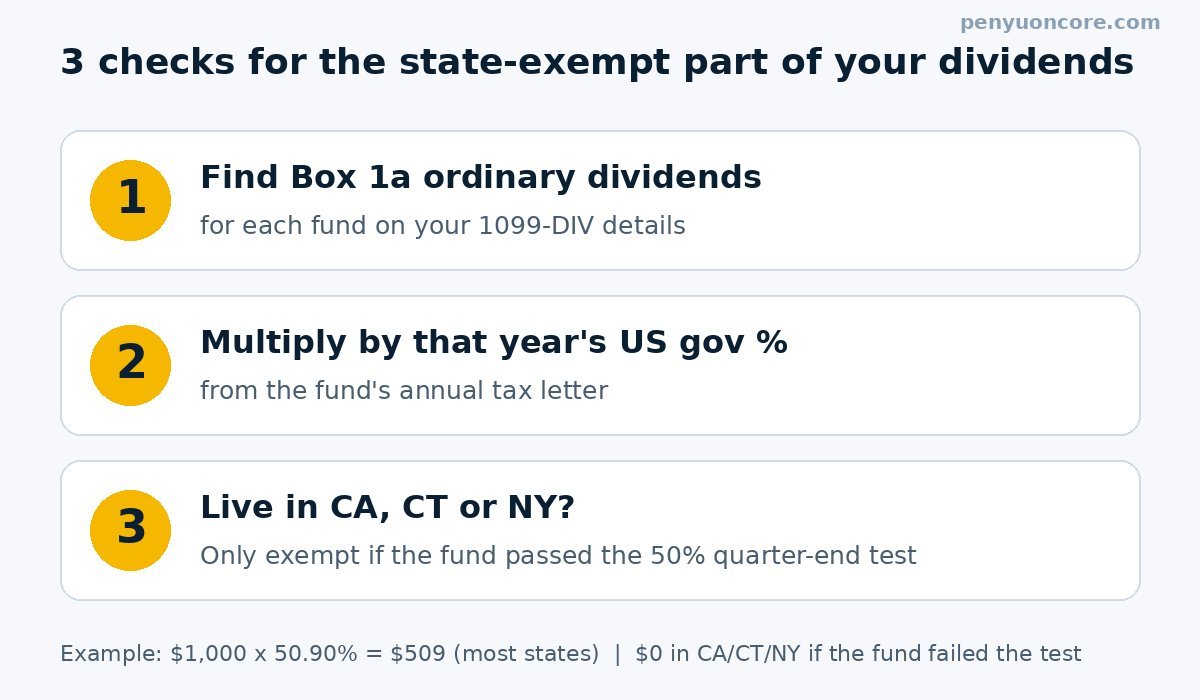
Step 1: Find your ordinary dividends per fund
Your consolidated 1099 lists total ordinary dividends in Box 1a, but you need the amount for each fund. Fidelity’s letter says brokerage customers can find it in the supplemental “Details of 1099-DIV Transactions” section of the 1099 Tax Statement.
Step 2: Multiply by that year’s percentage
Use the percentage for the same tax year as your 1099. Here’s an illustrative example using SPAXX’s 2025 figure: $1,000 of SPAXX dividends × 50.90% = $509 of US government income.
Step 3: Apply your state’s rule
- Most states with an income tax: you’d typically subtract that $509 as US government interest, following your state’s instructions.
- California, Connecticut or New York: because Fidelity marked SPAXX as failing the minimum-investment test, none of the $1,000 is exempt. For a fund that passed, such as VMFXX, you’d apply its percentage as normal.
- States without a broad income tax: there’s usually nothing to subtract, but check your state’s rules.
Your broker usually reports the full amount as ordinary dividends, and your tax software won’t necessarily know the fund’s percentage. Look for the screen or line that covers US government interest or obligations on the state return. Federal tax still applies to the whole dividend either way.
Direct T-bills vs funds in the three strict states
The 50% fund test applies to fund dividends. Interest on Treasury bills you own directly falls under the federal exemption in 31 U.S.C. § 3124, so it doesn’t depend on any fund’s quarter-end holdings. If you live in California, Connecticut or New York and keep a large cash balance, it’s worth comparing the after-tax yield of a fund that failed the test with one that passed, or with T-bills held directly. Yields, fees and convenience all differ, so run the numbers rather than going by the fund’s name.
Taxes are only one part of choosing where to keep cash. Money market funds aren’t FDIC-insured (Investor.gov notes that mutual funds aren’t guaranteed or insured by the FDIC or any other government agency). For what protects your account if a brokerage itself fails, see what happens if your broker goes bankrupt. If this cash is your safety net, how much emergency fund you need is a good first question to answer.
FAQ
Is SPAXX state tax exempt?
Partly. Fidelity reported that 50.90% of SPAXX’s 2025 income came from US government securities, which most states let you exclude. Fidelity also marked it as failing the minimum-investment requirement for California, Connecticut and New York, so residents of those states can’t exclude any of it for 2025.
Is VMFXX state tax exempt?
Vanguard reported 66.61% for 2025 and marked VMFXX as meeting the California, Connecticut and New York threshold, so that share may be excludable in those states too.
Are money market dividends exempt from federal tax?
No. The government-obligation exclusion only applies to state (and local) income tax. Taxable money market funds still pay federally taxable dividends.
Does the percentage stay the same every year?
No. Each fund company publishes a new figure for every tax year, and whether a fund passes the 50% test can change too. Always use the letter for the year you’re filing.
Bottom line
To work out how much of your money market fund’s dividends you can keep out of state tax, you need two things from the fund’s annual tax letter: the US government percentage and, if you live in California, Connecticut or New York, whether the fund passed the 50% test. Then multiply your Box 1a dividends by that percentage and claim it on the right line of your state return.
Disclaimer: This article is for general educational purposes only and isn’t tax, legal or financial advice. State tax rules vary and change, and fund percentages are reset every year. Check your state’s instructions or a qualified tax professional before filing.