
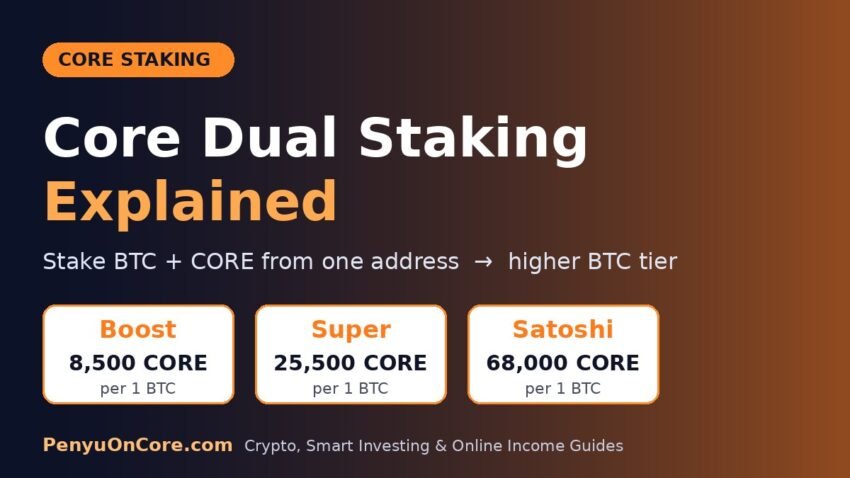
Quick answer: Core dual staking means staking BTC (through a Bitcoin timelock) and staking CORE (delegating to a validator) from the same Core address, so your BTC staking rewards move into a higher tier. Right now Core’s docs list three boosted tiers: 8,500, 25,500 and 68,000 CORE staked per 1 BTC staked. The boost applies only to your BTC staking rewards. Your CORE staking rewards stay the same.
If you already stake Bitcoin on Core, dual staking is the main lever that changes how much CORE your BTC earns. This guide covers how the tiers work, how to work out the CORE you need, the activation step people often miss, and the risks. It uses Core’s official documentation and the live staking API, checked on 15 November 2026.
What Is Core Dual Staking?
Core runs on Satoshi Plus consensus, which combines three delegation sources: Bitcoin miners delegating hash power, CORE holders delegating tokens, and BTC holders doing self-custodial Bitcoin staking. (Our Satoshi Plus explainer covers the background.) According to Core’s “How Dual Staking Works” page, dual staking is an add-on to Bitcoin staking. If you stake both BTC and CORE and reach set CORE-to-BTC ratios, you get “boosted Bitcoin staking rewards, paid in CORE.”
The docs also say what dual staking doesn’t do. It doesn’t create a new reward pool, and it doesn’t change your CORE staking yield. Rewards still come from three separate pools (hash power delegators, Bitcoin stakers and CORE stakers). Dual staking only gives BTC stakers who also stake CORE a larger share of the Bitcoin staking pool.
Core Dual Staking Tiers and Ratios (November 2026)
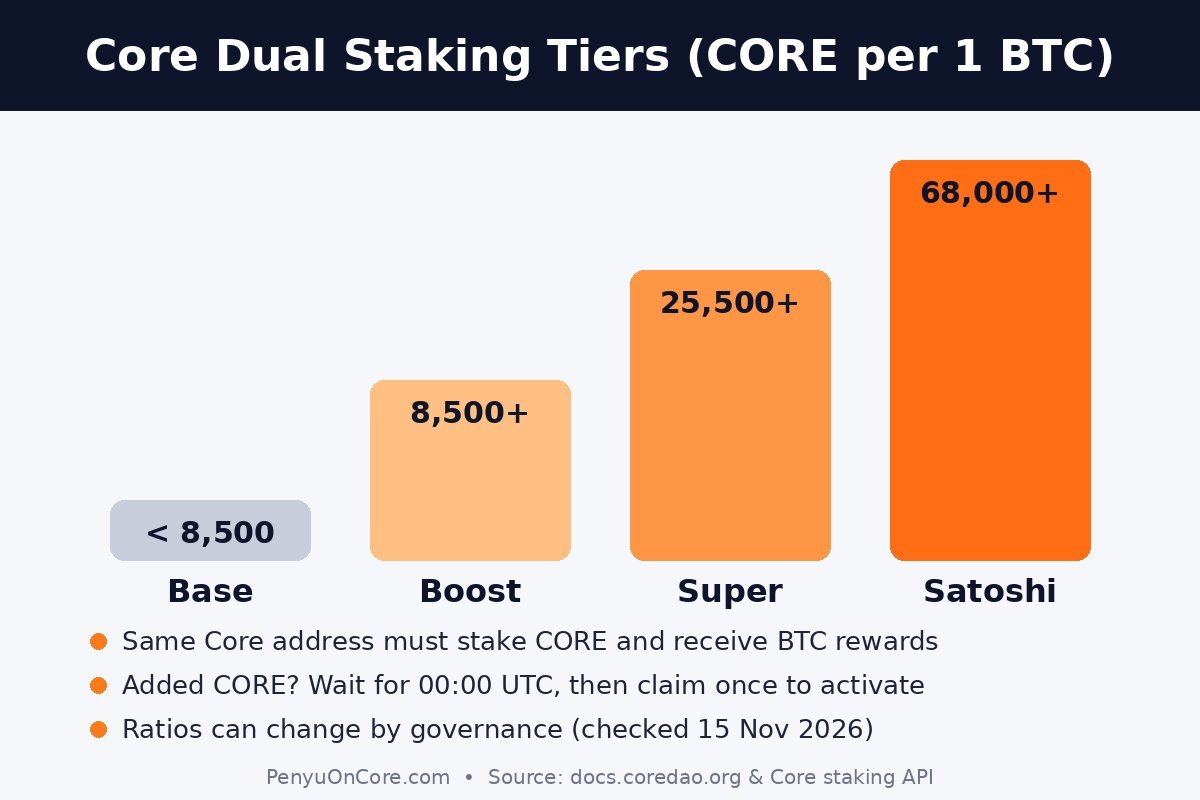
Your tier depends on how much CORE you have staked for each BTC you have staked. Core’s dual staking overview names four tiers, and the integration guide lists the current requirements. On 15 November 2026 we checked Core’s public staking API (dual staking grade endpoint), and its stakeRate values matched: 0, 8,500, 25,500 and 68,000.
| Tier | CORE staked per 1 BTC staked | What it means |
|---|---|---|
| Base | Below 8,500 | Solo BTC staking rate (the lowest BTC yield) |
| Boost | 8,500 to under 25,500 | Entry-level boosted BTC yield |
| Super | 25,500 to under 68,000 | Higher boosted BTC yield |
| Satoshi | 68,000 or more | Maximum boosted BTC yield |
These numbers aren’t fixed. Core’s docs say the ratios and the number of tiers “are configurable and subject to change by governance vote,” and the multiplier for each tier is also dynamic. The ratios have changed before: Core’s CIP-9 governance proposal doubled the earlier requirements (4,250, 12,750 and 34,000 CORE per BTC) to today’s 8,500, 25,500 and 68,000. Always check the current figures at stake.coredao.org before you buy or stake anything.
How to Calculate the CORE You Need
Multiply your staked BTC by the tier ratio:
- Boost: BTC staked × 8,500
- Super: BTC staked × 25,500
- Satoshi: BTC staked × 68,000
Core’s own example uses 10 BTC, which needs 85,000 CORE for Boost, 255,000 for Super and 680,000 for Satoshi. With a smaller position, say 0.5 BTC, the same ratios give 4,250 CORE for Boost, 12,750 for Super and 34,000 for Satoshi. With 0.1 BTC, they give 850, 2,550 and 6,800 CORE.
Each tier is a threshold, so there’s no partial credit. If you need 12,750 CORE for Super and have 12,700 staked, you stay in Boost. A small cushion above the threshold helps, especially because Core can raise the ratios later.
How to Set Up Dual Staking Step by Step
1. Use one Core address for everything
This rule matters most. Core’s dual staking FAQ says the address you stake CORE from must be the same address that receives your BTC staking rewards. That’s how the protocol knows both stakes belong to the same person. On stake.coredao.org, connect your Core wallet first and then your Bitcoin wallet. The site uses the connected Core address as the reward address for your BTC stake.
2. Stake your BTC
BTC staking means sending a timelock transaction on the Bitcoin network. Your coins stay in a script you control until the lock expires. The full process, including wallets, lock times and fees, is in our step-by-step BTC staking guide.
3. Delegate enough CORE
From the same Core address, delegate CORE to one or more active validators. Our how to stake CORE guide walks through it. Core’s docs say staked CORE and staked BTC can be spread across multiple validators and still count toward your ratio. Keep a little unstaked CORE for gas, because claiming and delegating are on-chain transactions.
4. Activate the new tier (the step people miss)
If your BTC was already staked and you add CORE to move up a tier, the higher tier doesn’t apply automatically. Core’s docs say to:
- Wait until the next 00:00 UTC after staking the extra CORE.
- Claim your rewards once at any time after that 00:00 UTC. This resets the tier calculation, and the new tier applies as soon as the claim confirms.
For US readers, 00:00 UTC is 7:00 pm Eastern (8:00 pm during daylight saving time). In the UK, it’s midnight in winter and 1:00 am during British Summer Time.
5. Check your tier
Open My Staking on stake.coredao.org with your Core wallet connected. Core’s FAQ says this page shows your CORE and BTC staking transactions and the CORE rewards you’ve accrued from both.
Common Dual Staking Problems
“I staked CORE but my BTC yield didn’t change”
Usually one of three things went wrong. The CORE is staked from a different address than your BTC reward address. You haven’t done the wait-until-00:00-UTC-then-claim step. Or your CORE is just under the threshold. Core’s FAQ suggests moving stakes spread across several addresses into one address.
“I unstaked some CORE. Did I lose rewards?”
Core says you can unstake CORE at any time, even while your BTC is still timelocked. Your BTC reward rate falls to match the lower CORE stake, but only for future rewards. Rewards you’ve already earned aren’t affected.
“My tier dropped even though I didn’t do anything”
Core’s tier adjustment system explains why this can happen. If too many people qualify for the Satoshi tier, the protocol can raise the CORE-to-BTC requirement. Some stakers then fall to a lower tier unless they add more CORE.
Risks to Understand Before You Dual Stake
- CORE price exposure. To reach a higher tier you have to hold more CORE, a volatile token. BTC rewards are also paid in CORE. A falling CORE price can wipe out the extra yield and more. See our article on why Core tokens fell.
- Moving thresholds. Ratios and multipliers can change by governance or tier adjustment, so the tier you aim for today may need more CORE later.
- Variable yields. Core’s FAQ says yields depend on total CORE and BTC staked, the BTC/CORE price ratio, validator commission, the number of active validators and how delegation is spread. No rate is guaranteed.
- Locked BTC. Your BTC can’t be moved until the timelock expires. Core says delegators aren’t slashed if a validator is, but they miss that round’s rewards.
FAQ
Does dual staking increase my CORE staking rewards?
No. Core’s docs say dual staking only boosts your BTC staking yield. CORE staking rewards are calculated the same way as before.
Can my BTC and CORE be with different validators?
Yes. The docs say staked CORE and BTC can be spread across multiple active validators. What matters is that both are tied to the same Core address.
What is the minimum CORE for dual staking?
There’s no single fixed number. The Boost tier currently needs 8,500 CORE for each 1 BTC you stake, so the minimum depends on how much BTC you stake.
How often do the tier ratios change?
There’s no set schedule. Changes come through governance or the tier adjustment system, and Core announces them through its official channels and the staking site.
Disclaimer: This article is for educational purposes only and isn’t financial advice. Staking involves risk, including loss of value of the CORE token. Do your own research and check current figures on Core’s official sites before acting.