
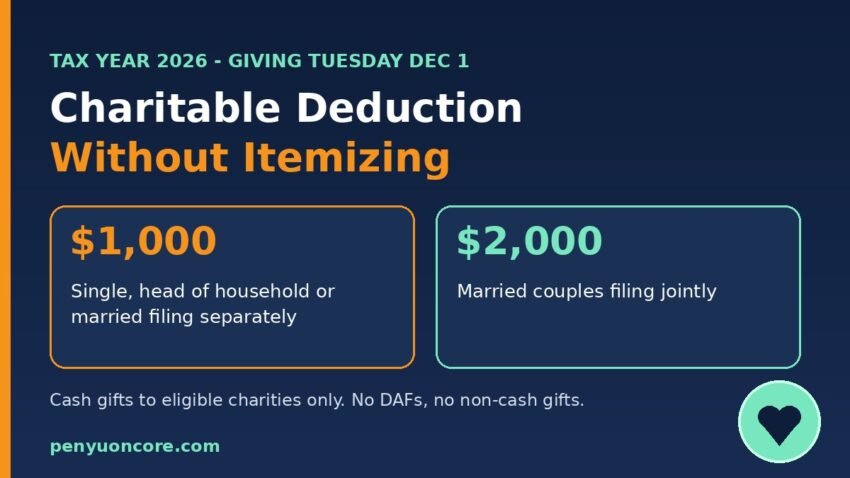
The charitable deduction without itemizing is back, and this time it is permanent. Starting with the 2026 tax year, people who take the standard deduction can deduct up to $1,000 of qualifying cash donations, or $2,000 for married couples filing jointly, according to the IRS (IR-2026-135, Nov. 10, 2026). With Giving Tuesday falling on December 1 this year, here is exactly what counts, what doesn’t, and the records you need before you donate.
Quick answer: If you don’t itemize, cash gifts you make during calendar year 2026 to eligible public charities can reduce your taxable income by up to $1,000 (single) or $2,000 (married filing jointly) on the return you file in 2027. Non-cash gifts, donor-advised fund contributions, gifts to supporting organizations and gifts to individuals do not qualify. Keep a bank record or a receipt for every donation.
How the charitable deduction without itemizing works in 2026
For years, most Americans got no tax benefit from donating because they claim the standard deduction, and charitable gifts were normally deductible only on Schedule A. The 2025 tax law (H.R. 1, the One Big Beautiful Bill Act, which the IRS now calls the Working Families Tax Cuts) changed that. The IRS Topic No. 506 page now states that beginning with tax year 2026, if you do not itemize, you may deduct up to $1,000 ($2,000 if filing jointly) of cash contributions to certain qualified organizations.
This deduction sits on top of your standard deduction. For 2026 the standard deduction is $16,100 for single filers, $32,200 for married couples filing jointly and $24,150 for heads of household, per the IRS 2026 inflation adjustments. (Planning ahead? See our guide to the standard deduction 2027 amounts.)
According to the Illinois CPA Society, the deduction reduces taxable income but does not reduce adjusted gross income (AGI). So it will not help you qualify for credits or benefits that are tied to AGI.
| Filing status | 2026 standard deduction | Extra charitable deduction (cash only) |
|---|---|---|
| Single / married filing separately | $16,100 | Up to $1,000 |
| Married filing jointly | $32,200 | Up to $2,000 |
| Head of household | $24,150 | Up to $1,000 |
Who can claim it
IRS Publication 6196 (Charitable Contribution Deduction Tips for Non-Itemizers) lists four conditions. You must:
- Not itemize deductions. You don’t have to take the standard deduction itself; the IRS notes that nonresidents and people who file separately from a spouse who itemizes may still qualify.
- Make cash contributions during 2026.
- Give to an eligible charitable organization.
- Keep records, such as receipts or bank records.
How much it could save you
A deduction lowers taxable income, not your tax bill dollar for dollar. Your saving is roughly the deduction multiplied by your top tax rate. For example, a single filer in the 12% bracket who gives $1,000 in cash would save about $120 in federal income tax. A couple in the 22% bracket giving $2,000 would save about $440. If you want to check your bracket, see our breakdown of the 2027 tax brackets and how they compare with 2026.
What counts as a “cash” donation
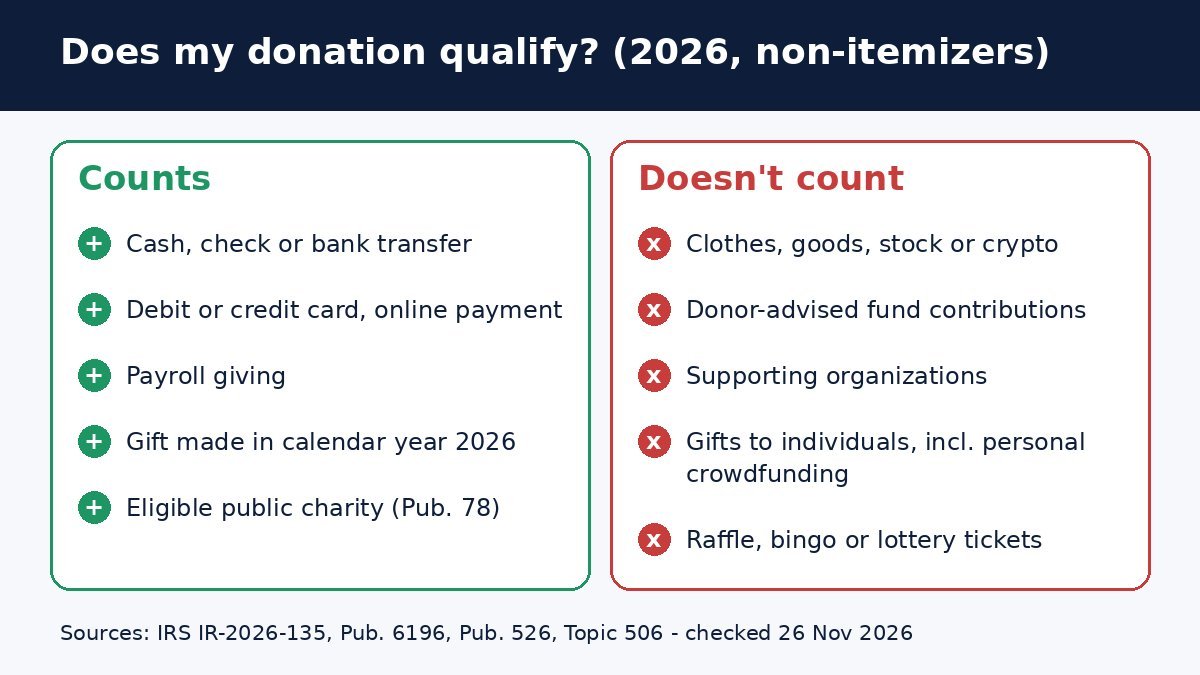
“Cash” is broader than paper money. IRS Publication 526 says cash contributions include payments made by cash, check, electronic funds transfer, online payment service, debit card, credit card, payroll deduction, or a transfer of a gift card redeemable for cash.
Timing matters because only gifts made in 2026 count toward your 2026 return. Publication 526 explains that:
- A mailed check counts on the date you mail it.
- A credit card gift counts in the year you make the charge, even if you pay the card bill in January.
- A gift by text message counts in the year you send the text, if it is charged to your phone or wireless account.
What does not qualify
The IRS reminder and Publication 6196 rule out several common types of giving:
- Non-cash gifts: clothes, household goods, stock and crypto don’t count toward the non-itemizer deduction. (Giving appreciated assets has its own rules; see our guide on how to donate Bitcoin to charity.)
- Donor-advised funds: cash contributions to establish or maintain a donor-advised fund do not qualify.
- Supporting organizations: cash gifts to supporting organizations are also excluded.
- Gifts to individuals: Topic 506 states that gifts to individuals are not deductible. That includes money sent directly to a person or family in need.
- Raffles, bingo and lottery tickets: Publication 526 says these are not deductible as charitable contributions.
- The value of anything you get back: if you receive merchandise, a dinner or event tickets, you can only deduct the amount above the fair market value of what you received (Topic 506).
How to check that a charity is eligible
Publication 6196 recommends the IRS Tax Exempt Organization Search tool. Choose “Pub. 78 Data,” search by name or EIN, and look at the deductibility code. Organizations with codes such as 50% (60% for cash contributions), PC, POF or FED are generally eligible. If you can’t find a group, it isn’t automatically ineligible: some churches, government bodies and organizations covered by a group exemption don’t appear separately.
Giving Tuesday and the holidays also bring fake charity appeals, especially ones that ask you to pay with gift cards or wire transfers. The AICPA advises giving only to organizations you’ve verified and not letting emotion drive the decision. Our guide to gift card scams covers the warning signs.
Records you need to keep
According to Topic 506 and Publication 526, you can’t deduct any cash gift, whatever the amount, unless you keep one of these:
- A bank record showing the charity’s name, the date and the amount: a canceled check, bank or credit union statement, credit card statement or electronic funds transfer receipt.
- A receipt, letter or email from the charity showing its name, the date and the amount.
- For payroll giving, a pay stub or W-2 showing the amount, plus a pledge card from the charity.
For any single contribution of $250 or more, you also need a contemporaneous written acknowledgment from the charity. It must say whether you received any goods or services in return. Separate gifts are not combined for this test, so $25 a week to your church does not trigger it.
If you itemize: the new 0.5% floor
Itemizers face a different change in 2026. The Illinois CPA Society and the AICPA both note that itemizers can deduct charitable gifts only to the extent that their total exceeds 0.5% of AGI. For example, someone with $200,000 of AGI who gives $5,000 would have a $4,000 deduction before other limits. If you’re close to the line between itemizing and taking the standard deduction, compare both ways. The $1,000/$2,000 non-itemizer deduction can tip the balance.
UK readers: Gift Aid is the equivalent
The US rule doesn’t apply in the UK. There, Gift Aid lets charities claim an extra 25p for every £1 you give, at no extra cost to you, provided you sign a declaration and have paid enough tax. Higher-rate taxpayers can claim back the difference through Self Assessment or by asking HMRC to change their tax code.
FAQ
Can I claim the charitable deduction without itemizing on my 2025 return?
No. The IRS says the deduction begins with tax year 2026, so it first appears on returns filed in 2027.
Do Giving Tuesday donations count?
Yes, if they are cash gifts (including card or online payments) made in 2026 to an eligible charity, and not to a donor-advised fund or supporting organization.
Is the limit per person or per return?
It’s $1,000 for individual filers and $2,000 for married couples filing jointly, per the IRS.
Do I need receipts for small donations?
Yes. Every cash gift needs a bank record or written receipt showing the charity, date and amount. Gifts of $250 or more also need a written acknowledgment.
Does donating stock or crypto count?
Not for this deduction. Only qualifying cash contributions are eligible; non-cash gifts are deductible only if you itemize.
Disclaimer: This article is general information based on IRS and GOV.UK guidance as of November 26, 2026. It is not tax, legal or financial advice. Your situation may differ, so check with a qualified tax professional before relying on it.