
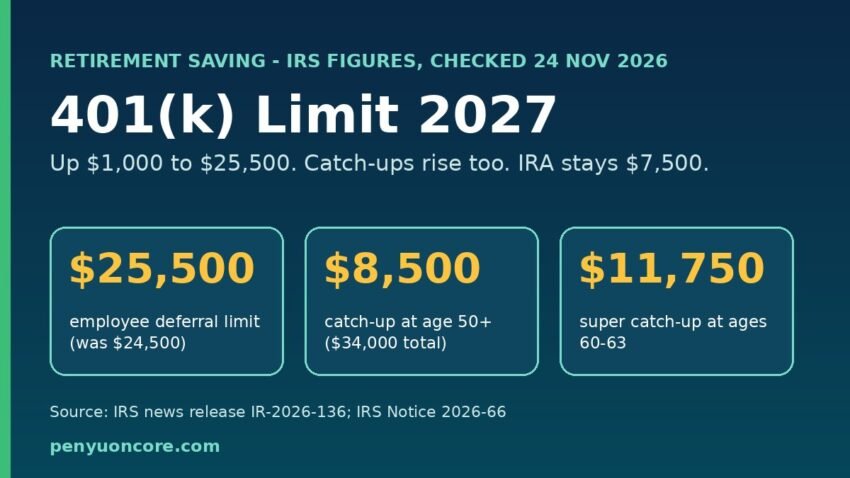
The 401k contribution limit 2027 is $25,500, up $1,000 from $24,500 in 2026. The IRS announced the new figure on 12 November 2026, along with higher catch-up limits for savers aged 50 and over, a bigger “super catch-up” for ages 60 to 63, and a slightly higher income line for the rule that forces some high earners to make catch-up contributions as Roth.
Short answer: In 2027 you can defer up to $25,500 of your salary into a 401(k), 403(b), most 457 plans or the Thrift Savings Plan. If you’re 50 or older you can add an $8,500 catch-up, for $34,000 in total, and if you’re 60, 61, 62 or 63 in 2027 your catch-up is $11,750 instead. The IRA limit stays at $7,500.
Every number below comes from the IRS news release IR-2026-136 and IRS Notice 2026-66, both checked on 24 November 2026.
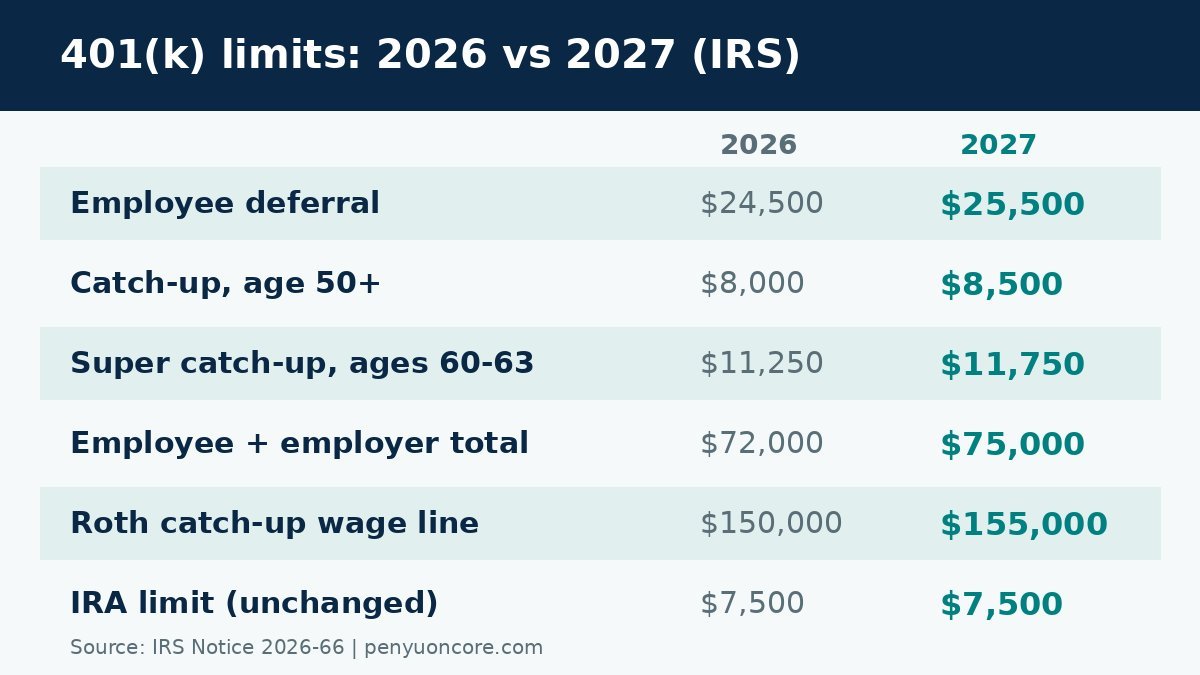
401k contribution limit 2027 vs 2026 at a glance
Here are the main figures that affect people saving through a workplace plan. “Employee deferral” means the money you choose to put in from your paycheck, whether it goes in as pre-tax (traditional) or Roth.
| Limit | 2026 | 2027 |
|---|---|---|
| Employee deferral (401(k), 403(b), governmental 457, TSP) | $24,500 | $25,500 |
| Catch-up, age 50 and over | $8,000 | $8,500 |
| Super catch-up, ages 60-63 | $11,250 | $11,750 |
| Max employee total, age 50-59 or 64+ | $32,500 | $34,000 |
| Max employee total, ages 60-63 | $35,750 | $37,250 |
| Total from you + employer (section 415(c)) | $72,000 | $75,000 |
| Roth catch-up wage threshold (prior-year FICA wages) | $150,000 | $155,000 |
| IRA contribution limit | $7,500 | $7,500 |
| IRA catch-up, age 50 and over | $1,100 | $1,100 |
The two “max employee total” rows are simply the deferral limit plus the relevant catch-up. The SIMPLE IRA limit also rises, from $17,000 to $17,500, while the standard SIMPLE catch-up stays at $4,000.
The $25,500 employee limit
The $25,500 cap is the most you can personally defer from your pay in 2027. It covers traditional and Roth 401(k) deferrals combined, so you can’t put $25,500 into each. If you change jobs during the year, the limit generally applies to you as a person, not to each employer’s plan, so keep track of what you already contributed at your old job before setting your new deferral rate.
A $1,000 rise works out to about $83 more per month, or roughly $38 more per paycheck if you’re paid every two weeks (26 pay periods). If you want to hit the new maximum, you’ll usually need to raise your deferral percentage or dollar amount, because many plans don’t increase it for you automatically.
Catch-up contributions in 2027: age 50+ and the 60-63 “super catch-up”
If you’re 50 or older by the end of 2027, you can contribute an extra $8,500 on top of the $25,500, for $34,000 in total. That’s up from $8,000 in 2026.
SECURE 2.0 created a higher catch-up for people who are 60, 61, 62 or 63 during the year. For 2027 it’s $11,750 instead of $8,500, which lets those savers defer up to $37,250. Once you turn 64, you drop back to the regular age-50 catch-up. Your plan has to offer catch-up contributions for any of this to apply, so check your plan documents or ask HR.
The Roth catch-up rule for higher earners
Under another SECURE 2.0 change, if your Social Security (FICA) wages from the employer sponsoring your plan were above a set threshold in the previous year, your catch-up contributions must go in as Roth (after-tax) rather than pre-tax. The IRS catch-up contributions page puts the threshold at $150,000 for 2026. Notice 2026-66 raises it to $155,000, and it’s measured on 2026 wages to decide how your 2027 catch-ups are treated.
In practice: if your 2026 FICA wages from your employer (generally Box 3 of your W-2) are over $155,000, plan on your 2027 catch-up dollars being Roth. Your regular $25,500 of deferrals can still be pre-tax if your plan allows it. The final regulations generally apply to contributions in taxable years beginning after 31 December 2026, so 2027 is the first year the detailed rules fully apply. If you’re unsure which side of the line you’re on, look at your W-2 when it arrives in early 2027 and confirm with your plan administrator.
The total limit with your employer match: $75,000
There’s a separate, much bigger cap on everything that goes into your account in a year: your deferrals, employer matching and profit-sharing contributions, and any after-tax contributions. For 2027 that limit is $75,000, up from $72,000. Catch-up contributions don’t count toward it, so a 50-plus saver could have more than $75,000 added in total.
Most people won’t come close to this limit. It matters mainly if your employer is generous with profit-sharing, or if your plan allows after-tax contributions beyond the $25,500 (sometimes used for a “mega backdoor Roth”). The pay that can be counted when working out employer contributions is also capped, rising from $360,000 to $375,000 in 2027.
The IRA limit stays at $7,500
The IRA contribution limit doesn’t change for 2027. It stays at $7,500, plus a $1,100 catch-up if you’re 50 or older. IRA limits are separate from 401(k) limits, so you can generally contribute to both in the same year, though your income may limit whether you can deduct a traditional IRA contribution or contribute directly to a Roth IRA.
The income ranges do move up for 2027. The Roth IRA phase-out rises to $158,000-$173,000 for single filers and heads of household (from $153,000-$168,000) and to $250,000-$260,000 for married couples filing jointly (from $242,000-$252,000). For single filers covered by a workplace plan, the traditional IRA deduction phase-out rises to $83,000-$93,000. If you’re deciding where your next dollar should go, our guides to 401(k) vs IRA and Roth vs traditional IRA walk through the trade-offs.
What to do before the end of 2026
The new limit doesn’t start until 1 January 2027, but Thanksgiving week is a good time to check a few things:
- Check your 2026 total. 401(k) deferrals for 2026 come out of 2026 paychecks, so you can’t make them later the way you can with an IRA. If you want to reach the $24,500 limit (or $32,500 / $35,750 with catch-up), see how many pay periods you have left and whether your plan lets you change your rate in time.
- Watch out for year-end bonuses. If a December bonus is subject to your deferral percentage, it could push you over or close to the limit. Most payroll systems stop at the cap, but if you had two employers this year you’ll need to check that yourself.
- Set your 2027 rate. Decide whether you want to raise your contribution for the first paycheck of 2027. To max out $25,500 evenly over 26 paychecks, you’d defer about $981 per paycheck.
- Check for the Roth catch-up. If you’re 50+ and earn around $155,000 or more, ask your plan whether it offers Roth catch-ups and how it will handle the change.
- Don’t forget the HSA. If you’re on a high-deductible health plan, your health savings account has its own separate limit. See our HSA vs FSA guide.
If you do go over, for example because you had two employers in 2026, the IRS says on its excess deferrals page that you should tell the plan and ask for the excess to be paid back to you by 15 April of the following year. Excess left in the plan after that date is effectively taxed twice.
FAQ
What is the 401(k) contribution limit for 2027?
$25,500 in employee deferrals, up from $24,500 in 2026. The same limit applies to 403(b) plans, most 457 plans and the federal Thrift Savings Plan.
What is the 401(k) limit for 2027 if I’m over 50?
$34,000 ($25,500 plus an $8,500 catch-up). If you’re 60, 61, 62 or 63 in 2027, it’s $37,250 ($25,500 plus an $11,750 catch-up).
Does my employer match count toward the $25,500?
No. The $25,500 applies only to your own deferrals. Employer contributions count toward the separate $75,000 total limit.
Did the IRA limit go up for 2027?
No. It stays at $7,500, with a $1,100 catch-up for people aged 50 and over. The Roth IRA income limits did go up.
When do the new limits start?
The 2027 limits apply to contributions for the 2027 calendar year, starting with paychecks paid on or after 1 January 2027.
Note: This article is general information, not financial or tax advice. Plan rules differ and tax rules can change, so check the IRS sources linked above and your plan administrator, or speak to a qualified tax professional, before making decisions.