
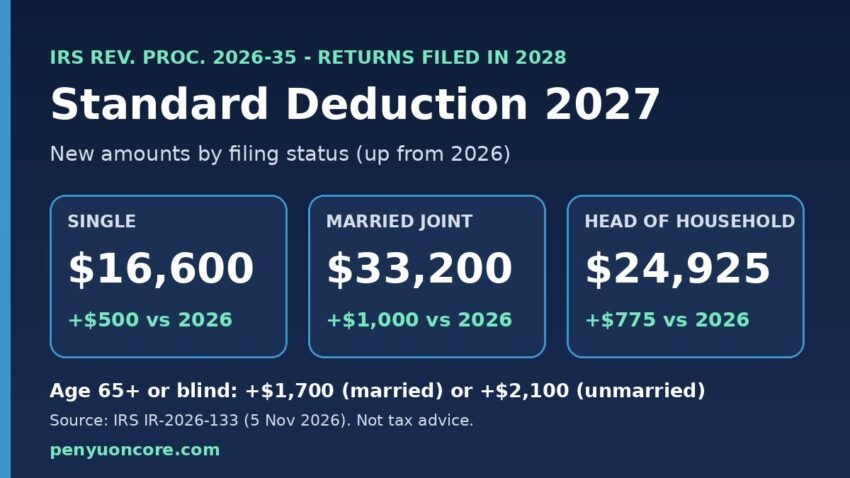
The standard deduction 2027 amounts are $16,600 for single filers and married people filing separately, $33,200 for married couples filing jointly and $24,925 for heads of household. These figures apply to income you earn in 2027, which you report on the tax return you file in early 2028. If you’re 65 or older or blind, you add $1,700 per qualifying condition, or $2,100 if you’re unmarried.
The IRS published the numbers on 5 November 2026 in news release IR-2026-133 and the underlying Revenue Procedure 2026-35. Below you’ll find the full table, how the extra amounts for seniors work (including the separate $6,000 senior deduction), and the one date mix-up that catches a lot of people every winter.
Standard deduction 2027 vs 2026 at a glance
The 2026 figures come from the IRS’s previous release, IR-2025-103 and Rev. Proc. 2025-32. The 2027 figures come from Rev. Proc. 2026-35.
| Filing status | 2026 (returns filed in 2027) | 2027 (returns filed in 2028) | Change |
|---|---|---|---|
| Single | $16,100 | $16,600 | +$500 |
| Married filing separately | $16,100 | $16,600 | +$500 |
| Married filing jointly / surviving spouse | $32,200 | $33,200 | +$1,000 |
| Head of household | $24,150 | $24,925 | +$775 |
| Extra for age 65+ or blind (married) | $1,650 | $1,700 | +$50 |
| Extra for age 65+ or blind (unmarried) | $2,050 | $2,100 | +$50 |
| Dependent’s minimum standard deduction | $1,350 or earned income + $450 | $1,400 or earned income + $500 | +$50 |
In short, a single filer can shield an extra $500 of income from federal income tax in 2027, and a married couple filing jointly an extra $1,000. Heads of household get the largest dollar rise of the three main statuses: $775.
Watch the year: 2026 return vs 2027 tax year
This is where most confusion comes from. The return you file between January and April 2027 covers your 2026 income, so it uses the 2026 amounts ($16,100 single, $32,200 joint). You won’t use the 2027 standard deduction until you file in 2028. The IRS release says the 2027 adjustments “generally apply to tax returns filed in 2028.”
How the standard deduction works
The IRS’s Topic no. 551 describes the standard deduction as “a specific dollar amount that reduces the amount of income on which you’re taxed.” It’s made up of a basic amount set by filing status, plus any additional amounts for age or blindness. It’s an either/or choice. You take the standard deduction or you itemize, and you generally pick whichever is bigger. The IRS’s Topic no. 501, Should I itemize? explains the comparison.
A simple example: a single filer with $60,000 of adjusted gross income and no other deductions would have $43,400 of taxable income in 2027 ($60,000 minus $16,600). The tax brackets then apply to that $43,400, not to the full $60,000. For 2027, the IRS says the 10% bracket covers taxable income up to $12,800 for single filers ($25,600 for joint filers), and the 12% rate applies above that up to $52,025 ($104,050 joint).
Who can’t use it
According to Topic 551, some people aren’t allowed the standard deduction at all. The main group is married people filing separately when their spouse itemizes. Most nonresident aliens are also excluded, with limited exceptions. If someone else can claim you as a dependent, your 2027 standard deduction is capped at the greater of $1,400 or your earned income plus $500, and it can’t exceed the normal amount for your filing status.
Standard deduction 2027 for seniors over 65
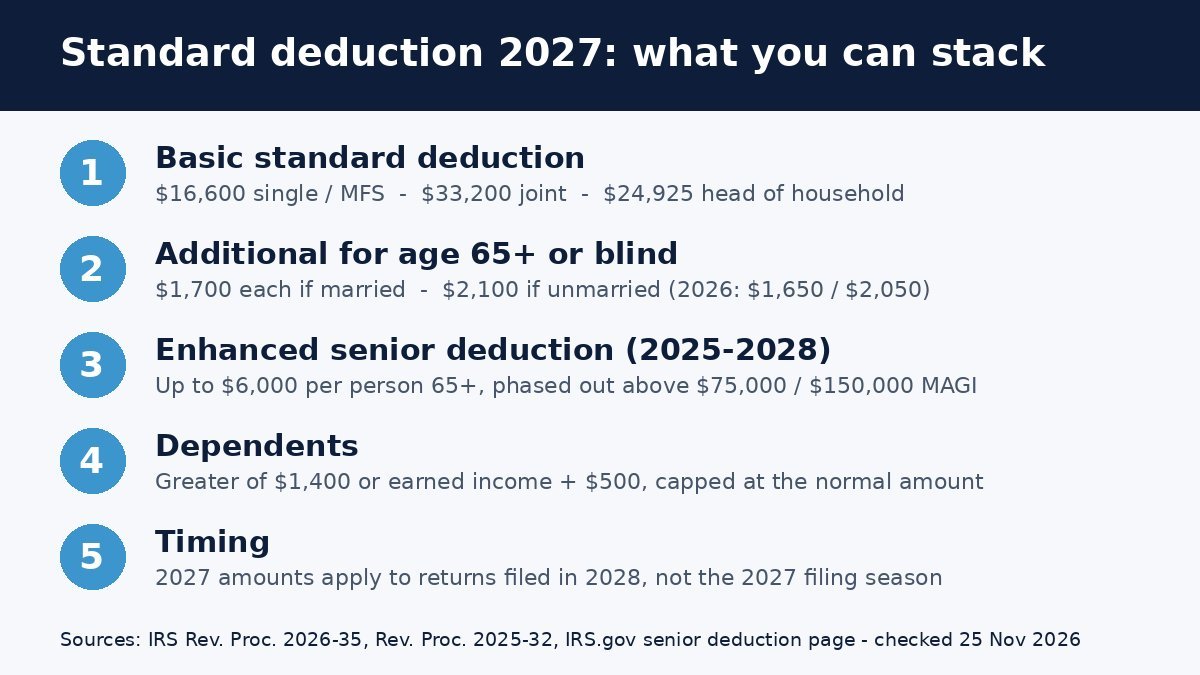
Older taxpayers can stack up to three separate amounts in 2027.
- The basic standard deduction for your filing status (see the table).
- The additional standard deduction for age 65 or older: $1,700 per qualifying person if you’re married, or $2,100 if you’re single or head of household. Blindness adds the same amount again. Topic 551 says you’re treated as 65 on the day before your 65th birthday, so anyone born before 2 January 1963 counts as 65 for 2027.
- The enhanced senior deduction of up to $6,000 per person aged 65 or older, created by the 2025 tax law the IRS now calls the Working Families Tax Cuts.
How the $6,000 senior deduction works
According to the IRS’s enhanced deduction for seniors page, this deduction runs from 2025 through 2028 and is “in addition to the standard deduction for seniors available under existing law.” It’s $6,000 per eligible person, or $12,000 if both spouses qualify. You can claim it whether you itemize or not. IRS Publication 6142 says you claim it on Schedule 1-A (Form 1040), and each qualifying person needs a Social Security number on the return. Married couples have to file jointly to get it.
It phases out above $75,000 of modified adjusted gross income (MAGI), or $150,000 for joint filers. Under the statute, 26 U.S.C. § 151(d)(5)(C), the $6,000 is reduced by 6% of MAGI above the threshold. That means it disappears completely at $175,000 for single filers and $250,000 for joint filers. The law sets it at a flat $6,000, so unlike the amounts above, it isn’t one of the inflation-adjusted figures.
Worked examples for 2027
- Single, age 67, not blind, MAGI $50,000: $16,600 + $2,100 = $18,700 standard deduction, plus the full $6,000 senior deduction, for a total of $24,700.
- Married filing jointly, both 66, MAGI $120,000: $33,200 + (2 × $1,700) = $36,600, plus $12,000 in senior deductions, for a total of $48,600.
- Single, age 70, MAGI $95,000: the senior deduction falls by 6% of $20,000 = $1,200, leaving $4,800 on top of the $18,700 standard deduction.
Retirees planning their 2027 budget may also want to check our explainers on the 2027 Social Security COLA and the 2027 Medicare Part B premium, since both affect how much income you have and how much you keep.
What the new numbers mean for you
Itemizing may matter even less
Every increase in the standard deduction raises the bar itemized deductions have to clear. If your mortgage interest, state and local taxes and charitable gifts usually come in near the standard amount, check the comparison again each year rather than assuming last year’s choice still wins.
Your paycheck withholding
Employers’ withholding tables are updated for each new tax year. If your situation changes in 2027, such as marriage, a new job or turning 65, the IRS’s Tax Withholding Estimator can help you decide whether to submit a new Form W-4.
Lower taxable income vs pre-tax saving
The standard deduction is automatic, but you can still lower taxable income through pre-tax contributions on top of it. Our guide to the 401k contribution limit 2027 covers the new $25,500 cap, and our HSA vs FSA comparison explains the two health accounts. For 2027, the IRS says the health FSA salary-reduction limit rises to $3,500.
FAQ
What is the standard deduction for 2027 for married filing jointly?
$33,200, up $1,000 from $32,200 in 2026. If one or both spouses are 65 or older or blind, add $1,700 for each qualifying condition.
What is the 2027 standard deduction for a single person over 65?
$16,600 plus $2,100, which is $18,700. If you qualify for the full enhanced senior deduction, you may deduct up to another $6,000 on Schedule 1-A.
Do I use the 2027 standard deduction when I file my taxes in 2027?
No. The return you file in 2027 is for tax year 2026 and uses the 2026 amounts. The 2027 figures apply to returns filed in 2028.
Is the $6,000 senior deduction permanent?
No. Under current law it covers tax years 2025 through 2028 only.
This article is general information, not tax or financial advice. Figures are from IRS publications checked on 25 November 2026. Tax law can change, so confirm your own situation with IRS.gov or a qualified tax professional.