
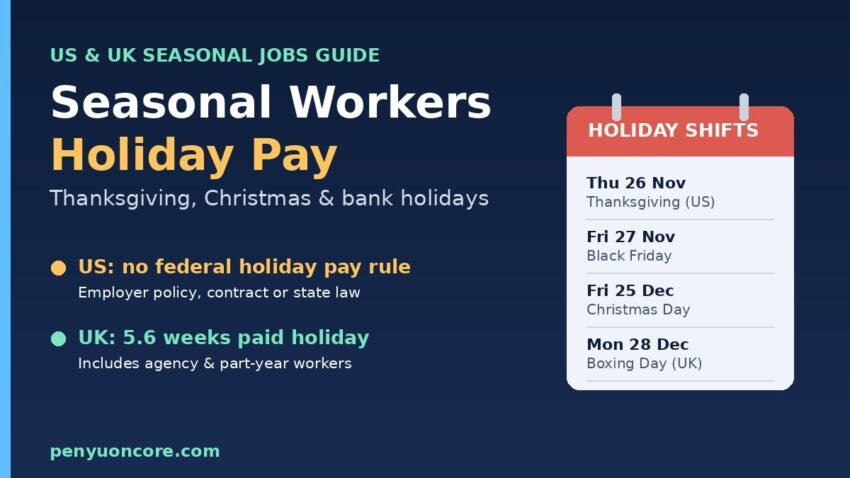
Seasonal workers holiday pay is one of the most common questions in late November, when millions of temporary hires start their first peak season just as Thanksgiving, Black Friday and Christmas arrive. The short answer depends heavily on where you work.
In the US, federal law does not require any employer to pay you for a holiday you take off, or to pay extra for working one; it comes down to company policy, a union contract or a small number of state laws. In the UK, almost every worker, including seasonal and agency staff, builds up paid holiday from day one, and anything unused must be paid out when the job ends.
Seasonal workers holiday pay in the US: what the law says
The US Department of Labor is direct about this. Its holiday pay guidance says the Fair Labor Standards Act (FLSA) “does not require payment for time not worked, such as vacations or holidays (federal or otherwise),” and that these benefits are “generally a matter of agreement between an employer and an employee.” There are narrow exceptions for certain federal government contracts, but they will not apply to most retail, warehouse or delivery jobs.
The same goes for working on the day itself. DOL Fact Sheet #23 says the FLSA “does not require overtime pay for work on Saturdays, Sundays, holidays, or regular days of rest, as such.” What it does require for non-exempt employees is time and a half for hours over 40 in a workweek. So a Thanksgiving shift only earns overtime under federal law if it pushes your week past 40 hours.
Paid day off vs premium pay for working
When people ask about “holiday pay,” they usually mean one of two different things, and seasonal hires should ask about both:
- Paid holiday: you are paid for a set number of hours on a holiday, even if you do not work. Employers often limit this to employees who meet eligibility rules such as employee class, hours or length of service.
- Holiday premium pay: you are paid a higher rate (often 1.5x) for hours you actually work on a holiday. This is a voluntary employer policy in most states.
Large employers define eligibility in their own policies. For example, an Amazon US fulfillment policy reference sheet (last updated October 2023) says paid holidays go to “eligible employees” with hours set by employee class, and that hourly employees scheduled for a shift that starts on a company holiday are paid time and a half. Policies change and vary by role and site, so treat your own offer letter, handbook or HR app as the final word.
States that add their own rules
A few states go further than federal law. Rhode Island is the clearest example: its Department of Labor and Training says work performed on Sundays and legal holidays, including Thanksgiving and Christmas Day, must be paid at least 1.5 times the normal rate, with exceptions for some industries such as health care and hospitality. Under R.I. Gen. Laws § 5-23-2, most retail stores must close on Thanksgiving and December 25, and holiday retail work that is allowed must be voluntary with a four-hour minimum. If you work outside Rhode Island, check your state labor department’s website before assuming either way.
Why this matters more for 2026 seasonal hires
The seasonal workforce is large this year. Amazon said on 20 October 2026 that it is hiring over 300,000 people for seasonal, part-time and full-time US roles, with seasonal pay averaging $20 an hour. UPS says it is hiring more than 100,000 seasonal employees, and Money tallied more than 431,000 announced seasonal roles across several big employers.
With Thanksgiving on 26 November and Christmas on a Friday this year, many new hires will hit a holiday within their first few weeks, often before any length-of-service requirement could kick in. If your budget assumes a full paycheck for Thanksgiving week, check now. Planning for a short week is easier with a small cash cushion; our guide on how much emergency fund you need covers how to size one.
Seasonal workers holiday pay in the UK
UK rules work very differently because paid annual leave is a legal right. According to GOV.UK, almost all people classed as workers are entitled to 5.6 weeks’ paid holiday a year, and that explicitly includes agency workers, irregular-hours workers and part-year workers. Most Christmas temps fall into one of those groups.
Bank holidays are not automatically paid
There is no separate legal right to a paid bank holiday. GOV.UK says bank or public holidays “do not have to be given as paid leave,” but an employer can count them as part of your statutory leave. Any extra pay for working Christmas Day or Boxing Day is a contract matter. In 2026, Christmas Day falls on Friday 25 December and the Boxing Day bank holiday is Monday 28 December, per the official bank holiday list.
The 12.07% accrual for irregular-hours and part-year workers
For leave years starting on or after 1 April 2024, irregular-hours and part-year workers accrue holiday at 12.07% of the hours they work in each pay period. GOV.UK’s worked example: 30 hours worked in a weekly pay period builds up 4 hours of leave (30 x 12.07% = 3.621, rounded up). For these workers, employers may also use “rolled-up holiday pay,” adding holiday pay to each payslip instead of paying when leave is taken. That is not allowed for regular-hours workers.
Leaving at the end of the season
This is the part seasonal staff most often miss. GOV.UK says the only time you can be paid instead of taking statutory leave is when you leave a job, and employers must pay for untaken statutory leave, even after a dismissal for gross misconduct. If your contract ends in January, check that your final payslip includes accrued but unused holiday (unless it was already rolled up into your hourly rate).
US vs UK at a glance
| Question | US (federal law) | UK (statutory) |
|---|---|---|
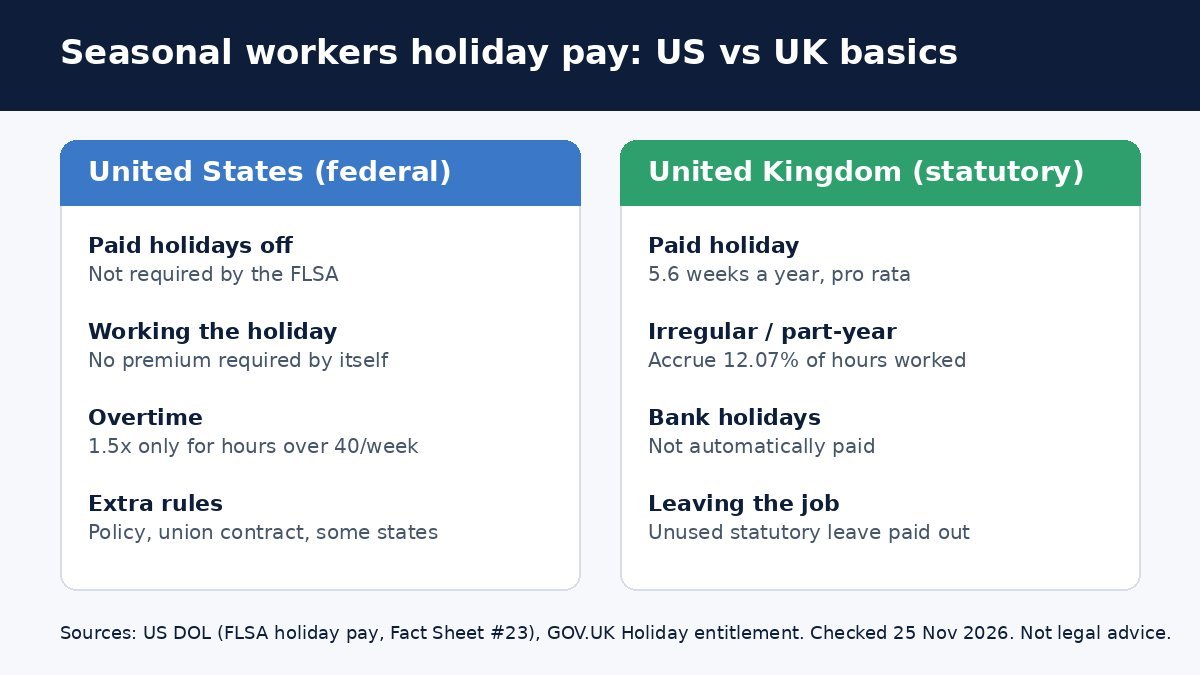
| Paid holiday leave required? | No, it is up to the employer | Yes, 5.6 weeks a year, pro rata |
| Seasonal or agency staff covered? | Depends on company policy | Yes, if classed as workers |
| Extra pay for working the holiday? | Not required (some states, e.g. Rhode Island, require it) | Not required; depends on contract |
| Paid public/bank holiday off? | Not required | Not required, may count toward leave |
| Unused leave paid when job ends? | No federal rule; varies by state and policy | Yes, for statutory leave |
What about gig apps and self-employed holiday work?
Many people add holiday income through delivery and rideshare apps rather than a seasonal job. If you are properly classified as an independent contractor, these rules mostly do not apply. The DOL notes that FLSA wage-and-hour protections “do not apply to properly classified independent contractors.” In the UK, GOV.UK says self-employed people generally do not have the employment rights of employees. Any holiday boost on an app is a platform incentive, not a legal entitlement, so read the offer terms before counting on it. If you want flexible holiday income that is not tied to shifts, our guide to a short-form video editing side hustle is one option to compare.
Questions to ask before your first holiday shift
- Am I eligible for any paid holidays this season, and which days count?
- If I work Thanksgiving, Black Friday, Christmas Eve or Christmas Day, what rate am I paid?
- Are holiday shifts mandatory, voluntary or first-come?
- (UK) Is my holiday pay rolled up into my hourly rate, or will accrued leave be paid when the contract ends?
- Where can I see this in writing (offer letter, handbook, HR app or agency terms)?
Remember that extra holiday earnings are taxed like any other wages. If you are also receiving a year-end bonus, our explainer on the bonus tax rate shows why withholding can make a check look smaller than expected.
FAQ
Do seasonal workers get paid for Thanksgiving?
Not by law in most of the US. The FLSA does not require pay for holidays not worked, so it depends on your employer’s policy and eligibility rules. Rhode Island requires at least time and a half for most holiday work.
Do I get overtime for working Christmas Day in the US?
Only if your employer’s policy or your state says so, or if the shift takes you over 40 hours that workweek. Federal law does not treat holidays as overtime days by themselves.
Do UK Christmas temps get holiday pay?
Yes, if they are classed as workers, including agency staff. Irregular-hours and part-year workers accrue 12.07% of hours worked, and unused statutory leave must be paid when the job ends.
Do agency workers get bank holiday pay in the UK?
There is no automatic right to a paid bank holiday, but agency workers do get statutory paid holiday, and an employer can count bank holidays as part of it.
Disclaimer: This article is general information about pay rules in the US and UK, checked against official sources on 25 November 2026. It is not legal, tax or financial advice. Employer policies and state laws vary, so confirm your own terms with your employer, agency, state labor department or Acas in the UK.