
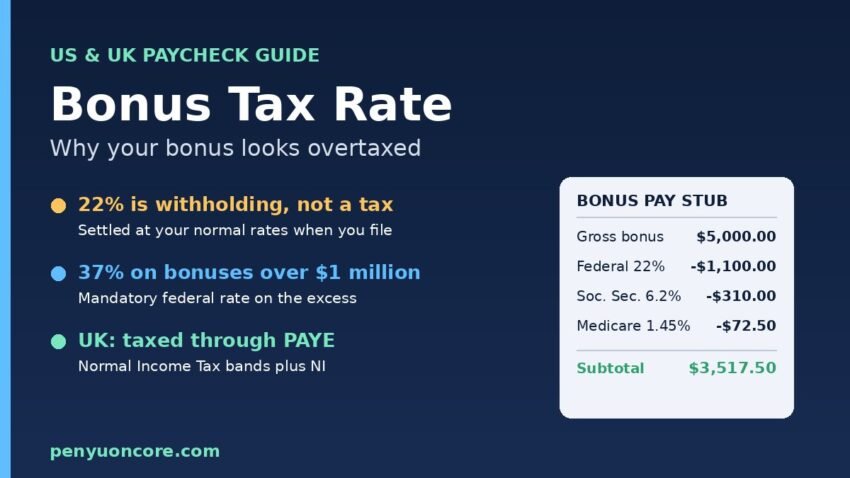
The US bonus tax rate most people see on their pay stub is 22%, but that is a federal withholding rate, not a special tax on bonuses. Your bonus is taxed as ordinary wages at your normal rates when you file your return, so if too much was held back you get it back as part of your refund, and if too little was held back you owe the difference.
Year-end bonus season is here, and so is the annual surprise of opening a payslip and seeing a much smaller number than expected. This guide explains how US employers withhold on bonuses in 2026, why the deduction often looks like 30-40%, what changes for very large bonuses, and how bonuses are taxed in the UK.
What is the bonus tax rate in 2026?
The IRS treats bonuses as “supplemental wages”, the same category as commissions, severance pay, back pay and awards. According to IRS Publication 15 (2026), the federal withholding rate on supplemental wages remains 22%, rising to 37% on supplemental wages above $1 million paid to one employee during the calendar year. The IRS notes these rates stay in place because the 2025 tax law (P.L. 119-21) permanently extended the individual tax rates first enacted in 2017.
Bonuses are not a separate type of income. IRS Publication 525 says bonuses and awards you receive for your work are included in your income and should be shown on your Form W-2, just like your salary.
The two methods your employer can use
If your employer withheld income tax from your regular pay this year or last year and pays the bonus separately (or lists it as a separate amount), Publication 15 lets it choose between two methods:
- Percentage (flat) method: withhold a flat 22% of the bonus for federal income tax. No other percentage is allowed.
- Aggregate method: add the bonus to your regular wages for the pay period, work out withholding on the total as if it were one normal paycheck, then subtract the tax already withheld from your regular wages.
If the bonus is simply folded into your regular paycheck without being identified separately, the employer must withhold as if the total were a single regular payment. That is effectively the aggregate method, and it is why a bonus paid inside a normal paycheck can trigger noticeably higher withholding: the payroll tables treat that one large check as if you earned that much every pay period.
Bonuses over $1 million
Once your supplemental wages from one employer (including businesses under common control) pass $1 million in a calendar year, the excess must be withheld at 37%, regardless of what your Form W-4 says. Most workers will never meet this rule, but it is common for senior executives and in some finance roles.
Why your bonus looks taxed at 30-40%
The 22% is only federal income tax withholding. Other deductions come out of the same payment. Publication 15 says supplemental wages are also subject to Social Security and Medicare taxes regardless of which withholding method is used. For 2026, the employee Social Security rate is 6.2% on wages up to the $184,500 wage base, and the Medicare rate is 1.45% with no wage cap. Employers must also withhold an extra 0.9% Additional Medicare Tax on wages above $200,000 in a calendar year.
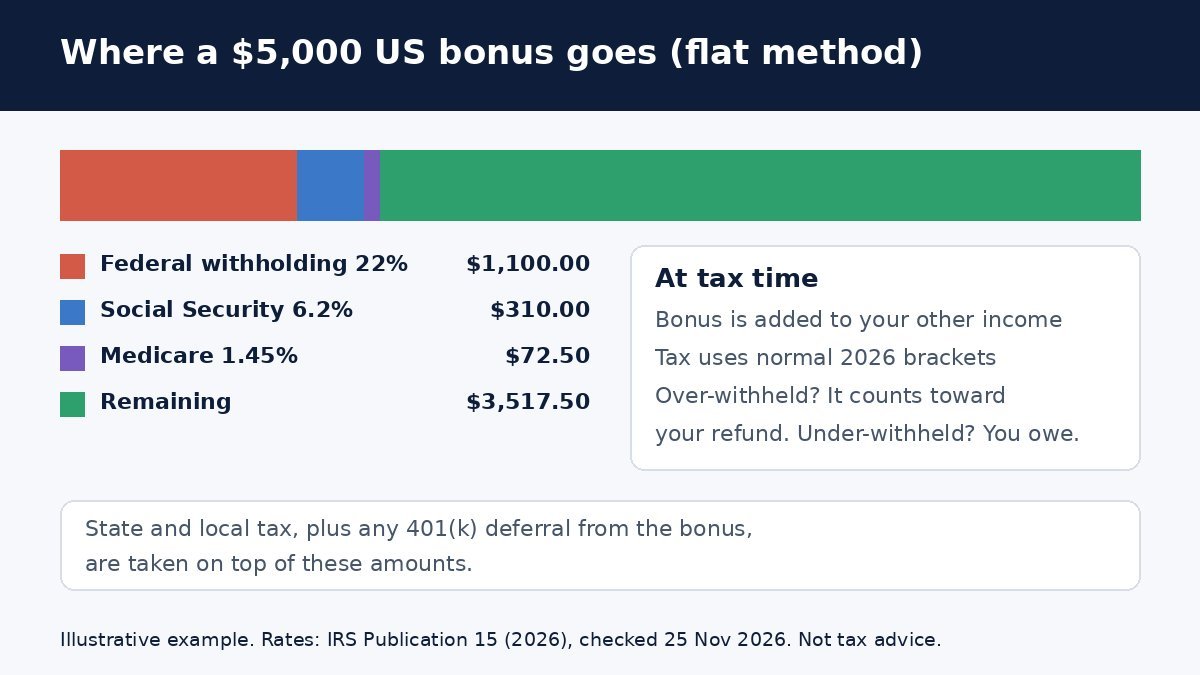
Here is a simple example for a $5,000 bonus paid with the flat method, before any state or local tax:
| Deduction | Rate | Amount on $5,000 |
|---|---|---|
| Federal income tax withholding | 22% | $1,100.00 |
| Social Security | 6.2% | $310.00 |
| Medicare | 1.45% | $72.50 |
| Total before state tax | 29.65% | $1,482.50 |
Add state income tax (many states have their own supplemental withholding rules), any local tax and your usual 401(k) percentage if your plan takes deferrals from bonuses, and a take-home figure of around 60% of the gross bonus is not unusual. That does not mean 40% is your real tax rate on the bonus.
Withholding vs the tax you actually owe
When you file, the IRS does not look at your bonus separately. Your bonus, salary and other income are added together, and your tax is worked out using the normal brackets. The IRS 2026 inflation adjustments set these taxable income thresholds:
| 2026 rate | Single taxable income over | Married filing jointly over | Is 22% withholding enough? |
|---|---|---|---|
| 10% / 12% | $0 / $12,400 | $0 / $24,800 | Usually more than needed; the excess can come back at filing |
| 22% | $50,400 | $100,800 | Roughly matches your top rate |
| 24% | $105,700 | $211,400 | Slightly short |
| 32% / 35% / 37% | $201,775 / $256,225 / $640,600 | $403,550 / $512,450 / $768,700 | Often short; you may owe at filing |
Taxable income is your income after deductions, so your bracket depends on more than your salary. The key point is that a flat 22% can be too much for someone in the 12% bracket and too little for a high earner. Higher earners who receive large bonuses are the group most likely to face a bill in April, especially when the bonus is paid under the flat method.
How to keep more of your bonus (legally)
You cannot change the withholding rules your employer uses, but you can change the result:
- Check your withholding for the year. The IRS Tax Withholding Estimator shows whether you are on track. If a large bonus leaves you under-withheld, you can give your employer a new Form W-4 asking for extra withholding from your remaining paychecks; if you are over-withheld, you can reduce it.
- Use your 401(k) if your plan allows bonus deferrals. Publication 15 says elective 401(k) deferrals are generally exempt from federal income tax withholding, although Social Security and Medicare still apply. Traditional deferrals count toward the annual limit of $24,500 for 2026; see our guide to the 401(k) contribution limit for 2027 for next year’s figures, and our Roth vs traditional comparison if you are deciding between pre-tax and Roth savings.
- Consider health savings options. If you are eligible for an HSA, contributions can lower taxable income; our HSA vs FSA guide covers the differences.
- Give the money a job. A bonus is a good moment to top up savings. Our guide on how much emergency fund you need can help you decide how much to set aside before spending or investing it.
Be careful with promises to “make your bonus tax-free”. A bonus is wages, and IRS Publication 525 says it is taxable in the year you receive it or it is made available to you.
How bonuses are taxed in the UK
There is no separate bonus tax rate in the UK either. GOV.UK lists money you earn from employment as taxable income, and your employer deducts Income Tax and National Insurance from a bonus through PAYE in the pay period it is paid.
- Income Tax: for 2026/27 in England, Wales and Northern Ireland, the rates are 20% from £12,571 to £50,270, 40% from £50,271 to £125,140, and 45% above that. Scotland has different bands.
- National Insurance: most employees (category A) pay 8% on earnings between £1,048.01 and £4,189 a month and 2% above £4,189 a month, according to GOV.UK’s 2026/27 rates. Because NI is worked out per pay period, the part of a large bonus month above £4,189 is charged at 2%.
- The £100,000 trap: your Personal Allowance falls by £1 for every £2 of adjusted net income above £100,000 and is zero at £125,140. Combined with 40% tax, that makes the effective rate on income in that band 60%. A bonus that pushes you over £100,000 is hit hardest.
GOV.UK’s adjusted net income guidance says pension contributions reduce adjusted net income, which is why some employees ask whether they can pay part of a bonus into their workplace pension. If you think too much tax was taken, HMRC usually sends employees a P800 tax calculation after the tax year ends; these are sent between June and the end of November.
Bonus tax rate FAQ
Is a bonus taxed more than regular pay?
No. In the US, the bonus is often withheld at a different rate, but it is taxed at the same ordinary income rates as your salary when you file. Any over-withholding counts toward your refund.
Why did my employer withhold more than 22% federal tax?
Your employer probably used the aggregate method or paid the bonus inside your regular paycheck, so withholding was calculated as if that large check were your normal pay. Check your pay stub, then compare your year-to-date withholding with the IRS Tax Withholding Estimator.
Is a holiday gift card from my employer taxed like a bonus?
Generally yes in the US. IRS Publication 15-B says cash and cash equivalents such as gift cards and gift certificates are never excludable as a tax-free de minimis benefit, no matter how small.
Does a bonus push all my income into a higher bracket?
No. Only the portion of taxable income above a bracket threshold is taxed at the higher rate. The same principle applies to UK tax bands, though the £100,000 allowance taper can create a 60% effective rate on part of your income.
Disclaimer: This article is general information, not tax, legal or financial advice. Withholding and tax depend on your full circumstances, state or country of residence and employer payroll practices. Figures were checked against IRS and GOV.UK pages on 25 November 2026; consult a qualified tax professional for your situation.