
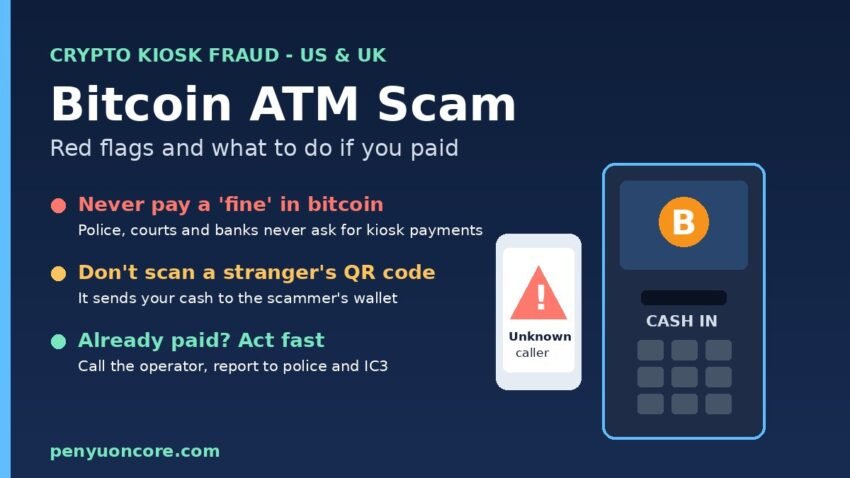
A Bitcoin ATM scam is when a stranger, usually posing as police, a government agency, your bank or tech support, pressures you to withdraw cash and feed it into a crypto kiosk, then scan a QR code that sends the bitcoin straight to their wallet. No real agency or company will ever ask you to pay this way. If you’ve already paid, call the kiosk operator and report it to the police straight away, because in some cases money can still be frozen or refunded.
These machines sit in gas stations, convenience stores and grocery stores, and they are now one of scammers’ favourite ways to get paid. The FBI’s Internet Crime Complaint Center (IC3) received more than 13,400 complaints involving cryptocurrency kiosks in 2025, with losses of over $388 million. That is a 23% rise in complaints and a 58% rise in losses from 2024. More than half of the complaints came from people over 50, who reported more than $302 million in losses.
This article is general information, not financial or legal advice. If you think you’re being scammed right now, stop the transaction and hang up.
How a Bitcoin ATM scam works
The FBI says that in typical complaints, criminals give detailed instructions: how to withdraw cash from the bank, how to find a kiosk, and how to deposit and send the funds. Stateline reports that in many cases the scammer stays on the phone during the whole transaction.
- The hook. You get a call, text, email, Facebook message or a pop-up on your computer. There’s a problem: a missed jury duty fine, a hacked bank account, a virus, a relative in trouble.
- The pressure. You’re told to act now and not to tell anyone, including your bank teller or family.
- The cash. You’re told to withdraw cash, sometimes from savings or retirement accounts, and drive to a specific kiosk.
- The QR code. The scammer sends a QR code. You scan it at the machine, feed in the cash, and the kiosk converts it to bitcoin and sends it to a wallet the scammer controls.
Once the coins are sent on the blockchain, nobody can simply reverse them. California’s financial regulator, the DFPI, describes kiosk transactions as immediate, irreversible and hard to trace. They are also expensive. FinCEN says kiosk fees range from 7% to 20%, and Stateline reports fees of 20% to 30% at some operators. You pay those fees even when the transaction is a fraud.
The scripts scammers use
FinCEN’s 2025 notice on crypto kiosks says the most common scheme is the tech or customer support scam. Others include government impersonation, romance scams, “person in need” emergencies and lottery or sweepstakes scams. Older adults are hit hardest: according to FTC data cited by FinCEN, people aged 60 and over were more than three times as likely as younger adults to report a loss using a kiosk.
| What the caller says | Who they pretend to be | The reality |
|---|---|---|
| “You missed jury duty and there’s a warrant. Pay the fine now or be arrested.” | Sheriff, police, court | Law enforcement and courts do not take payment through Bitcoin ATMs. |
| “Your account was hacked. Move your money to a safe account.” | Your bank or PayPal | No bank asks you to “protect” savings by buying bitcoin. |
| “Your computer has a virus. Call this number to fix it.” | Microsoft or other tech support | Pop-ups with phone numbers are a classic way to start this scam. |
| “I need help, please don’t tell anyone.” | A relative, online partner or “investment” contact | Sending crypto to someone you’ve only met online is a top FBI warning sign. |
Police in Hardin County, Texas, have warned that callers use official titles, badge numbers, real officers’ names and spoofed phone numbers, and may already know personal details about you. Knowing your name proves nothing. The same playbook shows up in gift card scams; only the payment method changes.
Red flags of a Bitcoin ATM scam
- Anyone who says you must pay a fine, tax, bail or “security deposit” in bitcoin.
- A QR code you didn’t create yourself, sent by someone you’ve never met.
- Being told to stay on the phone, keep it secret or lie to the bank about why you need cash.
- Being directed to a particular gas station or store kiosk.
- Anyone offering to pay you, or “refund” you, if you first send crypto. This is also how task scams get paid.
The FBI adds one more: if a kiosk operator calls you mid-transaction to say it looks like fraud and you should stop, stop or cancel the transaction.
What to do if you already paid at a Bitcoin ATM
Speed matters. Recovery is never guaranteed, but it does happen.
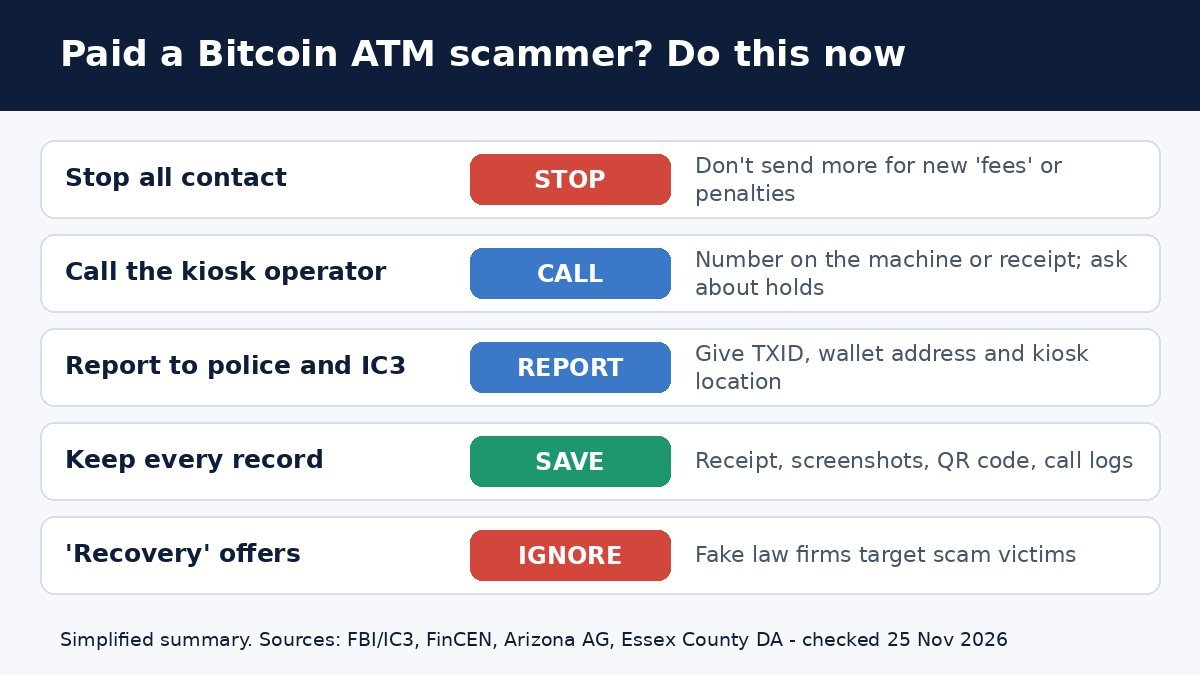
- Stop all contact and don’t send more. Scammers often come back with new “fees” or penalties.
- Call the kiosk operator. The phone number is usually on the machine or the receipt. Stateline reports that some operators, including CoinFlip, now use holding periods during which transactions can be reversed, and offer refunds to scam victims.
- Report it to local police, then file a complaint with the FBI at IC3.gov. The FBI asks for the transaction ID (TXID), the wallet address the funds went to, the kiosk location, any phone numbers, emails or names the scammer used, and a description of what happened. You can also report to the FTC at ReportFraud.ftc.gov.
- Tell your bank if you withdrew cash or moved money because of the scam, and ask it to watch your accounts.
- Keep every record. Receipts, screenshots, call logs and the QR code. In one Massachusetts case, a victim’s photo of the kiosk screen showing the wallet ID and amount helped a detective get a search warrant to retrieve the funds.
- Check your state’s rules. Some states now require refunds. Under Arizona’s law, kiosk operators must give a full refund, including fees, if you report the fraud to the Attorney General’s Office or local police within 30 days of the transaction. Arizona says 35 victims got refunds totaling $171,332 in the law’s first year.
There are real recoveries. The Essex County DA’s office returned about $20,000 to three victims in March 2026, and Ohio’s BCI returned $15,300 to a tech support scam victim in October 2026. Even then, the Essex DA notes that fees, conversion rates and tracing problems can make a 100% refund impossible.
Beware of “crypto recovery” offers
After you report a loss, you may be contacted by a “law firm” or “recovery agency” that promises to get your bitcoin back for a fee. The FBI has warned about fictitious law firms that target crypto scam victims. Red flags include asking for payment in crypto or gift cards, claiming to be official partners of government agencies, and knowing exact details of your earlier losses. The FBI says no law firms are officially authorized partners of US government agencies.
Bitcoin ATM scam rules are tightening in the US
Lawmakers are responding. According to Stateline’s 16 November 2026 report, Indiana, Minnesota, Tennessee and Vermont enacted statewide kiosk bans this year, and a Hawaii law that took effect in October bans cash deposits into kiosks to buy crypto. AARP counts at least 35 states that have passed kiosk laws since 2023. Iowa’s attorney general found that 98% of transactions at Bitcoin Depot kiosks in the state and 94% at CoinFlip kiosks were linked to scams. Bitcoin Depot later filed for bankruptcy and took its kiosks offline in May.
On 4 November 2026, California’s DFPI ordered CoinFlip to pay more than $4.8 million to California victims. The regulator found failures including accepting more than $1,000 in a single day from kiosk customers and charging excessive fees.
Are Bitcoin ATMs legal in the UK?
No legal crypto ATMs operate in the UK. The Financial Conduct Authority says none of the crypto firms registered with it have been approved to offer crypto ATM services, so any machine operating in the UK is doing so illegally and consumers should not use them. In February 2025, Olumide Osunkoya was sentenced to four years for running an illegal crypto ATM network, the UK’s first sentence for unregistered crypto activity. The FCA says crypto ATMs listed on CoinATMRadar in the UK fell from more than 80 in 2022 to none in 2024.
UK scammers still use the same scripts with bank transfers, gift cards or crypto apps. If you’ve been targeted, contact your bank immediately and report it to Report Fraud (Police Scotland on 101 in Scotland).
If you want to own bitcoin, buy it on your own initiative through a regulated platform or fund. Never do it because a caller told you to. Our comparison of a Bitcoin ETF vs buying bitcoin explains the main options.
FAQ
Can a Bitcoin ATM transaction be reversed?
Not once the coins have been sent on the blockchain. Some operators use holding periods or offer refunds, and some states require refunds, so call the operator and police immediately.
Do police or the IRS ever ask for payment through a Bitcoin ATM?
No. The FBI says no legitimate law enforcement or government official will call to demand payment via a cryptocurrency kiosk.
What information should I give the FBI?
The transaction ID, the receiving wallet address, the kiosk location, the scammer’s phone numbers, emails or aliases, and a description of the scam.
Someone says they can recover my bitcoin for a fee. Is it real?
Treat it as a scam. The FBI warns that fake law firms and recovery services target people who have already lost money.