
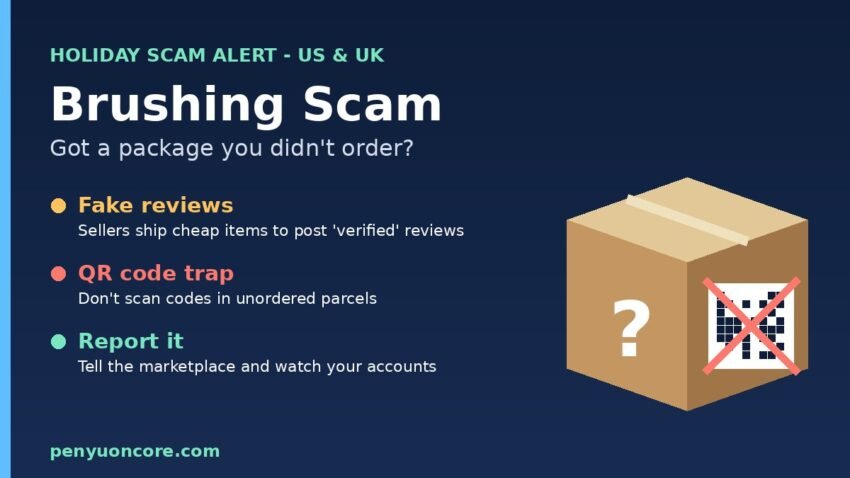
A brushing scam is when a package you never ordered turns up addressed to you, usually a cheap item from an online seller you’ve never heard of. It’s more likely during the Black Friday (27 November 2026) and Cyber Monday (30 November) rush, when unexpected boxes are easy to overlook. The seller isn’t after your money. It wants to make its sales look real so it can post fake “verified” reviews. But it does mean someone has your name and address, and some packages now include a QR code designed to steal more of your data.
Quick answer: If a package you didn’t order arrives addressed to you, check that nobody in your household ordered it and that it isn’t a gift. In both the US and the UK you can usually keep it without paying. Don’t scan any QR code inside, report it to the marketplace it came from (Amazon has a dedicated form) and keep an eye on your accounts and credit reports.
What is a brushing scam?
The US Postal Inspection Service explains that the sender is usually an international third-party seller who found your address online. Shipping you a low-cost item makes it look as if you’re a verified buyer, and the seller then posts positive reviews in your name. Those reviews push the product up the search rankings, which the seller hopes will bring in real sales. Because the items are cheap to buy and post, the fake reviews are worth more to the seller than the cost of sending them.
It isn’t new. The BBC reported on mystery parcels linked to brushing back in 2020, and Which? estimated in 2021 that more than one million UK households could have been targeted. In its February 2026 guide, Which? said the scam is “seeing a resurgence”.
Why brushing scam packages show up around the holidays
On 24 November 2026, the US Postal Service included brushing in its holiday scam warnings, part of the Postal Inspection Service’s “Don’t Get Hit by Holiday Crime” campaign. In the same release, USPS cited a 2026 AARP survey finding that 84% of US consumers experienced or were targeted by at least one form of fraud during the holidays. Earlier in November, police in Buena Vista, Virginia warned residents about brushing packages after a resident handed one in. When parcels are arriving every day, one more box doesn’t stand out, and that’s when people are most likely to scan a code out of curiosity.
The QR code twist: when a brushing scam becomes phishing
The traditional version is mostly a privacy problem. The newer version is more dangerous. The FBI issued a public service announcement about unsolicited packages that contain a QR code. Scanning it prompts you to enter personal and financial information, or can lead you to download malicious software that steals data from your phone. The FBI says criminals often leave off the sender’s details so you’ll scan the code to find out who sent the “gift”. It also notes this variation is “not as widespread as other fraud schemes”.
The Postal Inspection Service calls this “quishing” (QR code phishing). The card might say you need to scan it to register the gift, see who sent it or arrange a return. The fake site that opens is after things like account logins, card numbers, PINs, your date of birth or your Social Security number.
The rule is simple: never scan a QR code that comes in a package you didn’t order, and never install an app it points you to.
What to do if you get a brushing scam package
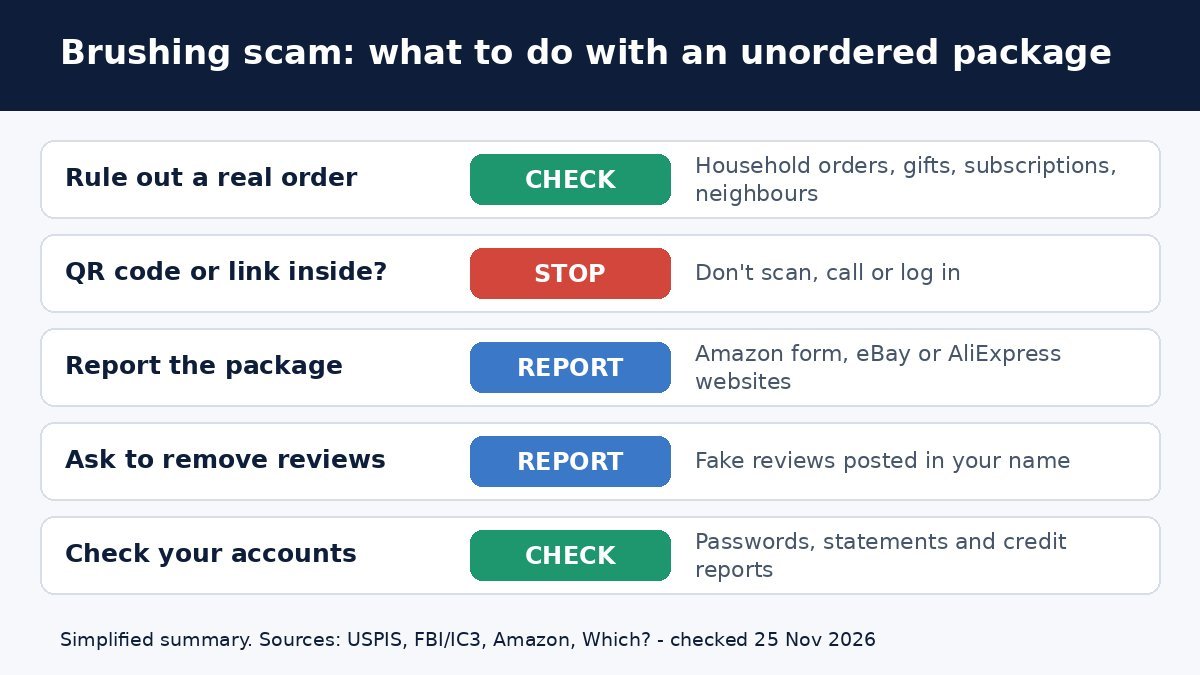
- Rule out the obvious first. Amazon’s guidance on unsolicited packages and brushing says to confirm the parcel isn’t a gift and to check with friends and family. Also check it isn’t a subscription delivery or a parcel meant for a neighbour or a previous resident.
- Don’t scan, call or log in. Ignore any QR code, phone number or link on the package or the card inside it. Buena Vista police also advise against switching on or connecting any device that came in it.
- Report it to the marketplace. If it came from an Amazon seller, use Amazon’s Report Unwanted Package form or contact Customer Service. Have the number of packages and a tracking number from the shipping label ready. Amazon says it may suspend sellers, withhold their payments and work with law enforcement. Which? says eBay and AliExpress also take brushing reports on their websites.
- Ask for fake reviews to be removed. USPIS suggests asking the retailer to remove any fake reviews posted under your name.
- Secure your accounts. The FBI suggests changing your account details and getting free credit reports from Equifax, Experian and TransUnion. In the UK, Which? suggests checking your credit file and putting your email address into Have I Been Pwned to see if it has appeared in a data breach.
- Report fraud if you’ve lost money. In the US, report it to the FBI at IC3 or at ReportFraud.ftc.gov. In the UK, contact your bank and report it to Report Fraud (or Police Scotland on 101 in Scotland).
Can you keep a brushing scam package?
Usually, yes, but the US and UK rules work differently.
| Question | United States | United Kingdom |
|---|---|---|
| Can I keep it? | Yes. Under 39 U.S.C. § 3009, unordered merchandise sent by post can be treated as a gift | Generally yes. Citizens Advice says you don’t have to pay for unsolicited goods or send them back |
| Do I have to pay? | No. The law bars the sender from billing you or sending payment demands | No. Citizens Advice says demanding payment for unsolicited goods is a criminal offence |
| What if it was a delivery mistake? | A parcel addressed to someone else isn’t yours. Contact the carrier or retailer | The BBC, citing Citizens Advice, notes that you can keep an item addressed to you that arrives out of the blue with no previous contact, but goods sent by mistake have to go back |
| Other options | USPIS says you can mark an unopened parcel with a return address “Return to Sender”, or throw it away if it’s safe to do so | Which? advises not using the item and reporting it to the marketplace |
Be careful with anything organic, such as seeds, plants or food, or any unknown liquid or substance. USPIS says to notify the proper authorities and follow their instructions rather than opening, planting or binning it.
Does a brushing scam mean I’ve been hacked?
Not necessarily. Security firm Kaspersky notes that scammers usually pay with their own card and use their own email address, so the order won’t appear in your account. Having your name and address isn’t the same as having your passwords or card details. Still, Which? says the data most likely came from a data breach or a previous scam, so expect more phishing emails, texts and calls. What really matters is evidence of misuse, like orders you didn’t place or charges you don’t recognise.
If you sell online, stay well away from brushing
If you sell on a marketplace or run a print-on-demand shop, it’s worth being clear: brushing is a shortcut that can end a store. Since 21 October 2024, the FTC’s rule on consumer reviews and testimonials has banned businesses from creating, buying or spreading fake reviews in the US, and violations can bring civil penalties. In the UK, the CMA’s fake reviews guidance explains that, from 6 April 2025, the Digital Markets, Competition and Consumers Act 2024 made submitting or commissioning fake reviews a banned practice. On top of that, Amazon says it may suspend or remove selling privileges and withhold payments from sellers caught brushing. If you’re building income on a platform, your reviews have to come from real customers.
Brushing is one of several scams that ramp up during the holidays. For more, see our guides to gift card scams, Facebook Marketplace scams for sellers and the task scam, which targets people looking for extra income.
FAQ
Is a brushing scam illegal?
USPIS says brushing is illegal in the US and many other countries. Posting or commissioning fake reviews is also banned under the FTC’s reviews rule in the US and the DMCC Act in the UK.
Should I return a brushing package?
You usually don’t have to. Amazon says you don’t need to return the item. In the US, you can mark an unopened parcel “Return to Sender” if it has a return address. Never pay a “return fee” someone asks for.
I already scanned the QR code. What now?
If you didn’t enter anything, close the page. If you typed in a password, change it everywhere you use it and turn on two-factor authentication. If you entered card details or installed an app, contact your bank, remove the app and report it (IC3 in the US, Report Fraud in the UK).
How do I stop more packages arriving?
Report every package to the marketplace so it can act against the seller. The USPS warns that contacting the sender may confirm your address and lead to more unwanted parcels.
Disclaimer: This article is general information for US and UK readers, not legal or financial advice. Rules and platform policies can change, so check with the retailer, your bank or the relevant authority for your situation.