
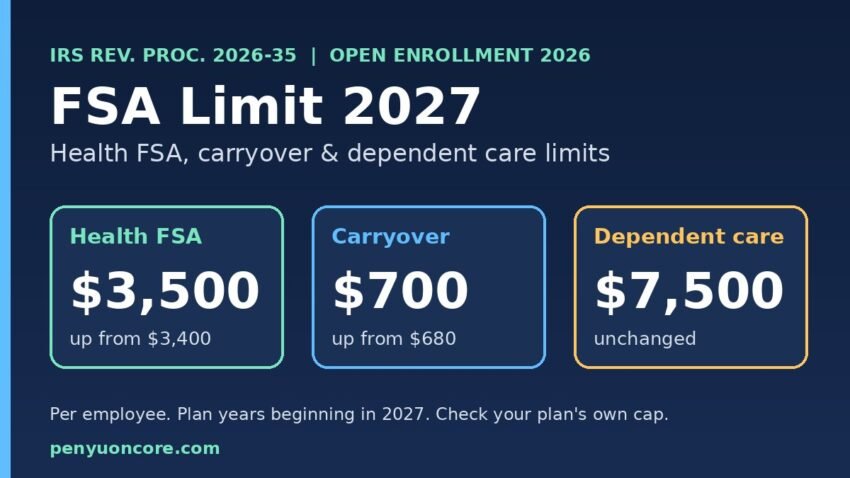
The FSA limit 2027 for health flexible spending accounts is $3,500 per employee, up $100 from $3,400 in 2026, and plans that allow a carryover can roll up to $700 of unused money into the next plan year. The dependent care FSA limit stays at $7,500 per household ($3,750 if married filing separately). With most employers running open enrollment right now, here is what the new numbers mean and how to choose your election.
The IRS published the health FSA figures on November 5, 2026, in news release IR-2026-133 and Revenue Procedure 2026-35 (section 3.16). The same release also set the 2027 tax brackets and the new standard deduction.
FSA limit 2027 at a glance
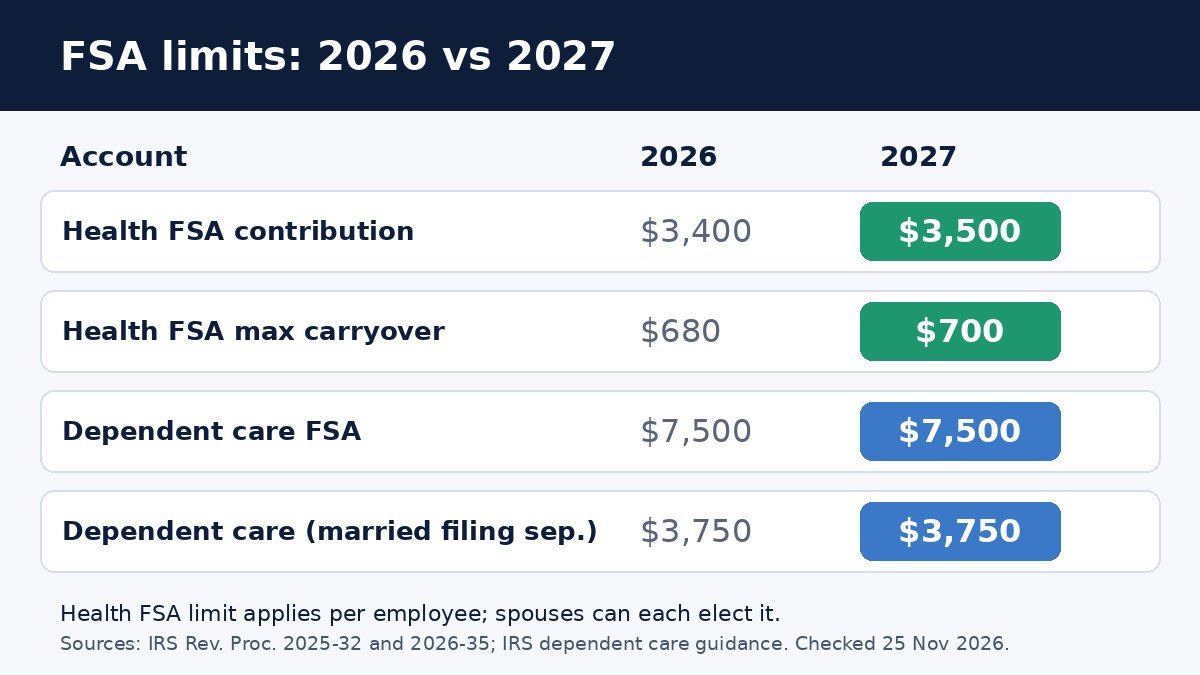
| Account | 2026 limit | 2027 limit | Source |
|---|---|---|---|
| Health FSA (employee salary reductions) | $3,400 | $3,500 | Rev. Proc. 2025-32 / Rev. Proc. 2026-35 |
| Health FSA maximum carryover (if your plan allows it) | $680 | $700 | Rev. Proc. 2025-32 / Rev. Proc. 2026-35 |
| Dependent care FSA (single, head of household, married filing jointly) | $7,500 | $7,500 | Fixed by law, not indexed |
| Dependent care FSA (married filing separately) | $3,750 | $3,750 | Fixed by law, not indexed |
The 2026 health FSA numbers come from Rev. Proc. 2025-32. The dependent care figure comes from the 2025 tax law the IRS now calls the Working Families Tax Cuts. According to the IRS’s Child and Dependent Care Credit page, it raised the dependent care benefits exclusion from $5,000 to $7,500 (from $2,500 to $3,750 for married people filing separately) starting in 2026. Because that amount is written into the law and isn’t adjusted for inflation, it doesn’t change for 2027.
Who the $3,500 health FSA limit applies to
It is per employee, not per household
IRS Notice 2012-40 says the health FSA cap applies employee by employee. You can elect up to the limit no matter how many family members your FSA covers. If both spouses can join a health FSA, each can elect up to the limit, even if they work for the same employer. HealthCare.gov says the same thing for 2027: you can contribute up to $3,500, and your spouse can put up to $3,500 into an FSA with their own employer.
It covers only your salary reductions
The cap applies to the pre-tax money you choose to have taken out of your pay. Notice 2012-40 says it doesn’t apply to certain employer non-elective contributions, sometimes called flex credits. Your employer can also set a lower cap than $3,500, so the maximum you see during enrollment is the one that counts.
It follows your plan year
The same notice says “taxable year” in this rule means the cafeteria plan’s plan year. So the $3,500 limit applies to plan years that begin in 2027. If your plan year starts on July 1, the new limit applies from your July 2027 enrollment, not January.
Self-employed people can’t use one
Health FSAs are plans set up by employers. IRS Publication 969 says plainly that self-employed people aren’t eligible for FSAs.
How the $700 FSA carryover and grace period work
Publication 969 describes FSAs as generally “use-it-or-lose-it” plans. Your employer can soften that rule in one of two ways, but not both:
- Carryover: the plan can let you roll a limited amount of unused money into the next plan year. For 2027 plan years the maximum is $700, so up to $700 left over from 2027 can pay for 2028 expenses. The cap that applies to unused 2026 money carried into 2027 is $680. Anything above the carryover cap is forfeited. The carryover doesn’t reduce how much you can contribute, so you can still elect the full $3,500 in 2027 on top of a carryover.
- Grace period: instead of a carryover, the plan can give you up to 2½ months after the plan year ends to incur new expenses and pay them with last year’s leftover balance.
Some plans offer neither. Check your plan’s summary before you pick an amount. Also note that the deadline to submit claims (often called a run-out period) is separate from the deadline to incur expenses.
Health FSA vs dependent care FSA
These are two separate accounts with separate limits. A health FSA pays for qualified medical, dental and vision costs for you, your spouse and your dependents. Publication 969 says this includes over-the-counter medicines and menstrual care products, but not insurance premiums or long-term care. Unlike most accounts, a health FSA must let you use your entire annual election at any point in the plan year, even before you’ve paid it all in.
A dependent care FSA pays for work-related care, such as daycare, preschool or after-school programs. You can only spend money that has actually been deposited. The IRS also warns that you can’t use the same expenses for both the dependent care FSA exclusion and the Child and Dependent Care Credit. Money you exclude through the FSA generally reduces the expenses you can count toward the credit.
Can you have an FSA and an HSA in 2027?
Generally, not a regular one. Publication 969 explains that if you’re covered by a high-deductible health plan and a general-purpose health FSA that pays medical expenses, you usually can’t contribute to an HSA. The exceptions are a limited-purpose FSA, which covers things like dental and vision plus preventive care, and a post-deductible FSA. Many employers offer a limited-purpose FSA next to their HDHP for this reason. For a side-by-side comparison, see our guide to HSA vs FSA.
How much should you put in your FSA for 2027?
The tax saving is real. Pub 969 says no federal income tax or employment taxes are taken from the salary you put into an FSA. For example, someone in the 22% federal bracket who elects and fully uses $3,500 would skip about $770 in federal income tax plus up to 7.65% in Social Security and Medicare tax, for a total of roughly $1,000. State income tax treatment varies.
The risk is forfeiting money you don’t spend. A sensible way to choose:
- Start with predictable costs: copays, regular prescriptions, glasses or contacts, planned dental work and your deductible if you expect to hit it.
- Look at last year’s spending: your insurer’s claims history or FSA statements show what you actually paid out of pocket.
- Check your plan’s rollover rule: with a $700 carryover, overshooting slightly costs less than in a plan with no carryover or grace period.
- Don’t count on changing it later: Publication 969 says you can change or revoke your election only if the law and your plan allow it, usually after a qualifying life event such as marriage or a birth.
If money is tight, remember that an FSA isn’t a substitute for an emergency fund, because it only pays for eligible expenses.
Don’t miss open enrollment
In many plans, your FSA election does not roll over automatically each year. For example, federal employees using FSAFEDS must re-enroll during the 2026 Federal Benefits Open Season, which runs November 9 to December 14, 2026 (ending 11:59 p.m. Eastern for FSAFEDS). FSAFEDS lists the 2027 maximum as $3,500 with up to $700 carryover. Private employers set their own deadlines, so check your HR portal. While you’re there, it’s a good time to review your 401(k) contribution for 2027 too.
FAQ
What is the FSA limit for 2027?
For plan years beginning in 2027, the health FSA limit is $3,500 per employee, and the maximum carryover is $700 (IRS Rev. Proc. 2026-35).
Did the dependent care FSA limit change for 2027?
No. It stays at $7,500 ($3,750 if married filing separately), the amount set by law beginning in 2026.
Can my spouse and I both contribute $3,500?
Yes, if each of you is eligible for a health FSA. The limit applies per employee, even if you are both in the same employer’s plan.
Does a carryover reduce my 2027 contribution limit?
No. IRS Publication 969 says a carryover doesn’t affect the maximum salary reduction contribution you can make.
Disclaimer: This article is general information, not financial, tax or legal advice. Plan rules vary by employer, so check your plan documents or talk to a qualified tax professional before choosing your election. Figures verified from IRS and OPM sources on November 25, 2026.