
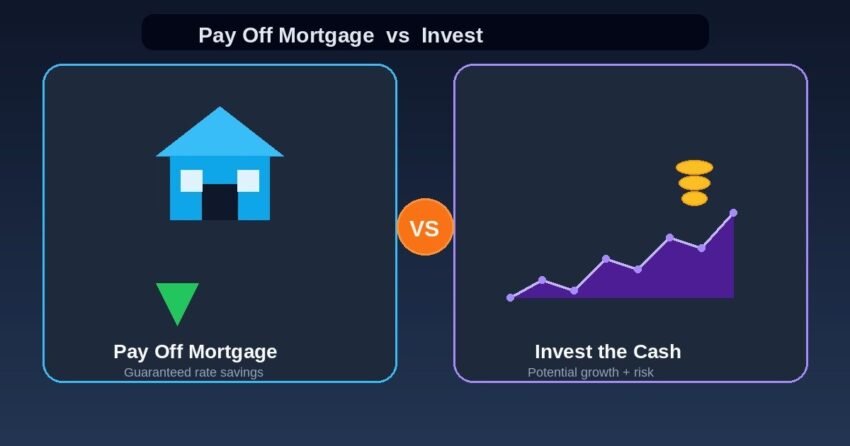
Short answer: Paying extra on your mortgage is a guaranteed after-tax return equal to the interest you avoid—attractive when rates are high (the U.S. 30-year fixed averaged 7.18% for the week ending 5 November 2026). Investing the same cash in stocks may produce a higher long-run return (U.S. large-cap history is often cited around ~10% annualized), but returns are not guaranteed, markets fluctuate, and stocks as a group have lost money in roughly 1 of every 3 years. Neither choice is always better; build an emergency fund first, then match the decision to your rate, taxes, risk tolerance, and liquidity needs.
This guide compares pay off mortgage vs invest with Freddie Mac rates, long-run S&P context, IRS mortgage-interest rules, and transparent worked examples for 2026.
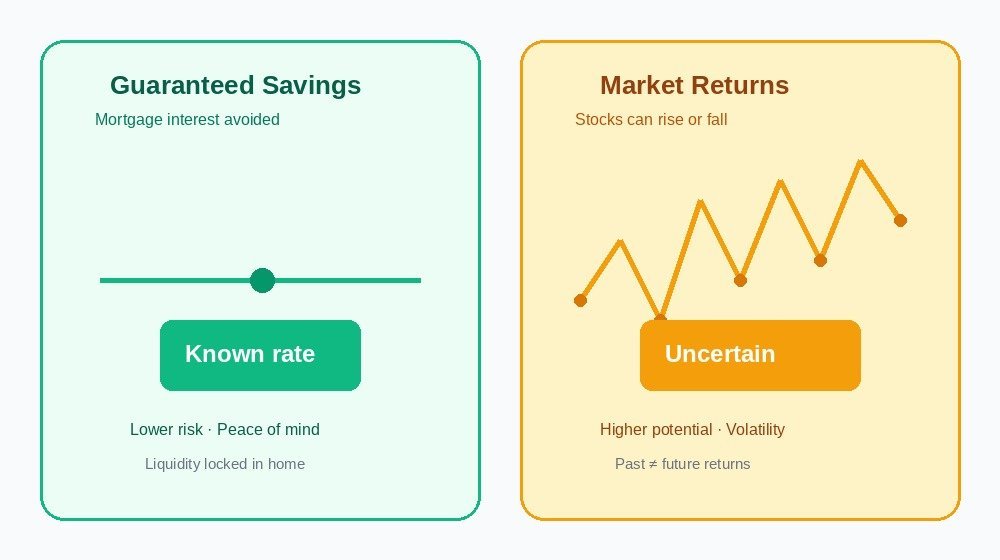
Guaranteed interest savings versus uncertain market returns—the core trade-off in this decision.
Quick Comparison Table
| Factor | Pay off mortgage early | Invest the same cash |
|---|---|---|
| Return type | Guaranteed interest avoided | Uncertain market return |
| 2026 rate backdrop | 30-year FRM avg 7.18%; 15-year 6.57% (week ending 5 Nov 2026) | Long-run S&P 500 often cited ~10% total return / ~7% price return since 1957 |
| Risk | Low (debt reduction) | Stocks can lose money; large drawdowns possible |
| Liquidity | Equity locked in the home | Investments can usually be sold (taxes/fees may apply) |
| Tax angle | Less future deductible interest if you itemize | Taxable, tax-deferred, or tax-free accounts change after-tax results |
| Emotional benefit | Peace of mind, lower required payment later | Flexibility and potential long-run wealth |
Sources: Freddie Mac PMMS, FRED MORTGAGE30US, S&P 500 index page, Fidelity on S&P average returns, Investor.gov on stocks.
2026 Mortgage Rates and What They Mean
According to Freddie Mac’s Primary Mortgage Market Survey and the FRED MORTGAGE30US series, the U.S. average 30-year fixed mortgage rate was 7.18% for the week ending 5 November 2026 (down from 7.24% the prior week). The 15-year fixed averaged 6.57% that same week.
At those levels, every extra dollar of principal you pay is like earning a risk-free after-tax return close to your mortgage rate—if you do not get a large tax break from the interest. That is why “pay it down” looks more compelling in 2026 for recent originations than it did for many 3%–4% loans taken out in 2020–2021.
Stock Returns Are Historical Averages—Not Promises
S&P Global materials for the S&P 500 cite roughly ~10% annualized total return and ~7% annualized price return since the index’s modern launch on 4 March 1957. Fidelity’s learning center similarly notes that long-term S&P averages are often cited around ~10% since 1957—and stresses that past returns do not predict future results.
A common long-run framing since 1926 is also about ~10% annualized, but yearly returns vary widely and large drawdowns happen. Investor.gov notes stocks can lose money, large-company stocks as a group have lost money on average about 1 of every 3 years, and diversification helps but does not eliminate risk. Treat historical averages as illustrations, never guaranteed yields.
Taxes: After-Tax Mortgage Cost Is Not Always “Rate × (1 − Tax Bracket)”
Qualified home mortgage interest may be deductible on Schedule A if you itemize, subject to debt limits. Per IRS Topic 505 and Publication 936:
- For mortgage debt incurred after 15 December 2017 to buy, build, or substantially improve a qualified home, interest is generally deductible on up to $750,000 of debt ($375,000 if married filing separately).
- Older debt may still be subject to a higher $1 million limit under prior rules (see Pub. 936 for details).
- Paying down principal reduces future deductible interest.
Important: “After-tax cost ≈ rate × (1 − marginal tax rate)” applies only if you itemize and the interest is deductible. Many households take the standard deduction and get little or no mortgage-interest tax benefit—so their true cost is closer to the full note rate.
Worked Examples (Illustrations Only)
Assumptions shared across examples: $300,000 remaining principal; original remaining term 30 years; fixed rate as stated; borrower considers $500/month either as extra principal or as a monthly investment. Monthly compounding for the investment annuity. Figures are rounded and ignore fees, points, PMI changes, state taxes, and investment taxes. Not advice.
Example A — High-rate mortgage (~current 7.18%)
Loan: $300,000 at 7.18% for 30 years.
- Estimated scheduled principal-and-interest payment: about $2,032/month.
- Paying only the schedule for 360 months: total interest roughly $432,000.
- Adding $500/month extra principal: payoff in about 207 months (~17.2 years); total interest roughly $224,000.
- Interest avoided: about $208,000; time saved: about 153 months (~12.8 years).
- Extra principal paid over that shortened life: about $103,500 ($500 × 207).
If instead you invest $500/month (hypothetical annualized returns; not guaranteed):
| Hypothetical annualized return | Future value after 30 years | Future value over ~17.2-year payoff horizon |
|---|---|---|
| 7% | ~$610,000 | ~$200,000 |
| 10% | ~$1,130,000 | ~$274,000 |
How to read this: At 7.18%, extra payments deliver a certain saving near that rate. A 7% or 10% portfolio illustration over 30 years can look larger in nominal dollars—but that path includes volatility, possible multi-year losses, and no guarantee of matching the table (Investor.gov). Peace of mind can still favor payoff when a spreadsheet prefers investing.
Example B — Lower legacy rate (3.5%)
Loan: Same $300,000 balance, but 3.5% (common for many 2020–2021 originations).
- Scheduled payment: about $1,347/month.
- Full-term interest (no extras): about $185,000.
- With $500/month extra: payoff in about 221 months (~18.4 years); interest about $107,000.
- Interest saved: about $78,000; time saved about 11.6 years.
Investing the same $500/month for 30 years at hypothetical 7% / 10% still yields the same illustrative balances as Example A (~$610k / ~$1.13M). On paper, a low mortgage rate makes investing look relatively more attractive—if you can tolerate risk and keep an emergency fund. A 3.5% loan is cheap debt; rapid payoff can still suit borrowers who value being debt-free.
Example C — Decision checklist
Work through these before choosing:
- Emergency fund: Prefer cash reserves before aggressive prepayment or equity investing. See how much emergency fund you may need and parking cash options like SGOV vs high-yield savings.
- High-interest consumer debt first: Credit cards and similar balances usually beat both mortgage payoff and stock investing as priorities.
- Job stability and cash-flow buffer: Illiquid home equity does not pay next month’s bills.
- Itemizing vs standard deduction: After-tax mortgage cost depends on whether interest is actually deductible (Topic 505; Pub. 936).
- Risk tolerance and time horizon: Investing needs a horizon that can absorb drawdowns.
- Liquidity needs: Can you access the money without selling the house?
- Prepayment penalties: Rare on modern conforming loans, but check your note.
- Contribution style: If you invest, decide DCA vs lump sum based on cash timing—not slogans.
FAQ
Is it better to pay off a mortgage or invest in 2026?
It depends on your rate, taxes, emergency savings, and risk tolerance. Near 7.18% 30-year averages (Freddie Mac / FRED), payoff is a strong guaranteed return. With a low legacy rate, investing may look better on paper—but stocks are not guaranteed (Investor.gov).
What is the current average 30-year mortgage rate?
For the week ending 5 November 2026, Freddie Mac reported a U.S. 30-year fixed average of 7.18% (prior week 7.24%) and a 15-year average of 6.57% (PMMS; FRED).
Do I get a tax break for mortgage interest if I pay it down?
Interest may be deductible if you itemize and stay within IRS debt limits (Topic 505; Pub. 936). Paying principal early reduces future deductible interest. Households on the standard deduction often see little mortgage-interest tax benefit.
What return should I assume for investing?
There is no safe assumption. Long-run S&P figures around ~10% total return / ~7% price return since 1957 are historical (S&P Global; Fidelity). Future returns can be higher or lower, and yearly results vary widely.
Should I invest before I have an emergency fund?
Usually no. Cash reserves come first so you are not forced to sell investments—or tap home equity—after a job loss or surprise bill (emergency fund guide).
Bottom Line
Pay off mortgage vs invest is a trade-off between a certain interest saving and an uncertain market return. In late 2026, with 30-year averages near 7.18%, many borrowers will find extra principal payments hard to beat on a risk-adjusted basis—especially if they do not itemize. Borrowers with low legacy rates, strong reserves, and high risk capacity may prefer investing while keeping the cheap loan. Build the emergency fund first, clear toxic high-interest debt, then decide with clear math—not slogans.
Related reading: How much emergency fund do you need? · SGOV vs high-yield savings · DCA vs lump sum: which wins? · Roth vs Traditional IRA for 2026
Disclaimer: This article is for educational purposes only and is not financial, tax, investment, or legal advice. Mortgage terms, tax deductibility, and investment outcomes depend on your loan documents, tax situation, and market results, which can differ from historical averages. Confirm rates and rules with Freddie Mac, IRS.gov, your lender, and a qualified professional before acting.