
Short answer: Lemon Squeezy charges a platform fee of 5% + 50¢ per transaction, with no monthly fee for its ecommerce features. Extra percentages are added for buyers outside the US (+1.5%), PayPal payments (+1.5%), subscription payments (+0.5%), and some marketing features. Payouts to a US bank account are free, while non-US bank and PayPal payouts carry their own fees.
That headline number is simple, but the real cost of a sale depends on who buys, how they pay, and whether the sale is a subscription. This guide walks through every fee Lemon Squeezy lists in its own documentation, shows worked examples, and points out a few details that catch new sellers off guard, such as the fee being calculated on the tax-inclusive total.
What Lemon Squeezy Is (and Why Its Fee Looks Higher Than Stripe’s)
Lemon Squeezy is a platform for selling digital products: downloads, software licences, courses, memberships and SaaS subscriptions. The key difference from a plain payment processor is that Lemon Squeezy acts as your merchant of record. According to its sales tax and VAT documentation, it is technically selling the product on your behalf, so it calculates, collects and remits sales tax and VAT, including UK and EU VAT.
That is why the fee is higher than a bare card-processing rate. The Lemon Squeezy fees page says the platform fee covers credit card transaction fees, currency conversion fees and taxes. If you have compared other creator platforms before, such as in our Payhip fees breakdown, you will recognise the trade-off: a higher percentage in exchange for less tax admin.
Every Lemon Squeezy Fee in One Table
The figures below come from Lemon Squeezy’s pricing page, its fees documentation and its refunds and chargebacks documentation, checked on 13 November 2026.
| Fee | Amount | When it applies |
|---|---|---|
| Platform fee | 5% + 50¢ | Every transaction |
| International surcharge | +1.5% | Buyer outside the US |
| PayPal surcharge | +1.5% | Buyer pays with PayPal |
| Subscription surcharge | +0.5% | Each subscription payment |
| Abandoned cart recovery | +5% | Payments recovered through abandoned cart emails |
| Affiliate referral (merchant) | +3% | Orders referred by an affiliate |
| Chargeback | $15 dispute fee | Each chargeback, deducted from your next payout |
| Monthly ecommerce fee | $0 | No monthly charge for ecommerce features |
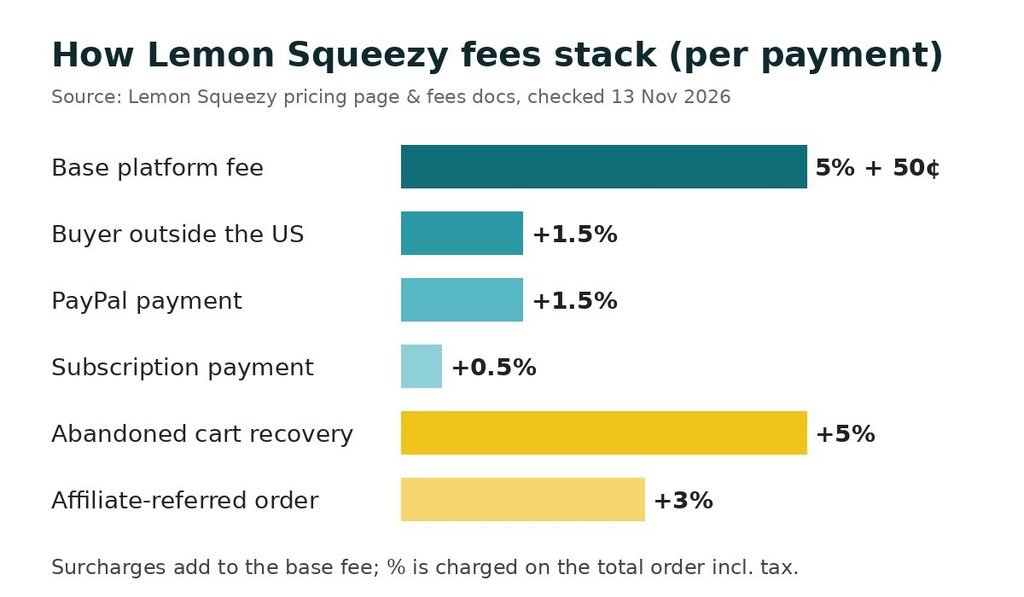
The surcharges stack. A buyer in the UK who pays for a subscription with PayPal could trigger the international, PayPal and subscription surcharges on the same payment, on top of the base 5% + 50¢.
The Detail Most Sellers Miss: The Fee Includes Tax
Lemon Squeezy’s documentation states that the platform fee “is calculated on the total order value”. In its own example, a buyer in France purchases a $20 product, 20% VAT adds $4, and the platform fee is worked out on the $24 total: $0.50 + 5% of $24 + 1.5% international = $2.06, leaving the seller $17.94 after tax and fees.
So when you sell to UK and EU customers, where VAT is often added at checkout, your percentage fee is charged on a larger number than your product price. Lemon Squeezy also offers tax-inclusive pricing, a store-wide setting where the price you set already includes tax. That keeps the customer’s price tidy, but the tax then comes out of your side of the sale.
Worked Examples: What You Actually Keep
These examples apply the published formula. They are illustrations, not quotes. Your dashboard is the final word, and US sales tax depends on where the buyer lives, so the US examples assume no sales tax is added.
Example 1: $20 ebook, US buyer, card
Fee = 5% of $20 ($1.00) + $0.50 = $1.50. You keep $18.50, an effective rate of 7.5%.
Example 2: $20 ebook, US buyer, PayPal
Fee = 6.5% of $20 ($1.30) + $0.50 = $1.80. You keep $18.20.
Example 3: $10/month subscription, UK buyer, card, 20% VAT added
The order total is $12. Fee = 7% of $12 (5% + 1.5% international + 0.5% subscription = $0.84) + $0.50 = $1.34. After the $2 VAT is remitted, you keep $8.66 per renewal. The surcharges apply again on every renewal, so this cost repeats each month.
Example 4: $5 template, US buyer, card
Fee = 5% of $5 ($0.25) + $0.50 = $0.75, an effective 15%. The fixed 50¢ hits cheap products hardest. Lemon Squeezy’s fees page specifically invites sellers of products under $10, or high-volume businesses, to contact sales about custom pricing.
Lemon Squeezy Payout Fees and Schedule
Platform fees are only half the picture. The fees documentation lists separate payout fees:
- Bank payout (via Stripe), US account: free
- Bank payout (via Stripe), non-US account: 1% per payout
- PayPal payout, US account: flat $0.50 per payout
- PayPal payout, non-US account: 3%, capped at $30 per payout
For a UK seller, that means a bank payout costs 1%, while PayPal costs 3% (up to $30). On a $1,000 payout, that is roughly $10 against $30, so a bank account is usually the cheaper route. The Getting Paid documentation adds that PayPal payouts are always in USD, and PayPal may charge its own fees to convert or withdraw. Bank payouts to a non-USD account are converted at the mid-market exchange rate at the time of payout.
When you get paid
- Payouts are created on the 1st and 15th of each month.
- Net sales are held for 13 days, then paid on the 14th and 28th.
- Funds can take 1 to 5 days to reach your bank.
- The minimum payout is $50. Smaller balances stay “Pending” and roll over to the next cycle.
Lemon Squeezy’s own example: a sale made on the 4th is included in the payout created on the 15th and paid on the 28th. Budget for a gap of three weeks or more between a sale and the cash arriving.
Refunds and Chargebacks: The Fee Is Not Returned
According to the refunds and chargebacks page, when you refund an order, the refunded amount minus the platform fee is deducted from your next payout. In other words, Lemon Squeezy keeps its fee on refunded sales.
For chargebacks, Lemon Squeezy generally handles the dispute, usually refunds the buyer on your behalf, and deducts the refunded amount (minus the platform fee) plus a $15 dispute fee. It also reserves the right to issue refunds within 60 days of purchase to prevent chargebacks, even if your store has a “no refunds” policy, and says stores with too many chargebacks may be suspended.
Marketing and Affiliate Fees
Two built-in growth tools carry extra fees for the merchant: +5% on payments recovered through abandoned cart emails and +3% on orders referred by an affiliate. The affiliate fees documentation shows a $20 product sold to an EU buyer via an affiliate earning 30%: fees of $2.78 plus a $6.00 commission leave the seller $11.22 after VAT.
Do You Still Owe Tax on Lemon Squeezy Income?
Because Lemon Squeezy is the merchant of record, its documentation says you should not need to report sales tax for sales made through it. But it also says you may need to pay tax on the income you receive as payouts, and recommends getting advice from a tax professional in your country. Each payout comes with a downloadable “reverse invoice” that records what Lemon Squeezy paid you, which is useful for bookkeeping. If you also sell on other platforms, our guide to Gumroad and Form 1099-K covers how US payment reporting works for creators.
How to Keep Your Lemon Squeezy Fees Down
- Avoid very low prices. The 50¢ fixed fee is a much bigger share of a $3 sale than a $30 one. Bundles can raise your average order value.
- Use bank payouts instead of PayPal, especially outside the US, where PayPal payouts cost 3%.
- Price subscriptions with the surcharges in mind. International and subscription surcharges recur on every renewal.
- Refund quickly and clearly when a customer is unhappy. A refund loses the platform fee, but a chargeback adds a $15 dispute fee on top.
- Ask about custom pricing if most of your products are under $10 or you have high volume, as the fees page suggests.
Comparing options? See how creator tipping and shop platforms charge in our Ko-fi fees guide.
FAQ
Does Lemon Squeezy have a monthly fee?
No. The pricing page lists $0 per month for ecommerce features. You pay per transaction. Email marketing is free up to 500 subscribers and paid beyond that.
Can Lemon Squeezy fees be more than 5% + 50¢?
Yes. Lemon Squeezy’s own FAQ says some edge cases carry extra fees. These include international buyers, PayPal, subscriptions, abandoned cart recoveries and affiliate sales, plus payout fees and chargeback fees.
What is the Lemon Squeezy minimum payout?
$50. If your balance is lower, it rolls over until it reaches the threshold.
Does Lemon Squeezy refund its fee when I refund a customer?
No. Its documentation says the refunded amount minus the platform fee is deducted from your next payout.
Is Lemon Squeezy cheaper for UK sellers using a bank or PayPal?
Based on the published fees, a non-US bank payout costs 1%, while a non-US PayPal payout costs 3% (capped at $30). For most payout sizes, the bank route is cheaper.
Disclaimer: This article is for general information only and is not tax, legal or financial advice. Fees and policies can change. Always check Lemon Squeezy’s current pricing and documentation, and consult a qualified tax professional about your own situation.