

Short answer: Yes, it can. If you sell a stock, ETF or mutual fund at a loss and an automatic dividend reinvestment buys more of the same security within 30 days before or after that sale, the loss on that many shares is treated as a wash sale. It is usually a partial wash sale: only the loss on the handful of reinvested shares is disallowed, and that amount is added to their cost basis rather than lost forever (except in IRAs, covered below).
This catches a lot of people in November and December, when tax-loss harvesting is popular and dividend reinvestment (DRIP) is still switched on in the background.
How the wash sale rule works
According to IRS Publication 550, a wash sale happens when you sell or trade stock or securities at a loss and, within 30 days before or after the sale, you buy substantially identical stock or securities, acquire them in a fully taxable trade, acquire a contract or option to buy them, or acquire them for your IRA or Roth IRA. A purchase by your spouse, or by a corporation you control, also counts.
The underlying law is 26 U.S. Code § 1091. In practice the window is 61 days: the 30 days before the sale, the sale date, and the 30 days after it.
When a loss is washed, it is not usually gone for good. Pub 550 says you add the disallowed loss to the cost of the new shares, and the holding period of the old shares carries over to the new ones. That postpones the deduction until you sell the replacement shares.
Why a dividend reinvestment counts as a purchase
A DRIP is simply an automatic purchase. Pub 550 describes a dividend reinvestment plan as one that lets you use your dividends to buy more shares instead of receiving cash, and notes that most mutual funds let you automatically reinvest distributions. Charles Schwab’s DRIP explainer says each reinvestment purchase “is then considered a new tax lot” with its own basis and purchase date.
The IRS’s wash sale text doesn’t mention dividend reinvestment by name, but nothing in the rule exempts it either. That’s why tax guides and investor communities such as the Bogleheads wiki warn that reinvesting dividends “may accidentally trigger a wash sale” if you plan to tax-loss harvest. The wiki also points out that because most bond funds pay dividends monthly, selling bond fund shares at a loss while reinvesting will almost always cause a wash sale.
Reinvestments before the sale count too
The window also runs 30 days back. If your fund reinvested a dividend 10 days before you sold at a loss, that purchase is inside the window. One of the worked examples in Pub 550 involves shares bought in the 30 days before a loss sale, and part of the loss is disallowed.
How big is the damage? A worked example
Pub 550 explains that when you buy fewer shares than you sold, you match the shares bought with an equal number of the shares sold, and only the matched shares are subject to the wash sale rule. A reinvested dividend usually buys only a few shares, so normally only a small slice of the loss is washed.
Hypothetical example (made-up numbers, for illustration only):
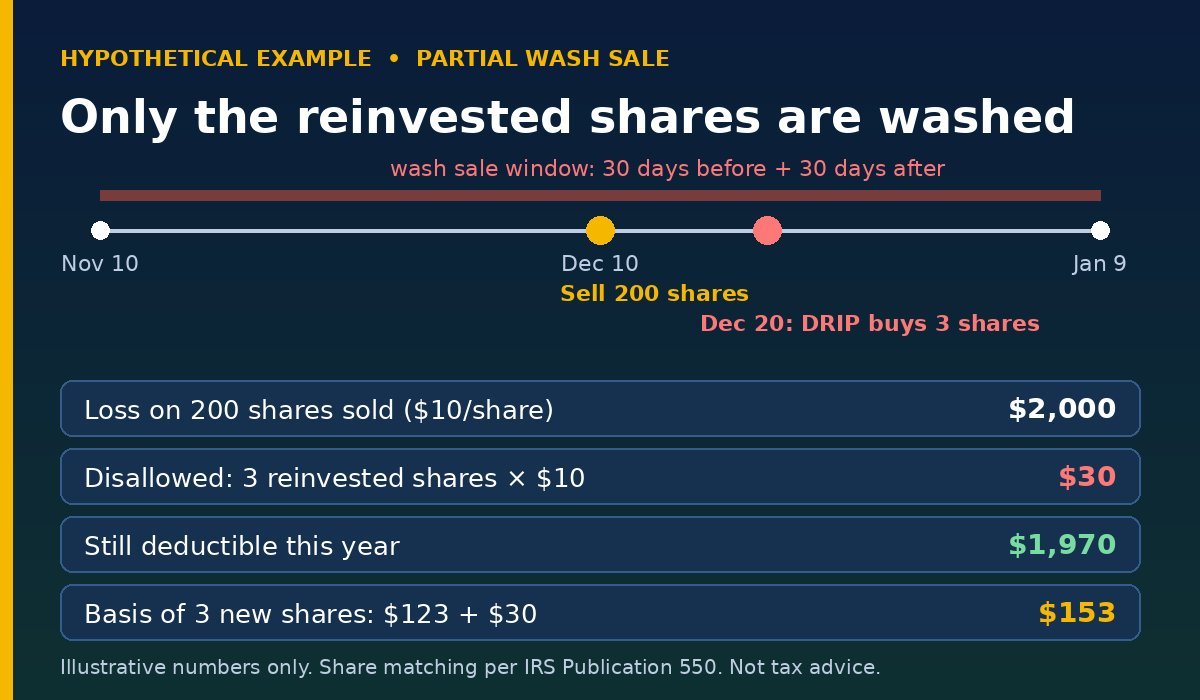
- You own 250 shares of a fund in a taxable account and sell 200 of them on December 10 at a loss of $10 per share, a $2,000 loss.
- You keep the other 50 shares with DRIP still on. On December 20 the fund pays a dividend that automatically buys 3 shares at $41 each ($123).
- The December 20 purchase falls within 30 days after the sale, so the loss on 3 of the 200 shares sold ($30) is a wash sale.
- You can still claim $1,970 of the loss. The $30 that was disallowed is added to the basis of the 3 new shares, so their basis becomes $153 instead of $123.
This works just like the IRS’s own example in the Form 1099-B instructions: there, an investor sells 100 shares at a $400 loss and buys back 75 shares, so $300 of the loss is disallowed and added to the basis of the 75 new shares.
In a taxable account, an accidental DRIP wash sale is usually an annoyance, not a disaster: extra paperwork and a small slice of loss pushed into the future. Years of DRIP also leave you with lots of tiny fractional tax lots; our guide to transferring fractional shares between brokers explains why those small lots can be a headache.
Where the reinvestment happens matters
| Where the reinvestment happens | Is it a wash sale? | Who tracks it |
|---|---|---|
| Same taxable account, same security | Yes, for the reinvested shares | Your broker must report it in box 1g of Form 1099-B (same account, same CUSIP) |
| A different taxable account or broker | Yes, the rule applies across all your accounts | Usually you. Report it on Form 8949 with code W |
| Your IRA or Roth IRA | Pub 550 lists IRA/Roth IRA purchases as wash sales | You. The loss is not added to IRA basis (Rev. Rul. 2008-5) |
| Your spouse’s account | Yes, per Pub 550 | You (and your spouse) |
Brokers only catch the obvious cases
The 2026 Form 1099-B instructions say brokers must report a disallowed loss when both the sale and the purchase “occur in the same account with respect to covered securities with the same CUSIP number.” Anything outside that, like a reinvestment in another account, at another broker or in your spouse’s account, may never show up on your 1099-B. The Form 8949 instructions tell you to enter code W and the nondeductible amount yourself in that case.
The IRA trap is the expensive one
In Revenue Ruling 2008-5, the IRS held that if you sell at a loss and cause your IRA or Roth IRA to buy substantially identical stock within the window, the loss is disallowed and your basis in the IRA is not increased. In other words, that part of the loss is permanently lost rather than deferred. The ruling deals with a purchase you cause the IRA to make. Because Pub 550 lists IRA and Roth IRA acquisitions as wash sales, the cautious approach is to pause DRIP in your retirement accounts for the same security too.
How to avoid a DRIP wash sale
- Switch reinvestment to cash for that security at least 31 days before you plan to sell, and leave it off for at least 31 days after. Most brokers let you do this per position. Schwab, for example, lets you change the “Reinvest?” setting for each position on its Positions page, according to its how-to page.
- Check every account, including IRAs, Roth IRAs, a spouse’s accounts and any workplace or robo accounts that hold the same fund.
- Look back 30 days before selling. If a reinvestment already happened, expect a small partial wash.
- Watch monthly payers. Bond funds and many money market funds distribute monthly, so a reinvestment almost always lands inside the window. (Money market funds rarely produce losses, but see our post on money market fund state tax exemptions for how their dividends are taxed.)
- Collect dividends as cash and reinvest by hand into a different holding during the window. Be careful, though: whether two funds are “substantially identical” depends on the facts. Pub 550 says you must consider “all the facts and circumstances,” and the IRS has not published a list of which funds count.
Pausing DRIP leaves a little cash idle for a few weeks. For timing questions more broadly, see our DCA vs lump sum guide.
A note for UK investors
The UK has no US-style wash sale rule, but it has something similar. HMRC’s “bed and breakfast” share identification rule matches a disposal with shares of the same class acquired by the same person in the 30 days after the disposal, ahead of your existing Section 104 holding. A dividend reinvested into the same shares in that period can therefore change which cost is used for part of your sale. Unlike the US rule, it only looks forward, not back.
FAQ
Does a dividend reinvestment wash sale cancel my whole loss?
Usually not. Only the loss on the number of shares bought by the reinvestment is disallowed, matched share-for-share as Pub 550 describes. The rest of the loss stays deductible, subject to the normal capital loss rules (net capital losses above $3,000, or $1,500 if married filing separately, carry forward, according to Pub 550).
Is the disallowed loss gone forever?
In a taxable account, no. It is added to the cost basis of the reinvested shares and you get it back when you sell them. In an IRA or Roth IRA, Rev. Rul. 2008-5 says basis is not increased, so the disallowed loss is effectively lost.
Will my broker fix it for me?
Only when the sale and the reinvestment are in the same account and the same CUSIP. Wash sales across accounts or brokers are generally yours to track and report.
Do I still pay tax on reinvested dividends?
Yes. In a taxable account, reinvested dividends are taxable just as if you’d received cash. Both Pub 550 and Schwab’s DRIP explainer say so.
Disclaimer: This article is general educational information, not tax, legal or financial advice. Tax rules change and depend on your circumstances. Check IRS/HMRC guidance or consult a qualified tax professional (CPA, EA or chartered tax adviser) before acting.