
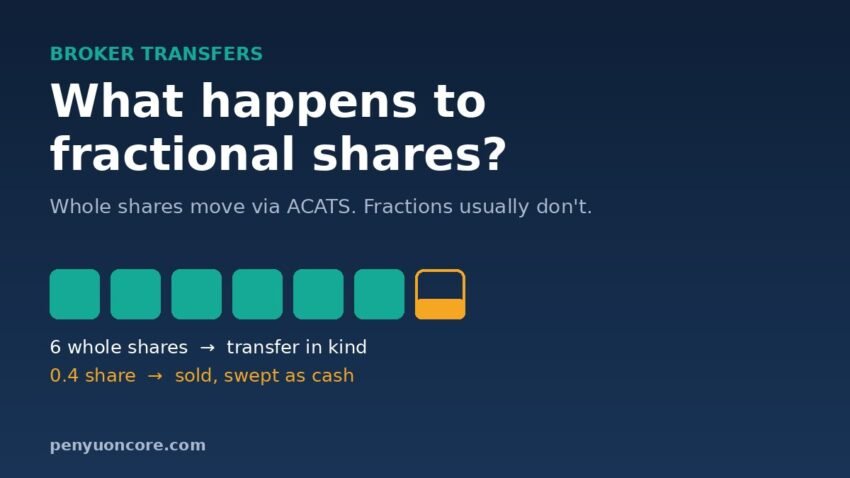
Short answer: fractional shares generally cannot move through ACATS, the automated system US brokers use to transfer accounts. In a full transfer, most sending brokers sell the fractional piece and forward the cash to your new broker afterwards. In a partial transfer, the fraction often stays behind at the old broker until you sell it yourself.
If you’ve bought stocks or ETFs in dollar amounts, or had dividends reinvested automatically, you probably own fractions like 12.384 shares. That’s handy while you’re building a position. When you switch brokers, though, the fraction gets handled differently from your whole shares, and in a taxable account that can mean a small taxable sale you didn’t plan on.
How an ACATS transfer works (in brief)
Most US brokerage-to-brokerage moves run through the Automated Customer Account Transfer Service (ACATS), operated by the National Securities Clearing Corporation. The process starts at your new broker. You fill in a transfer form there, and the new firm submits it to your old firm.
Under FINRA Rule 11870, the old (carrying) firm has to validate or take exception to the transfer instruction within one business day. It must then complete the transfer within three business days after validation. When a full transfer is validated, the old firm “freezes” the account: open orders are canceled and no new orders are taken (the one exception is options expiring within seven business days). FINRA summarized these timeframes in Regulatory Notice 22-21.
The thing to know is that ACATS moves whole units of eligible securities. A fractional share isn’t a full unit, so it needs separate handling.
Why fractional shares don’t transfer
Brokers that offer fractional investing usually keep the fractions on their own books. As a result, a fraction can’t be delivered to another firm the way a whole share can. Broker help pages say this plainly:
- Charles Schwab says that if you transfer your account or specific positions to another broker, “only whole shares can be transferred,” and fractional shares that can’t be transferred “will be liquidated at prevailing market prices.” Schwab also notes that because fractions can’t be transferred, “your overall SIPC coverage may be affected.”
- Robinhood says fractional shares aren’t transferable to other brokerages. In a full ACATS transfer it automatically sells them and sends the cash to the other brokerage in a later “residual transfer.”
- Coinbase (for its stock brokerage accounts) says fractional shares can’t go through ACATS, that a full transfer may result in them being sold and sent as settled cash, and that “this sale is a taxable event.”
Full transfer vs. partial transfer: what happens to the fraction
Whether you request a full or a partial transfer makes the biggest difference.
Full account transfer
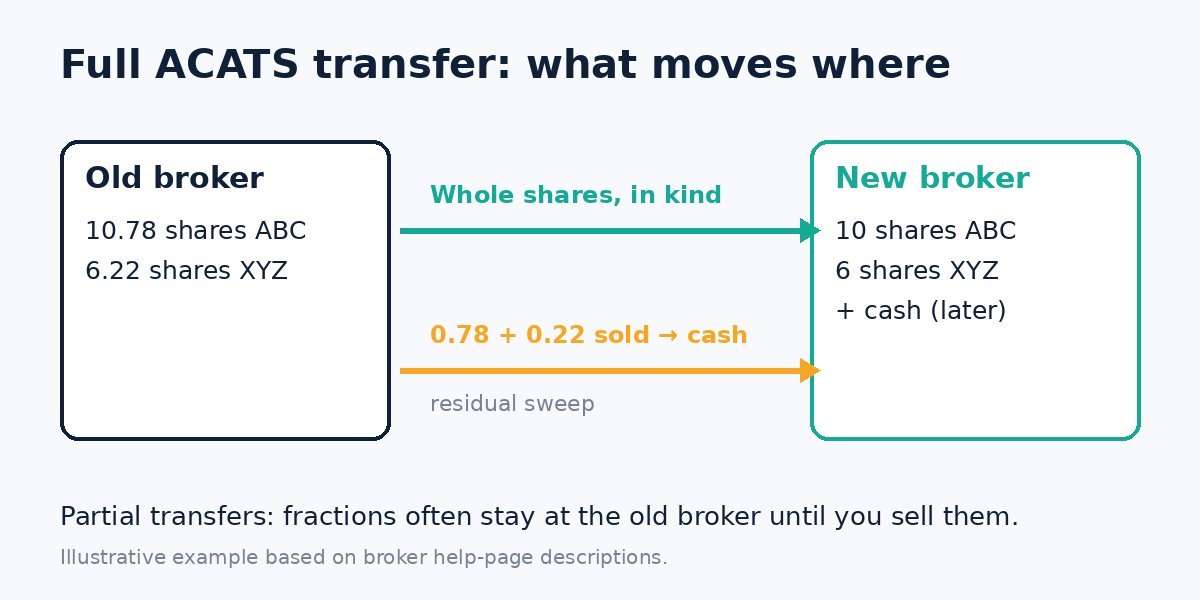
You move everything and the old account is usually closed or restricted. Your whole shares move in kind. The fractional remainder is sold, and the cash follows in a residual sweep. M1’s help center gives an example: an account holding 10.7834 shares of one stock and 6.2259 of another sends 10 and 6 whole shares in kind, while the 0.7834 and 0.2259 fractions are liquidated and the cash is swept over, typically within about a week. M1 also says it keeps sweeping late-arriving residuals, such as dividends, for 180 business days after the transfer.
Partial account transfer
You name specific positions and quantities. Per M1, only the whole shares you request move, and the fractions “will not be transferred and will remain in your M1 account.” To clear them out, you’d sell them at the old broker and move the cash separately.
Policies aren’t identical everywhere. Kraken’s ACATS FAQ says it accepts full shares only, and that depending on the sending broker, fractions may be sold and sent as cash, left at the sending firm, or cause the transfer to be rejected. Ask your old broker before you submit.
| Broker (help page) | Fractions in a full transfer | Fractions in a partial transfer |
|---|---|---|
| Charles Schwab | Liquidated at prevailing prices; only whole shares transfer | Only whole shares can be transferred |
| Robinhood | Sold automatically; cash sent in a residual transfer | Fractions not transferable to other brokerages |
| M1 | Liquidated; cash swept, typically within about a week | Fractions stay in the M1 account |
| Coinbase (brokerage) | May be sold and sent as settled cash; taxable event | Cannot be transferred via ACATS |
Based on each broker’s public help page as checked in November 2026. Policies change, so confirm with your broker before you transfer.
The tax angle: a small sale you didn’t plan
Moving whole shares in kind is a change of custodian, not a sale. Selling a fraction is a sale. In a taxable account, that sale can realize a capital gain or loss, and Coinbase says outright that the sale is a taxable event. The fraction is usually worth only a few dollars, so the tax effect is typically small, but it can still add a line to your 1099-B.
In IRAs and other tax-advantaged accounts, selling a fraction inside the account generally doesn’t create a current tax bill. The cash just moves to the new IRA. If you’re unsure how a transfer affects a retirement account, check with the receiving custodian or a tax professional.
What about cost basis on the shares that do move?
For the whole shares that transfer, the old broker has to send cost-basis information to the new one. Under IRS regulation 26 CFR § 1.6045A-1, the transferring firm must furnish a transfer statement within fifteen days after the transfer settles. The statement covers items such as adjusted basis and original acquisition date, with separate entries for lots bought on different dates or at different prices. If the receiving broker doesn’t get a complete statement, it has to request one. If it still doesn’t receive one, it may treat the security as “noncovered.” So for a few weeks after a transfer, your basis can show as blank or missing. That’s normal at first, but check that it fills in.
How to plan a transfer when you own fractional shares
- Check your old broker’s policy. Read its “transfer out” help page and find out how it handles fractions in full vs. partial transfers, and whether it charges an outgoing transfer fee. Robinhood, for example, lists a $100 fee for partial and full ACATS transfers out.
- Decide whether to round up or round down. If you’d rather not have the broker sell a fraction for you, you can buy enough to round it up to a whole share, or sell the fraction yourself so you choose the timing (and, where your broker allows it, the tax lot). In both cases, let the trade settle before you start the transfer. US stock trades generally settle T+1, and Coinbase notes that cash must be settled before you initiate a transfer.
- Pause automatic investing and dividend reinvestment. Recurring buys and DRIPs create new fractions. Turning them off before you transfer keeps the account clean.
- Use a full transfer if you’re leaving for good. The residual sweep takes care of the fractions and late dividends. With a partial transfer, you may have to come back and clean up leftovers yourself.
- Match names and account details exactly. The SEC’s investor guide on account transfers warns that mismatched details, such as a missing middle initial, can delay a transfer.
- Afterwards, check basis and residual cash. Confirm that the swept cash arrived and that cost basis shows up for each lot within the following weeks.
If the swept cash will sit idle at the new broker for a while, it’s worth knowing where it’s parked. Our comparison of SGOV vs. a high-yield savings account covers the trade-offs for short-term cash. And if part of the reason you’re moving is how well your current broker protects customer assets, read what happens if your broker goes bankrupt. It explains how SIPC coverage works, which ties in with Schwab’s note that fractional holdings can affect it.
Should you avoid fractional shares because of this?
Not necessarily. Fractional investing makes it easy to invest a fixed dollar amount on a schedule, and that’s the core of the approach we compare in DCA vs. lump sum. The transfer issue is a one-time cleanup cost, usually a small cash sweep and possibly a small realized gain or loss. It’s a reason to plan the move, not a reason to skip fractional shares.
FAQ
Can fractional shares be transferred to another broker?
Generally not through ACATS. Brokers like Schwab, Robinhood, M1 and Coinbase say only whole shares transfer. In a full transfer, the fractional part is usually sold and sent as cash.
Will I be taxed when my fractional shares are sold during a transfer?
In a taxable account, the sale can realize a capital gain or loss, which is usually small. Coinbase calls it a taxable event. Inside an IRA, a sale within the account generally doesn’t trigger current tax.
How long does the cash from fractional shares take to arrive?
It varies by broker. M1 says the cash is typically swept within about a week. Robinhood says residual sweeps usually happen weekly after the main transfer completes.
What if I do a partial transfer?
The fractions often stay at the old broker. You’d need to sell them and transfer the cash separately, or leave a small balance behind.
Disclaimer: This article is for general educational purposes only and isn’t financial, tax, or legal advice. Broker policies and rules change; confirm details with your brokerage and consult a qualified professional about your situation.