
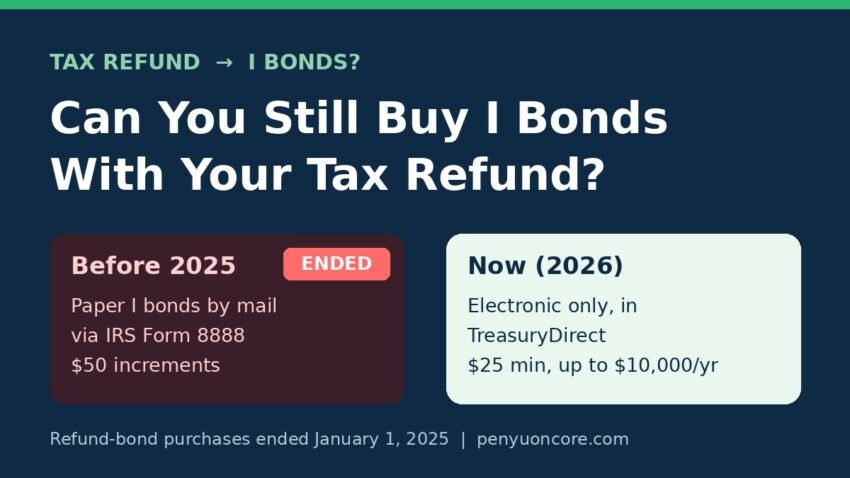
Quick answer: No. As of January 1, 2025, you can no longer use your federal tax refund to buy Series I savings bonds, and IRS Form 8888 can now only split a refund between bank-type accounts. To put refund money into I bonds today, have the refund direct-deposited to your bank, then buy electronic I bonds in a TreasuryDirect account (from $25, up to $10,000 per person per calendar year).
For years, filers could tick a box at tax time and get paper I bonds in the mail. A lot of older articles and forum posts still describe that option, so people keep looking for it on their returns. This guide explains what ended, what Form 8888 does now, and the simplest way to turn a refund into I bonds in 2026. It also covers what to do if you already own paper bonds from the old program.
What changed: the Tax Time Savings Bonds program ended
TreasuryDirect’s own FAQ on using your income tax refund to buy paper savings bonds puts it plainly: “As of January 1, 2025, you are no longer able to buy paper Series I savings bonds with your tax refund.”
The program behind it was called the Tax Time Savings Bonds (TTSB) program. Treasury says it was set up in 2010 to help tax filers, “particularly low- and moderate-income individuals,” buy paper I bonds with their refunds. According to the same FAQ:
- On average about 35,000 filers a year used it, which Treasury puts at 0.03% of tax filers.
- Fewer than 10% of participants used it for more than two years.
- Refund purchases made up less than 1% of all Series I bond sales.
Treasury’s stated reasons for ending it were that the option “was costly and not frequently used,” and that mailing physical bonds “was also subject to fraud, theft, loss, and delays.”
The refund route wasn’t the only door that closed. TreasuryDirect’s I bonds page now says that as of January 1, 2025, “I bonds are only available electronically,” and its buying savings bonds page notes that the Payroll Savings Plan was to be discontinued on January 31, 2025. The TTSB FAQ adds that banks stopped selling paper savings bonds back in 2012.
What Form 8888 does now
Form 8888 (Allocation of Refund) used to be where you asked for bonds. The current revision of Form 8888 (Rev. December 2025) carries this reminder: the program allowing your refund “to be deposited into your TreasuryDirect® account to buy savings bonds, as well as the ability to buy paper bonds with your refund, has been discontinued. Form 8888 is now only used to split your direct deposit refund between two or more accounts.”
The bond section of the form is now labelled “Reserved for future use.” That covers both old routes: sending part of a refund straight into TreasuryDirect, and receiving paper bonds. Per the form instructions, you can still split a refund across two or three accounts, such as checking, savings, a traditional, Roth or SEP IRA (not a SIMPLE IRA), an HSA, an Archer MSA or a Coverdell ESA. Each deposit must be at least $1, and every account must be in your name.
Old way vs. now at a glance
| Question | Before 2025 (TTSB program) | Now |
|---|---|---|
| How you bought | Requested on your tax return via Form 8888 | In your TreasuryDirect account (BuyDirect) |
| Bond format | Paper Series I bonds by mail | Electronic only |
| Purchase amounts | $50 increments | $25 minimum, then any amount to the penny |
| Annual limit | Separate paper allowance (no longer offered) | $10,000 per person per calendar year |
| What Form 8888 does | Direct deposit splits and bond purchases | Direct deposit splits only |
How to put your refund into I bonds in 2026
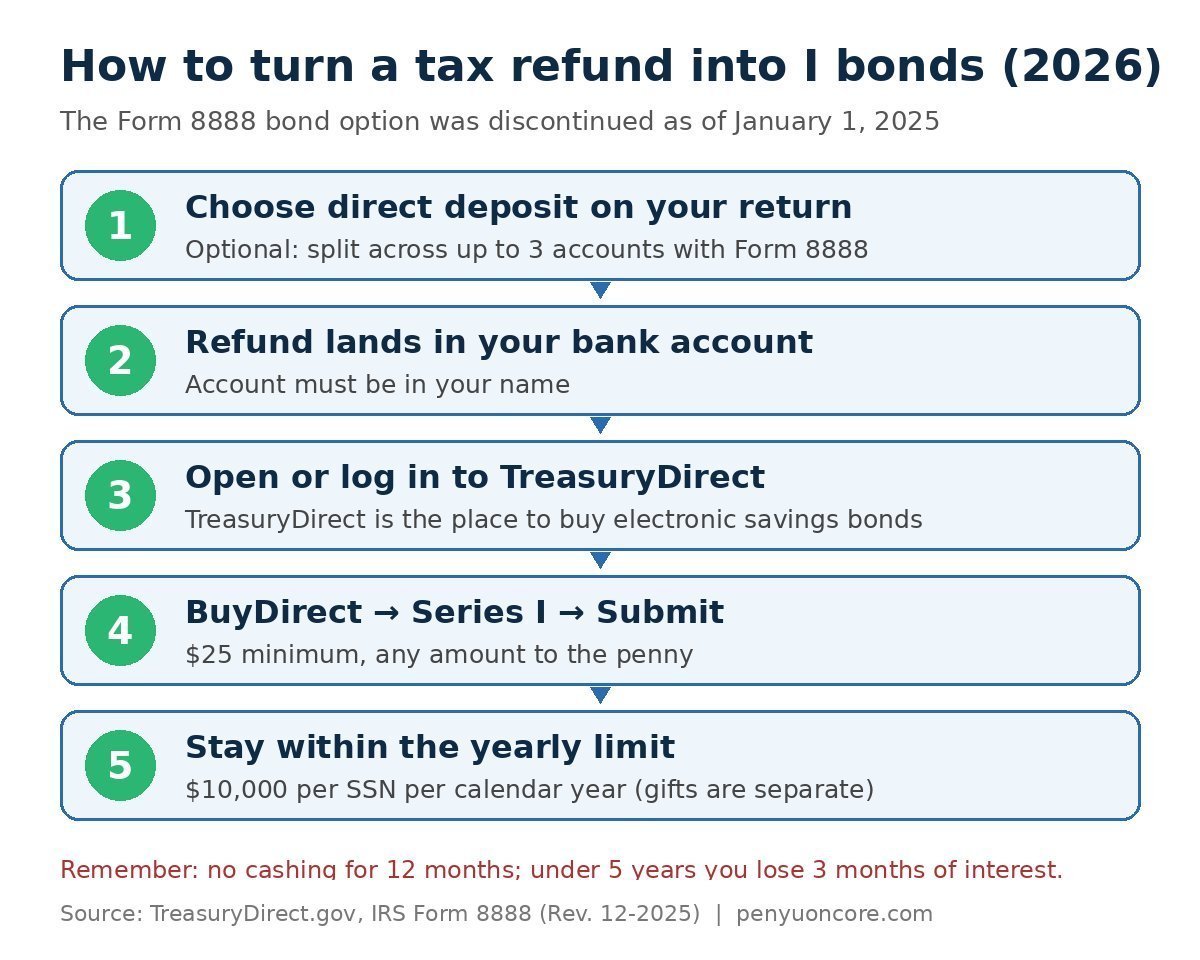
The workaround is a two-step process. The refund goes to your bank first, and then you move it into I bonds yourself.
Step 1: Get the refund direct-deposited
Ask for direct deposit to a checking or savings account in your name on your return. If you only want part of the refund set aside for bonds, Form 8888 lets you split it between up to three accounts. One thing to know: the IRS limits the number of refunds that can be deposited into a single account or prepaid card to three. A fourth refund to the same account is converted to a paper check. That mostly affects families who send several family members’ refunds to one shared account.
Paper refund checks are also being phased out. The Form 8888 instructions note that under Executive Order 14247, starting in October 2025 the IRS will generally stop issuing paper checks for federal payments, including tax refunds, unless an exception applies.
Step 2: Buy electronic I bonds in TreasuryDirect
Per TreasuryDirect’s buying instructions: log in to your TreasuryDirect account, choose BuyDirect, pick I bonds, click Submit, and fill in the rest. If you don’t have an account yet, you’ll need to open one first.
- Amount: any amount from $25, to the penny. Treasury’s example is $75.38. You aren’t stuck with $50 steps any more.
- Limit: up to $10,000 in electronic I bonds per Social Security Number per calendar year for yourself as owner. The same page says that’s in addition to what you spend buying bonds for a child or as gifts.
- Rate: I bonds issued from November 1, 2026 to April 30, 2027 earn a composite 5.51%, including a 1.40% fixed rate, according to TreasuryDirect. The inflation part resets every six months.
Before you lock refund money away, remember the liquidity rules on TreasuryDirect’s I bonds page. You can’t cash an I bond for the first 12 months. If you cash it before five years, you lose the last three months of interest. If you might need part of the money later, our guide to partially redeeming I bonds explains how to cash only some of a bond.
What about the extra refund allowance?
Many older guides add a separate refund-based paper allowance on top of the $10,000 electronic limit. That allowance went away with the program. Asked whether the purchase limit had changed, Treasury’s FAQ answers: “You may continue to purchase up to $10,000 of series I bonds in a calendar year.”
Gifts are the one legitimate way to buy more than $10,000 in a year. Treasury says gift bonds are registered to the recipient and don’t count toward your own $10,000 limit, but the limit still applies to the recipient. Treasury’s gifting page says electronic gifting requires both you and the recipient to have TreasuryDirect accounts, and you must hold the bond for at least five business days before delivering it. We cover the strategy, and its catch, in our I bond gift box guide.
Already have paper I bonds from a past refund?
Nothing happens to them. Treasury says you can keep paper bonds until you’re ready to cash them, or convert them to electronic bonds in TreasuryDirect so they’re easier to track. Paper I bonds have to be submitted to be cashed. To check what they’re worth, Treasury points to its Savings Bond Calculator.
Taxes on I bond interest haven’t changed. Per TreasuryDirect’s tax information page, the interest is subject to federal income tax but exempt from state and local income tax, and you can report it each year or defer it until you cash the bond. For electronic bonds, the 1099-INT is available in your TreasuryDirect account by January 31 of the year after you get the interest. See our walkthrough on finding your TreasuryDirect 1099.
FAQ
Can I direct-deposit my refund into my TreasuryDirect account?
No. The Form 8888 revision says the program allowing a refund to be deposited into your TreasuryDirect account to buy savings bonds has been discontinued. Deposit to your bank, then buy in TreasuryDirect.
Can I still buy paper I bonds anywhere?
No. TreasuryDirect says I bonds are only available electronically as of January 1, 2025.
Is the minimum still $50?
No. Electronic I bonds can be bought from $25, in any amount to the penny.
Does tax software still offer a savings bond option?
It shouldn’t. The IRS form that handled bond purchases now only splits direct deposits, so any bond option in older software or guides is out of date.
Disclaimer: This article is for general information only and isn’t financial or tax advice. Rules and rates can change, so check TreasuryDirect and IRS.gov or talk to a qualified professional before acting.