
Last updated: November 20, 2026
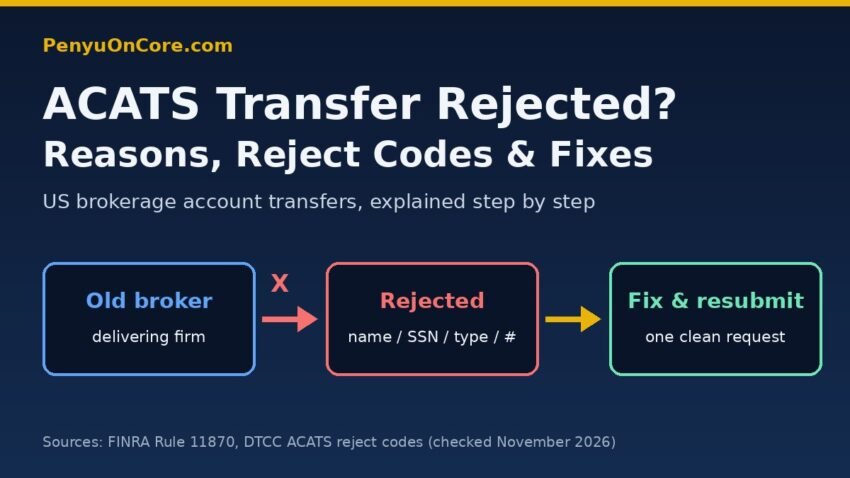
Short answer: An ACATS transfer rejected by your old broker almost always means the details on your transfer request don’t match that firm’s records: the account title, Social Security number/Tax ID, account type or account number. It can also mean the account is empty, already being transferred, or missing a signature or document. Get the exact reject reason from your new broker, fix that one thing at the source, and resubmit.
Moving a brokerage account through ACATS (the Automated Customer Account Transfer Service run by the National Securities Clearing Corporation) is normally quick. FINRA says validation and delivery together “generally take about three to four business days.” So when you get a “transfer rejected” email instead, it helps to know what the rejection actually means and how to fix it on the first try.
Who can reject an ACATS transfer, and why it matters
Two firms are involved. The delivering (carrying) firm is your old broker. The receiving firm is your new broker. You start the transfer by submitting a Transfer Initiation Form (TIF) to the new firm, and it enters the request into ACATS.
- The old broker can only “take exception” (reject) for the specific reasons listed in FINRA Rule 11870(d)(3). Those include extra documentation needed, a flat (empty) account, an invalid account number, a duplicate request, an SSN/Tax ID mismatch, an account title or account type mismatch, a missing or improper authorization, or you cancelling the request. It cannot reject the transfer because of a dispute over positions or cash balances.
- The new broker, after validation, can reject a full transfer only if the account doesn’t meet its credit policies or minimum asset requirements. Under the same rule it has to reject the whole account, not just the parts it doesn’t like.
- The ACATS system itself can bounce a request automatically if the data doesn’t meet minimum requirements, according to FINRA.
If you know which side rejected it, you know who to call.
ACATS reject codes explained
Brokers don’t always show you the code, but behind the scenes DTCC’s ACATS uses standard reject codes. Here is the delivering-firm list from DTCC’s ACATS help documentation, with a plain-English fix for each:
| Code | Reason | What to do |
|---|---|---|
| 01 | SSN / Tax ID mismatch | Confirm the exact SSN/TIN each firm has on file; a joint or trust account may be registered under a different number. |
| 02 | Account title mismatch | Match names exactly, including middle initials, suffixes and joint-owner order. Update the name at one firm if needed. |
| 03 | Documentation needed | Send what the old firm asks for (e.g., death or marriage certificate, trust documents). |
| 04 | Account flat | Check the account still holds assets; resubmit with your latest statement attached. |
| 05 | Invalid account number | Copy the brokerage account number from a recent statement, in the format the old firm uses. |
| 06 | Duplicate | Make sure only one request is open for that account. |
| 07 | Account in distribution or transfer | Wait until the pending transfer or distribution is finished. |
| 08 | Client rescinded | You (or someone on the account) cancelled; start a new request if that was a mistake. |
| 09 | Missing authorization signature | Sign or e-sign the TIF again, including any co-owner, custodian or trustee. |
DTCC’s documentation also notes that for standard transfers, codes 01-05 are “soft” rejects and 06-09 are “hard” rejects. With a soft reject the receiving firm has 20 business days to correct the request; with a hard reject the transfer has to be resubmitted. Receiving-firm codes include 21 (“account violates credit policy of receiving firm”).
Common real-world causes
Broker help pages describe the same problems in everyday terms, plus a few firm-specific ones.
Name and account-type mismatches
Interactive Brokers and Betterment both point to a missing middle initial, a nickname or a recent name change as typical title problems. Account types have to line up too: individual to individual, joint to joint, Traditional IRA to Traditional IRA, Roth IRA to Roth IRA. A 401(k) isn’t a brokerage account, so Betterment says it usually needs a rollover rather than ACATS.
Wrong account number format
Some firms issue more than one number. Webull publishes example formats. For instance, it lists Fidelity numbers as 9 alphanumeric characters (like Z12345678) and Schwab numbers as 8 digits. Use the number on your brokerage statement, not a login ID or a linked bank account.
Assets the new broker can’t hold
Proprietary mutual funds, some annuities, certain foreign ADRs, micro-cap stocks and fractional shares are common sticking points. If you hold partial shares, see our guide on what happens to fractional shares when you transfer brokers. Under FINRA Rule 11870, the firms must tell you about nontransferable assets and offer options such as liquidating them or leaving them where they are.
Timing problems
Interactive Brokers says it can’t process ACATS requests during options expiration week, and it rejects transfers with unsettled trades. Webull also rejects transfers with unsettled sales. It lists a $500 minimum for ACATS transfers into Webull, and it may reject a transfer if there isn’t enough cash to cover the old broker’s outgoing transfer fee. These are individual firm policies, not universal rules, so check your own brokers’ pages.
Transfer locks and margin
Interactive Brokers notes that a “transfer lock” security feature at the old firm will block an inbound transfer until you turn it off. A margin balance the new firm won’t accept can trigger a credit-policy rejection.
How to fix a rejected ACATS transfer: step by step
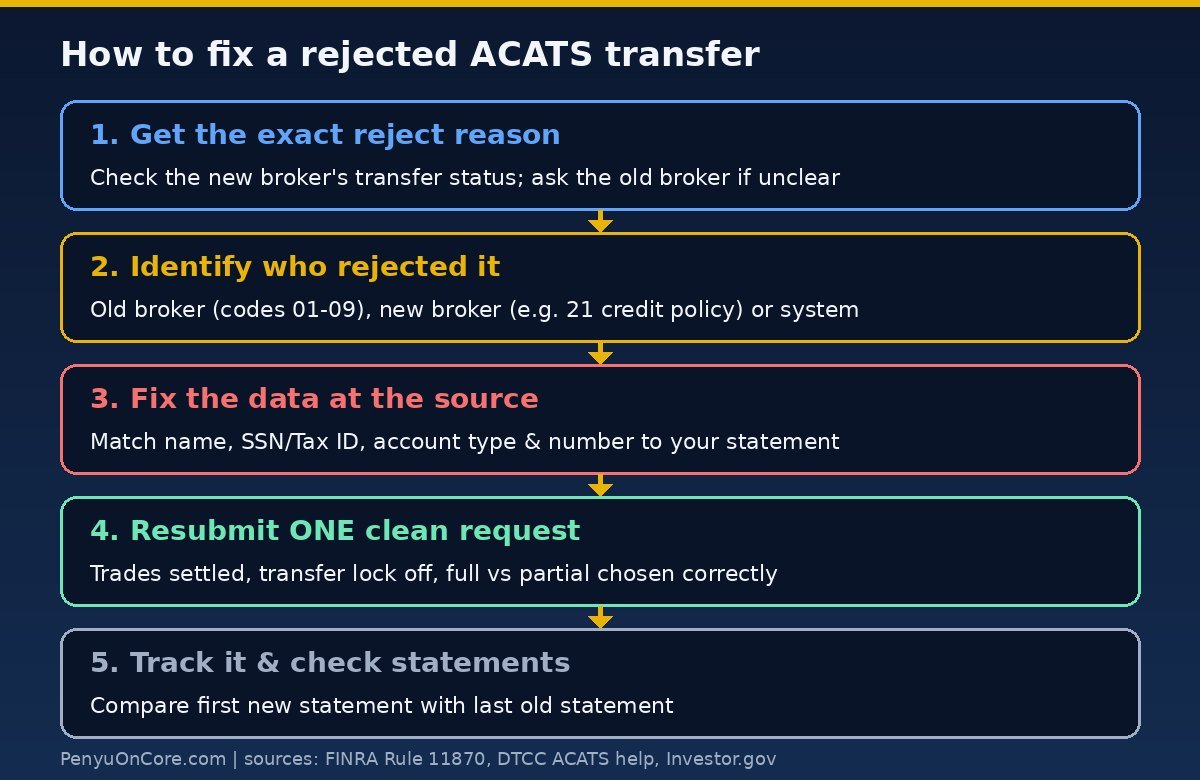
- Get the exact reason. Check your new broker’s transfer status page or message centre. If it only says “rejected,” ask the old broker which exception it took. IBKR says a generic reject usually means contacting the delivering broker.
- Pull your latest statement from the old firm. Copy the account title, account number and account type exactly as printed. Investor.gov says most transfer delays come from an incorrect or incomplete TIF.
- Fix the mismatch at the source. If your name or SSN differs between firms, update the record (often with ID or a legal name-change document) before you resubmit. A new request with the same bad data will just bounce again.
- Clean up the account. Let trades settle, cancel open orders, deal with assets that can’t be transferred, and turn off any transfer lock.
- Resubmit once. Don’t send several requests at the same time, or you risk a duplicate reject (code 06). If you’re moving everything, choose a full transfer. Webull says a partial transfer with every asset selected gets rejected.
- Track it and check the result. When the assets arrive, compare your first new statement with your last old one, as Investor.gov recommends.
A note on conflicting timelines
Official sources don’t agree on one detail. The current text of Rule 11870(b) gives the old firm one business day to validate or take exception, but FINRA’s key-topics page says three business days. Investor.gov says a request that isn’t acted on or fixed within two business days is purged from ACATS and has to be started again. The rule itself says these time frames can change based on NSCC publications. Either way, the window is short, so respond to any document request right away. After validation, the rule says delivery should be completed within three business days.
FAQ
Can my old broker refuse a transfer just to keep me?
No. Rule 11870 lists the only exceptions the old firm may take, and a dispute over positions or balances isn’t one of them. If you think a transfer is being stalled, ask both firms in writing what’s wrong.
Will a rejected ACATS transfer cost me money?
The rejection itself doesn’t move your assets, which stay with the old broker. Outgoing transfer fees depend on the firm, so ask before you resubmit. Investor.gov suggests asking both firms about fees.
Can I transfer an account to a different account type?
Not through a standard ACATS transfer. Account types have to match, so open the matching account type at the new broker first. If you’re moving Treasury bills instead of a whole account, see how to transfer T-bills from TreasuryDirect to a brokerage, which isn’t an ACATS process.
What if my old broker is shutting down or failing?
That’s a different situation from a normal transfer rejection. Read what happens if your broker goes bankrupt for how customer assets are protected.
Disclaimer: This article is general information, not financial, tax or legal advice. Broker policies change, so confirm details with your brokers before acting.