
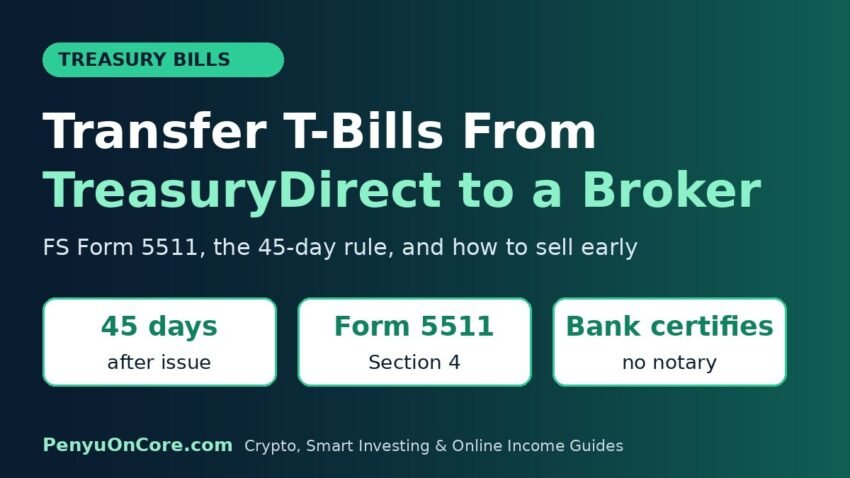
Quick answer: To get a Treasury bill out of TreasuryDirect, you fill out FS Form 5511 (TreasuryDirect Transfer Request), have your signature certified at a bank, trust company, or credit union (a notary isn’t accepted), and mail it to Treasury Retail Securities Services in Minneapolis. The bill must have been held for at least 45 days after its original issue date, so 4-week bills bought at auction in TreasuryDirect can’t be transferred at all. Once the bill arrives at your brokerage, you can sell it there before it matures.
TreasuryDirect has no “sell” button. If you need your money before a bill matures, or you just want all your Treasuries in one brokerage account, transferring it out is the only option. Below is the full process: the information to get from your broker before you start, the 45-day rule, and the mistakes that most often slow transfers down.
Why you have to transfer a T-bill before you can sell it
TreasuryDirect’s help page on selling Treasury bills says it plainly: to sell a bill you hold in TreasuryDirect, you first transfer it to a bank, broker, or dealer, and then ask them to sell it for you. Treasury’s page on selling a marketable security adds that any sale before maturity has to go through a bank, broker, or dealer.
Treasury describes three places securities can be held:
- The commercial book-entry system, which is a bank, broker, or dealer account
- TreasuryDirect, the current online system
- Legacy Treasury Direct, the older system that is being phased out
Moving a bill to a brokerage means moving it from TreasuryDirect into the commercial book-entry system. The same steps apply to Treasury notes, bonds, TIPS, and FRNs held in TreasuryDirect. They don’t apply to savings bonds: Section 4 of FS Form 5511 says brokerage transfers do not apply to EE or I bonds.
The 45-day holding rule (and why 4-week bills are stuck)
The TreasuryDirect user guide says marketable securities must be held for 45 days after original issue before they can be transferred out. Key details:
- 4-week bills bought at original issue in TreasuryDirect can’t be transferred at all, because the 28-day term is shorter than the 45-day hold.
- Treasury also sells 6-week bills. Six weeks is 42 days, which is also shorter than 45, so the same problem applies.
- The hold also covers reinvested bills when the maturing security didn’t pay for the whole new one, meaning you added new money.
- If you mail the form during the hold period, Treasury processes it once the hold ends. It isn’t rejected.
- Securities that came into TreasuryDirect from a broker or from Legacy Treasury Direct aren’t subject to the hold.
If you think you may need cash early, this rule matters at purchase time. A 4- or 6-week bill bought in TreasuryDirect can only be held to maturity. Bills bought through a brokerage avoid TreasuryDirect’s transfer process entirely. If you’re still deciding where to keep short-term cash, our comparison of SGOV vs a high-yield savings account covers other places to park short-term cash.
| Bill term | Days (approx.) | Transferable out of TreasuryDirect? |
|---|---|---|
| 4-week | 28 | No (matures before day 45) |
| 6-week | 42 | No (matures before day 45) |
| 8-week | 56 | Yes, after day 45 (small window) |
| 13, 17, 26, 52-week | 91 to 364 | Yes, after day 45 |
With an 8-week bill, the window between day 45 and maturity is short. Once you count mailing time and processing, a transfer may not be practical.
What to get from your brokerage first
Before you open the form, contact the brokerage that will receive the bill. Treasury’s page on transferring between systems lists four things to get:
- The financial institution’s wire name
- The institution’s routing number (ABA number)
- The agent or broker’s name and phone number
- The name and account number of the account receiving the security
The form’s instructions explain that the wire name has to be in the approved telegraphic “short” form. The account details go in the Special Handling Instructions line, for example “FURTHER CREDIT TO JOHN DOE BROKERAGE ACCOUNT NUMBER XXXXX.” The form’s own example shows a brokerage receiving securities through a bank, so ask your broker for its exact delivery instructions for Treasury securities coming from TreasuryDirect. Treasury warns that wrong handling instructions can get a transfer rejected or delayed. The form also says securities can’t be transferred to a checking or savings account.
Step by step: transferring a T-bill out of TreasuryDirect
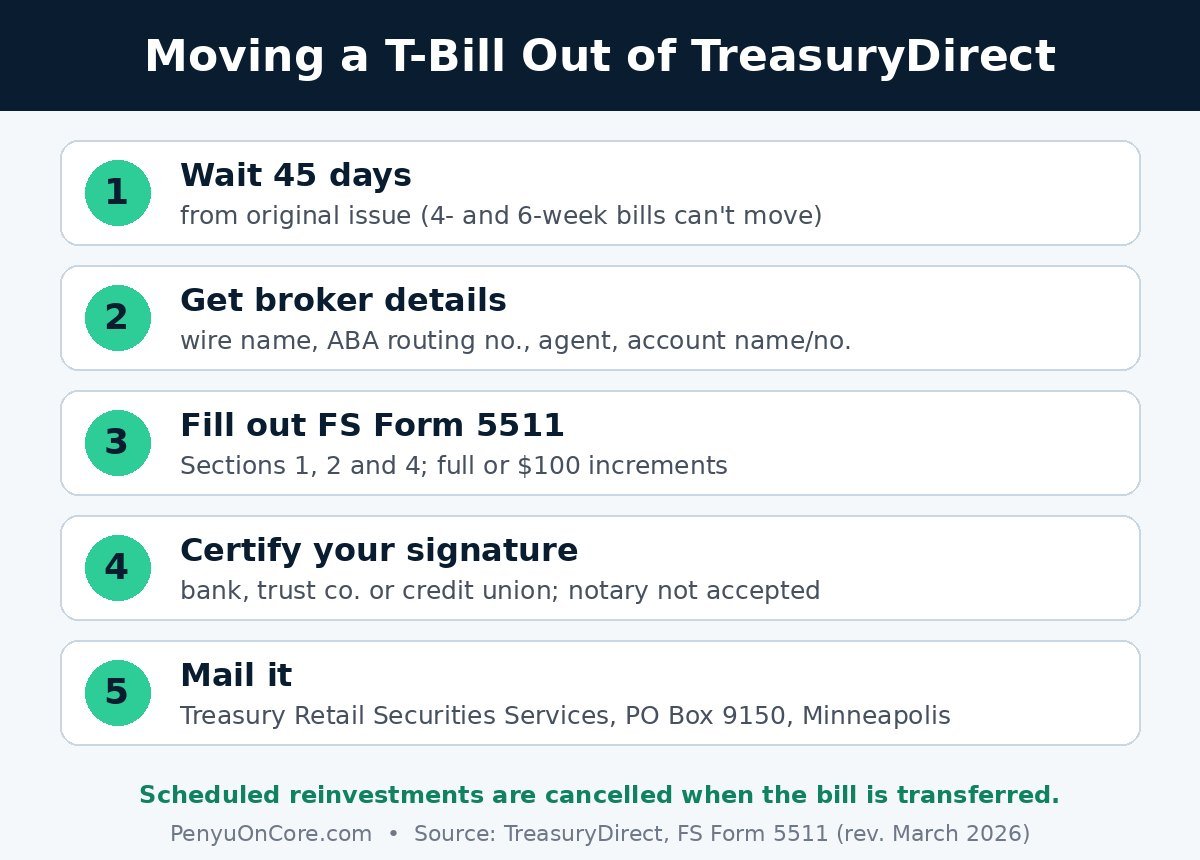
1. Start the transfer in your account
Log in to TreasuryDirect, go to Manage Direct, choose Transfer securities, select the bill or bills, and choose External Transfer. This leads you to FS Form 5511. You can also find it on Treasury’s forms page.
2. Fill in Sections 1, 2 and 4
- Section 1: your TreasuryDirect account number, account name, and SSN or EIN.
- Section 2: choose whether to transfer all securities, those on an attached list printed from your account, or those you describe in the table (confirmation number, issue date, par amount, CUSIP). Marketable securities can move in full or in $100 increments. If you don’t mark a partial transfer, Treasury assumes a full transfer.
- Section 4 (Transfer to a Financial Institution or Brokerage Firm): the routing number, wire name, agent details, and special handling instructions from your broker. Skip Section 3, which is for transfers to another TreasuryDirect account.
3. Get your signature certified (not notarized)
The form says to sign “in ink in the presence of a certifying officer” and that “notary certification is not acceptable.” The certifying officer works at a bank, trust company, or credit union. They must be able to guarantee signatures, and they stamp the form with an accepted seal, such as a Signature Guaranteed or Medallion stamp. Call your bank first to confirm it offers this service.
4. Mail the form
As of the March 2026 revision, the form says to send it to: Treasury Retail Securities Services, PO Box 9150, Minneapolis, MN 55480-9150. Keep a copy. You’ll get an email when the activity has been processed.
5. Sell at your brokerage (if you want to)
Once the bill shows up in your brokerage account, you can place a sell order or keep holding it. Before maturity, the price is whatever the market pays that day. Face value is only guaranteed if you hold until the bill matures. Ask your broker about any fees for incoming transfers or Treasury trades.
Things that commonly go wrong
- Using a notary. The form explicitly rejects notary certification. You need a certifying officer at a bank, trust company, or credit union.
- Incomplete delivery instructions. If the account name and number are missing from Special Handling Instructions, the broker may not be able to credit the bill.
- Forgetting about auto-reinvestment. The form says all scheduled reinvestments tied to the transferred securities are cancelled at the time of transfer.
- Cutting it close to maturity. Neither the form nor the Treasury help pages cited here give a processing time, so leave plenty of room between mailing the form and the bill’s maturity date.
- Old Legacy accounts. Bills in Legacy Treasury Direct use a different form, FS Form 5179 (Security Transfer Request).
Taxes when you sell a T-bill early
According to IRS Publication 550, T-bill interest is subject to federal income tax but exempt from state and local income taxes. For short-term government obligations (one year or less), a gain on sale is treated as ordinary income up to your ratable share of the acquisition discount, which is the discount earned for the time you held the bill. Your broker’s tax forms and a tax professional can help with the exact numbers. For more on how the state-tax exemption works with fund holdings, see our guide on whether money market funds are state tax exempt.
If you’re moving Treasuries because you’re worried about where they’re held, our explainer on what happens if your broker goes bankrupt covers how brokerage custody and SIPC work.
FAQ
Can I sell a T-bill directly in TreasuryDirect?
No. TreasuryDirect doesn’t sell securities for you. You transfer the bill to a bank, broker, or dealer, and they sell it.
Can I transfer just part of a T-bill?
Yes. FS Form 5511 allows marketable securities to be transferred in full or in increments of $100.
Can I move T-bills from a brokerage into TreasuryDirect?
Yes. Your broker delivers them to receiving bank name TREASURYDIRECT, ABA 051736158, along with your TreasuryDirect account number. Incoming securities aren’t subject to the 45-day hold.
Can a notary sign FS Form 5511?
No. The form says notary certification isn’t acceptable. Use a certifying officer at a bank, trust company, or credit union.
Disclaimer: This article is for general educational purposes only and is not financial, tax, or legal advice. Treasury procedures and forms can change, so check TreasuryDirect and talk to your broker or a qualified professional before acting.