
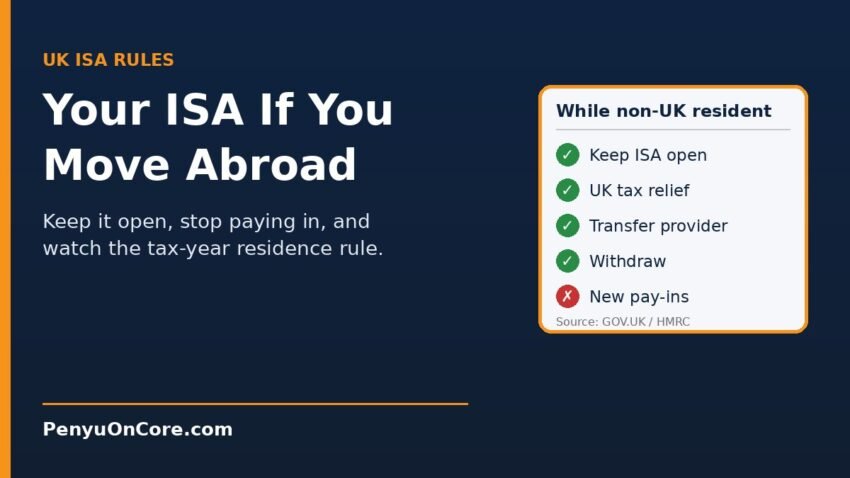
Your ISA if you move abroad does not have to be closed. Under GOV.UK’s rules, you can keep it open and the money already inside stays free of UK tax, but you can’t pay new money in while you’re non-UK resident (unless you, or your spouse or civil partner, are a Crown employee serving overseas). You must tell your provider when you stop being UK resident, and you can pay in again once you come back and become UK resident.
That’s the short version. The details that trip people up are when the pay-in ban actually starts, what happens if you keep a direct debit running, whether a flexible ISA lets you put money back, and how a Lifetime ISA behaves abroad. This guide covers each one using HMRC’s own guidance for ISA providers.
What happens to your ISA if you move abroad
Here’s what GOV.UK and HMRC say holds for every ISA type once you become non-UK resident:
- Your ISA stays open. HMRC’s guidance for ISA managers says an existing ISA “does not need to be closed”.
- UK tax relief continues. Interest, dividends and gains inside the ISA stay free of UK Income Tax and Capital Gains Tax.
- No new subscriptions, apart from a short list of technical exceptions covered below.
- You can still transfer the ISA to another provider while non-resident.
- You can still withdraw. GOV.UK says you can take money out of an ISA at any time without losing tax benefits, though your provider’s own terms may add rules or charges.
The UK tax-free status only covers UK tax. The country you move to may tax the interest, dividends or gains under its own rules. It doesn’t have to recognise the ISA wrapper at all.
Provider policies can be stricter than HMRC
HMRC lets the ISA stay open, but your provider doesn’t have to keep serving you. Two examples from provider help pages:
- Monzo says customers leaving the UK permanently need to close their current account and Savings Pots, Cash ISA included. People moving abroad temporarily can keep the Cash ISA but can’t add to it.
- InvestEngine says your ISA can stay open, you can switch ETFs and transfer other ISAs in, and withdrawals go to a UK bank account.
Before you leave, read your own provider’s terms. If they’ll close the account, an ISA transfer to a provider that accepts non-residents keeps the tax wrapper. Cashing out does not. Our guide to ISA transfers that are taking too long explains how transfer timescales work.
When the pay-in ban starts: the tax-year rule
GOV.UK’s summary page makes it sound like the ban starts the day you move. HMRC’s detailed guidance is more precise. For ISA purposes you are either UK resident or not resident for the whole tax year (6 April to 5 April), “regardless of whether split year treatment applies”. You work this out with the Statutory Residence Test (RDR3).
In practice:
- If you’re still UK resident for the tax year you leave, subscriptions made in that tax year are generally valid, within the £20,000 annual allowance (2026 to 2027).
- If you’re non-resident for a whole tax year, no subscriptions are allowed that year. HMRC notes there will “always be a gap year” for someone with a continuous direct debit in place.
- When your provider gets an overseas address but you haven’t confirmed you’re non-resident, HMRC says it can keep accepting subscriptions until 5 April of that tax year. It shouldn’t accept them in the following tax year until you confirm you expect to be UK resident.
Source conflict flagged: GOV.UK’s consumer page says you “cannot put money into” an ISA once you move abroad and become non-UK resident. It doesn’t mention that residence is judged for the whole tax year. HMRC’s manager guidance is the more detailed rule. If your departure year is borderline, check your status with RDR3 or call the ISA Helpline before paying in.
What if you paid in while non-resident?
HMRC says subscriptions made in a tax year when you were non-resident, plus any income or growth on them, must be removed from the ISA. Any Lifetime ISA bonus for that year goes back to HMRC. That also applies if you tell your provider later that you left in an earlier tax year. So cancel standing orders and direct debits into your ISAs before your first full non-resident tax year starts.
The exceptions: what non-residents can still pay in
HMRC lists a few subscription types that non-residents can still make:
| Subscription type | What it means |
|---|---|
| Flexible ISA replacement | Putting back cash you withdrew from a flexible ISA in the same tax year |
| Additional permitted subscription | The extra allowance for a surviving spouse or civil partner |
| Defaulted cash / investment subscriptions | Correcting a payment the provider failed to process properly |
| Help to Buy ISA reinstatement | Reinstating Help to Buy ISA funds in specific cases |
| Lifetime ISA (limited) | Only a defaulted payment, or returning a withdrawal after a failed first-home purchase |
Flexible ISAs: can you put money back while abroad?
According to HMRC, yes. Flexible ISA replacement subscriptions are on the list of exceptions open to non-residents. Three conditions apply. Your ISA has to be flexible (your provider can tell you), the replacement has to go back within the same tax year as the withdrawal, and your provider must accept it.
Source conflict flagged: some third-party expat guides say money withdrawn while non-resident can’t be paid back in. That doesn’t match HMRC’s exception list, which allows flexible replacements. It may simply reflect providers that don’t offer flexibility, or that block all payments from non-residents. Confirm with your provider before you withdraw anything you plan to put back.
Lifetime ISA if you move abroad
To pay into a Lifetime ISA, you must be UK resident, or a Crown servant or armed forces member (or their spouse or civil partner) living outside the UK. Once you’re non-resident, regular payments and the 25% bonus stop. The account and its existing bonus stay put.
Watch the withdrawal rules. GOV.UK says withdrawals are charge-free only for a first home, from age 60, or if you’re terminally ill. Anything else carries a 25% withdrawal charge. HMRC’s first-home guidance says the property must be your first residential property in the UK, bought with a mortgage, costing £450,000 or less (above that, a 20% charge applies), and you must live in it as your main residence. A home bought abroad doesn’t qualify.
If you’d rather keep the account but move it, see how to transfer a Lifetime ISA to another provider. For what happens later on, read what happens to a Lifetime ISA at 50.
Moving to the US with an ISA
If you become a US resident, or you’re already a US citizen, the IRS says you generally report worldwide income. The ISA’s UK tax-free status doesn’t carry over automatically. The same IRS page says you must file an FBAR (FinCEN Form 114) if your foreign financial accounts total more than $10,000 at any time in the calendar year, and you may need Form 8938 above its thresholds. Cross-border investment rules are complicated, so talk to a tax adviser who knows both systems before you move.
Coming back to the UK
When you become UK resident again, you can pay in up to the annual allowance for that tax year. HMRC says you should give your provider a declaration confirming you’re UK resident, with your permanent UK address. You don’t need a full new application for an existing account. Lifetime ISAs work differently because the application declaration applies to each year you pay in. Since April 2024 you can also pay into more than one ISA of the same type in a year; see our guide to two stocks and shares ISAs in the same tax year.
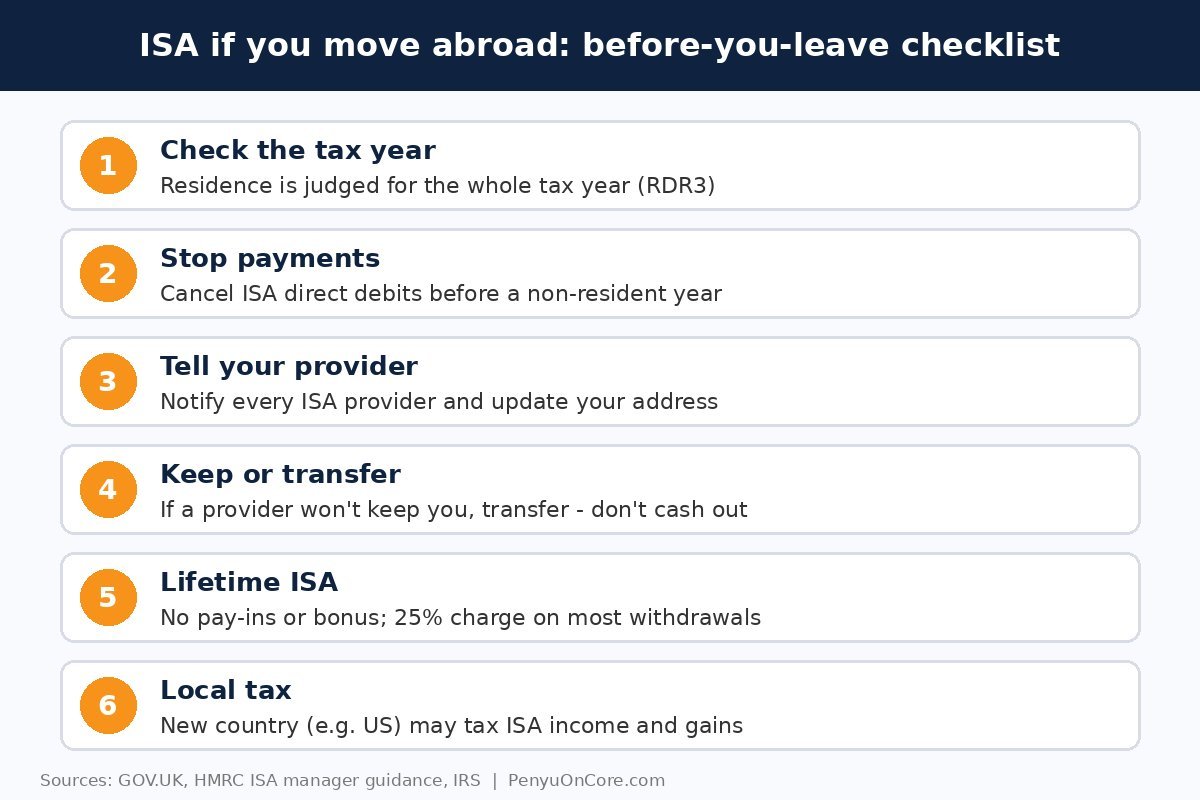
Checklist before you leave
- Check your residence status for the tax year you leave with RDR3.
- Use any remaining allowance while you’re still UK resident for that tax year, if it suits you.
- Cancel ISA direct debits and standing orders before your first non-resident tax year.
- Tell every ISA provider you’re becoming non-UK resident, and update your address.
- Check whether each provider will keep your account. If not, transfer rather than cash out.
- Keep a UK bank account if your provider only pays withdrawals to one.
- Get local tax advice on how your new country treats ISA income and gains.
FAQ
Do I have to close my ISA if I move abroad?
No. HMRC says an existing ISA doesn’t need to be closed, although an individual provider’s terms may require it.
Can I open a new ISA while living abroad?
Generally no. To open or pay into an ISA you must be UK resident, or a Crown employee serving overseas (or their spouse or civil partner).
Is my ISA still tax-free abroad?
It stays free of UK tax, but your new country may tax the income and gains under its own rules.
Can I transfer my ISA while non-resident?
Yes. GOV.UK confirms you can transfer an ISA to another provider even if you aren’t UK resident.
Disclaimer: This article is general information, not financial or tax advice. ISA rules and provider policies change, and your residence status depends on your own circumstances. Check GOV.UK, call the ISA Helpline or speak to a regulated adviser before acting.