
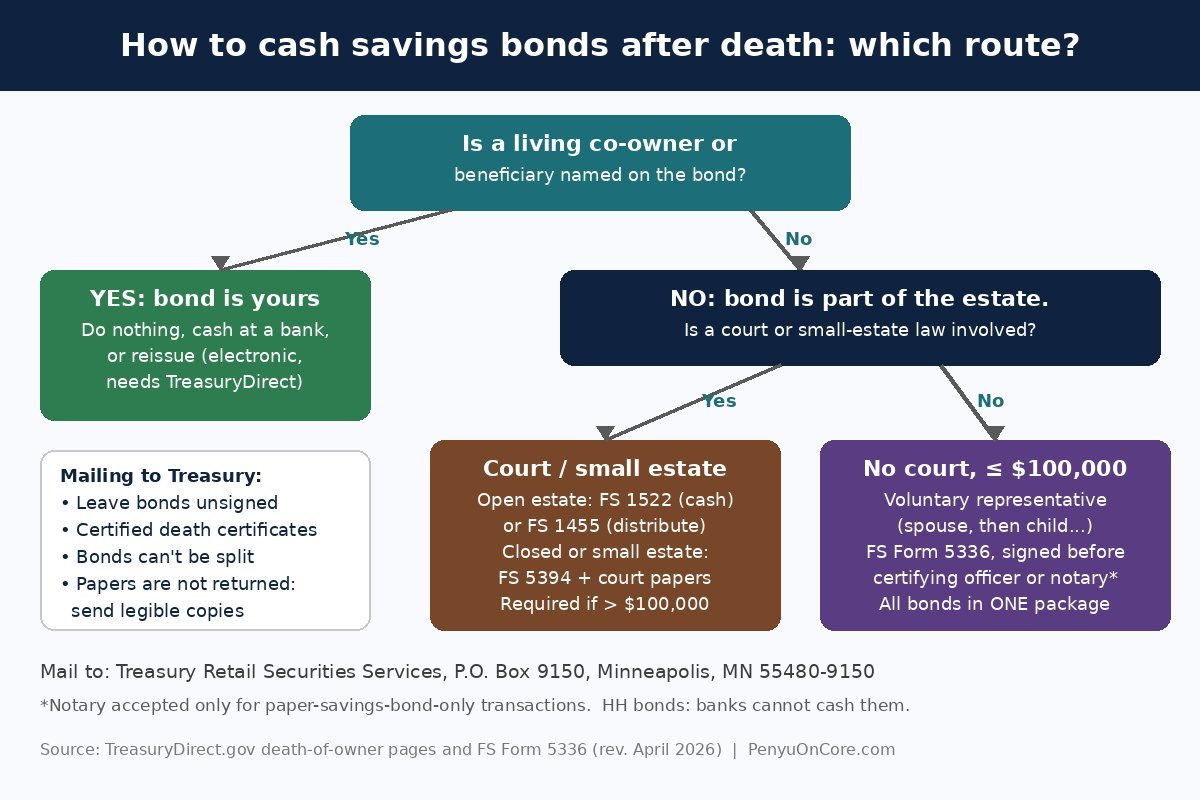
If you need to cash savings bonds after death of a parent, spouse or relative, the first thing to check is whose names are printed on the bond. A living co-owner or beneficiary can usually cash paper EE or I bonds at a bank that offers the service. If no one named on the bond is alive, the bonds belong to the estate, and the right Treasury form depends on whether a court is involved and on whether the estate’s Treasury securities total more than $100,000.
This guide walks through each situation using the official rules published by TreasuryDirect, the Treasury’s savings bond service, plus the IRS rules on who reports the interest. It covers U.S. Series EE, E, I and HH paper bonds. For bonds held electronically, the process starts differently (see below).
The short answer: who can cash savings bonds after death?
According to TreasuryDirect’s death-of-owner page, ownership works like this:
- One person named, and that person died: the bond is part of that person’s estate.
- Two people named, and both died: the bond is part of the estate of the person who died last.
- Two people named, and one died: the survivor becomes the owner as if they had been the only owner from the issue date. The bond does not go through the estate.
| Your situation | Who acts | Main form |
|---|---|---|
| A living co-owner or beneficiary is named on the bond | The named survivor | None at a bank that cashes bonds; FS Form 1522 if no bank will |
| Court-appointed representative, estate still open | Executor or administrator | FS Form 1522 (cash) or FS Form 1455 (distribute) |
| Estate closed, or settled under a state small-estate law | People named in the court or small-estate documents | FS Form 5394 |
| No court, no small-estate procedure, Treasury securities of $100,000 or less | A “voluntary representative” (next of kin, in strict order) | FS Form 5336 |
Electronic bonds in a TreasuryDirect account
If the person who died held bonds in an online TreasuryDirect account, the Treasury’s instruction is simple: contact TreasuryDirect. It will put a hold on the account and tell you what to do next. Do not try to log in to the deceased person’s account yourself. If you hold your own TreasuryDirect account, now is a good time to add a beneficiary to your TreasuryDirect bonds so your own heirs avoid this paperwork.
Situation 1: you are the named co-owner or beneficiary
When your name is on the bond as co-owner or beneficiary, the bond passes straight to you. Per TreasuryDirect’s inheritance guidance, for EE or I bonds still earning interest (they earn for 30 years from issue) you have three options:
- Do nothing. Interest keeps building, and you get it when you cash the bond or it matures.
- Cash it at a bank. Find a bank or other financial institution that will pay savings bonds. Ask what ID and documents they need, and whether they have a limit on how much they will cash. If no local bank will cash it, Treasury’s instructions for surviving registrants say to use FS Form 1522, with your signature certified by a bank officer.
- Reissue it in your name alone. Reissued EE and I bonds become electronic, so you need a TreasuryDirect account; the request is made on FS Form 4000. After that you can also convert your other paper savings bonds to electronic.
Series HH bonds are different. All HH bonds reached final maturity as of August 1, 2024, and banks are not allowed to cash them, so they have to be sent to the Treasury for payment. Bonds that have stopped earning interest should simply be cashed.
Situation 2: a court-appointed representative is handling the estate
An estate with savings bonds and other Treasury securities worth more than $100,000 in redemption value at the date of death must be administered by a court. The court-appointed representatives page splits this into three cases.
Open estate: cash or distribute
The executor or administrator can redeem the bonds to the estate or hand specific bonds to specific heirs. A local bank may be willing to cash E, EE or I bonds for the representative. If not, mail FS Form 1522 with a certified signature and title, the unsigned bonds, a death certificate for each deceased person named on the bonds, and court evidence of the appointment (for example, letters testamentary).
To distribute instead, the representative signs FS Form 1455. Each heir then files FS Form 1522 to cash their bonds or FS Form 4000 to reissue unmatured bonds electronically, which needs a TreasuryDirect account. Matured bonds must be redeemed.
Closed estate or state small-estate procedure
If the representative has already been discharged, or the estate was settled under a state small-estate law (such as a small estate affidavit, Texas muniment of title or Louisiana judgment of possession), submit FS Form 5394 with the certified signatures it asks for, the unsigned bonds, death certificates, and the final account, decree of distribution or small-estate document.
Situation 3: no court involved (FS Form 5336)
This is the most common route for families with a modest number of paper bonds. Under TreasuryDirect’s non-administered estate rules, it applies only when no one named on the bond is living, there is no court administration or small-estate procedure, and Treasury securities total $100,000 or less at the date of death.
The person who signs is the “voluntary representative.” They must be at least 18, competent, and first in this order on FS Form 5336: surviving spouse; then a child (if there is no competent surviving spouse); then descendants of a deceased child; parents; brothers or sisters; their descendants; and finally next of kin under state law. Only one voluntary representative is recognized at a time.
Step by step
- Gather every bond. All securities in the estate must go in ONE transaction, even if you want to cash some and distribute others.
- Complete FS Form 5336, but wait to sign it until you are in front of a certifying officer. For paper-bonds-only transactions, a notary is also accepted. Certifying officers are available at most banks and credit unions.
- Get certified copies of death certificates for everyone named on the bonds who has died.
- Leave the bonds unsigned. Each bond is cashed or distributed whole; bonds cannot be split.
- Mail the package to Treasury Retail Securities Services, P.O. Box 9150, Minneapolis, MN 55480-9150. Documents are not returned, so send legible copies of legal papers.
By signing, you certify that you will pass the money or bonds to the people entitled to them under the law of the state where the deceased lived. If heirs want to keep bonds, each one files FS Form 1522 (cash) or FS Form 4000 (keep an EE or I bond) in the same package.
Missing or lost bonds
The Treasury retired its Treasury Hunt search tool: as of September 30, 2025, it is no longer available. If you believe the estate has lost, stolen or destroyed bonds, file FS Form 1048. You can ask for cash or a replacement; replacement EE and I bonds are electronic. Our guide to replacing lost savings bonds explains the claim in detail.
Who pays tax on the interest?
Savings bond interest is subject to federal income tax but not state or local income tax. Bonds can also be subject to federal estate tax and state estate or inheritance taxes, according to TreasuryDirect’s tax page.
IRS Publication 550 explains how the untaxed interest is split when the owner had been deferring it (the usual case):
- The surviving spouse or personal representative can choose to report all interest earned before death on the decedent’s final return. The heir then reports only the interest earned after death.
- If that choice is not made, the pre-death interest is “income in respect of a decedent.” The person who gets the bonds reports all of it when they cash the bonds or the bonds mature, and may deduct any federal estate tax paid on that portion.
For more on the IRS paperwork you’ll see, read our TreasuryDirect 1099 guide, and consider asking a tax professional before cashing a large holding.
FAQ
Can I cash my late parent’s savings bonds at a bank?
If you are named on the bond as co-owner or beneficiary, usually yes, if your bank cashes savings bonds. If your parent was the only person named, the bonds belong to the estate, and banks may help a court-appointed representative. Otherwise you will probably mail FS Form 5336 to the Treasury.
Do I need probate to cash savings bonds after death?
Not always. If the estate’s Treasury securities total $100,000 or less and there is no court or small-estate proceeding, a voluntary representative can use FS Form 5336. Above $100,000, Treasury rules require court administration.
Can one savings bond be split between siblings?
No. Each bond must be cashed or distributed for its full amount to one person. The representative can cash everything and split the money, or give whole bonds to different heirs.
Do inherited savings bonds stop earning interest?
No. EE and I bonds keep earning interest until 30 years after their issue date, whoever owns them.
Disclaimer: This article is general information, not financial, legal or tax advice. Treasury forms and procedures change, so confirm the details on TreasuryDirect.gov and consult an estate attorney or tax professional for your situation.