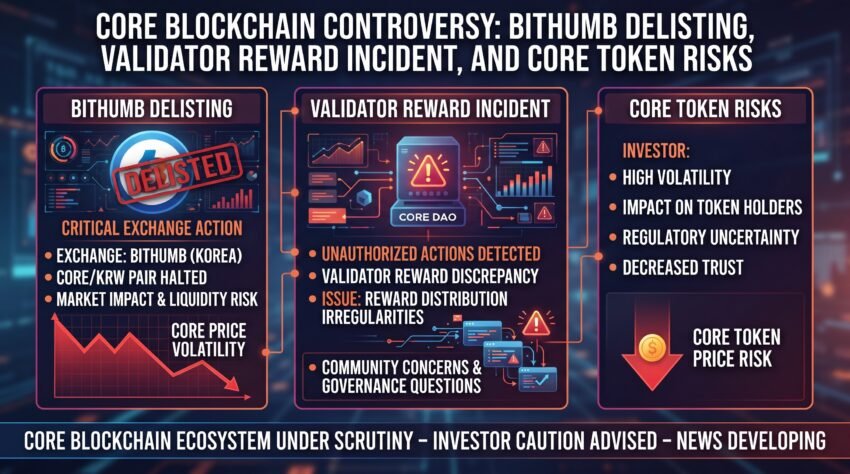
Core Blockchain is facing increased scrutiny as concerns about exchange support, network security, token price performance, and project transparency attract attention from cryptocurrency investors. These developments have raised questions about the future of the CORE token and the broader Core DAO ecosystem.
This article examines the major controversies surrounding Core Blockchain, distinguishes reported developments from speculation, and explains the risks investors should monitor in November 2026.
1. Bithumb CORE Delisting Raises Investor Concerns
One of the most significant developments involving CORE is the reported decision by South Korean cryptocurrency exchange Bithumb to terminate trading support for the token.
Reports published in late October 2026 indicated that trading termination was scheduled for November 30, 2026, followed by a withdrawal support deadline of December 30, 2026.
Investors should verify these dates and the reasons for the decision through the exchange’s official announcement before making financial decisions.
Why Is the Bithumb Delisting Important?
When an exchange removes a cryptocurrency from its trading market, affected users may need to transfer their assets to another supported exchange or wallet.
- Reduced access to trading for users relying on the exchange.
- Potential selling pressure before the trading deadline.
- Possible liquidity challenges if alternative markets are limited.
- Negative sentiment among investors concerned about the project’s outlook.
However, a delisting from one exchange does not automatically mean that CORE will be removed from every other exchange or that the Core Blockchain network will stop operating.
Investors can consult Bithumb’s official website to look for the relevant announcement and confirm the applicable deadlines.
2. Core DAO Validator Reward Incident Raises Security Questions
Another concern involves a reported validator reward distribution incident in the Core Blockchain ecosystem.
According to a post-incident report attributed to Core DAO, an issue involving the validator reward accounting mechanism resulted in approximately 255 million CORE being distributed ahead of schedule.
The report stated that approximately 186.15 million CORE was subsequently removed from circulation, while approximately 69 million CORE had been moved and remained unrecovered at the time described in the report.
The same report indicated that a network upgrade was implemented on September 3, 2026, to address the issue. These figures should be checked against the original incident report and any subsequent updates.
What Does This Incident Mean for CORE Holders?
An unexpected reward distribution can raise questions about the security and reliability of a blockchain’s token issuance mechanisms.
- Protocol security: Investors need to understand how the issue occurred and whether the corrective measures were independently reviewed.
- Token supply transparency: Unexpected distributions can create uncertainty about circulating supply and token accounting.
- Validator oversight: The incident highlights the importance of monitoring mechanisms designed to detect irregular reward distributions.
- Investor confidence: Even after a technical problem is addressed, restoring confidence may take time.
It is important to distinguish a validator reward accounting incident from a confirmed theft of user funds. The reported incident alone does not establish that all user funds were compromised or that the entire blockchain network was hacked.
Investors should seek updated recovery figures, technical documentation, and independent assessments before drawing conclusions about the incident’s lasting impact.
3. CORE Token Price Pressure Creates Additional Risks
Price performance is another factor influencing sentiment toward Core Blockchain. A cryptocurrency experiencing a prolonged decline may face increasing skepticism from traders, long-term holders, and potential new investors.
Reported CORE price weakness during 2026, combined with concerns surrounding exchange support, makes it important to examine trading volume, market depth, circulating supply, and broader market conditions.
Factors That Could Influence CORE Price
Several variables may influence the token’s future performance.
- Exchange liquidity: Reduced access to trading markets can make buying and selling more difficult.
- Market sentiment: Negative headlines may influence trading behavior, particularly when investors are already concerned about a project’s outlook.
- Token supply: Changes in circulating supply and the movement of large token holdings may affect market dynamics.
- Ecosystem adoption: Demand for CORE depends partly on actual usage within the network and its applications.
- Broader cryptocurrency conditions: Bitcoin performance, market liquidity, and risk appetite can influence altcoins.
A falling token price does not, by itself, prove that a blockchain project has failed. Investors should evaluate market data alongside technical progress and actual ecosystem activity.
4. Questions About Core DAO Decentralization and Transparency
Decentralization is an important consideration when evaluating any blockchain ecosystem. Validator participation, token distribution, governance arrangements, and development responsibilities can all influence investor confidence.
Questions about decentralization and transparency deserve careful examination, particularly when a project undergoes leadership changes or adjusts responsibilities related to block production.
What Should Investors Examine?
- The number of active validators and their distribution.
- The concentration of voting power among major participants.
- Public information about token allocations and vesting schedules.
- Governance proposals and independent stakeholder participation.
- The availability of technical documentation and security audits.
A blockchain may have independent validators while still experiencing concentrated token ownership. Therefore, decentralization should not be judged using a single metric.
Similarly, community criticism should not automatically be treated as evidence of misconduct. Claims about centralized control or undisclosed token allocations require supporting documentation.
5. Legal Disputes and Business Relationships
Legal disputes involving cryptocurrency projects can also affect investor confidence. Core Foundation’s past dispute with Maple Finance attracted attention because it involved contractual disagreements and activities related to Bitcoin yield products.
Reports indicated that the parties reached a settlement in May 2026, with settlement terms not publicly disclosed.
A settlement does not automatically establish that either party was responsible for wrongdoing. Nevertheless, investors may examine whether such disputes affected product development, business relationships, or the project’s broader strategy.
When assessing legal controversies, it is important to distinguish allegations, court orders, settlement agreements, and final judicial findings.
6. Is Core Blockchain at Risk of Failing?
The negative developments surrounding Core Blockchain warrant attention, but they do not independently prove that the network is approaching failure.
A more reliable assessment requires evidence from several areas, including network activity, decentralized finance usage, token liquidity, security improvements, and development progress.
Network Activity
Investors should examine active addresses, transaction counts, network fees, and other indicators of actual usage. Increasing activity may suggest growing adoption, although transaction counts alone cannot establish organic demand.
DeFi Ecosystem Growth
Decentralized finance applications can provide insight into whether a blockchain is attracting users and capital. Total value locked, application activity, and the sustainability of incentives are useful metrics to monitor.
Token Liquidity and Distribution
Trading volume, market depth, exchange availability, and large wallet movements can help investors understand potential market risks. Token distribution and vesting schedules are also important because large future unlocks may affect selling pressure.
Security and Development
Independent security audits, transparent incident reports, active development, and documented network upgrades can help investors evaluate the project’s technical resilience.
Official Communication
Consistent, verifiable communication from project representatives can help reduce uncertainty. Investors should prioritize primary documentation and independently corroborated reporting over anonymous social media claims.
7. Core Blockchain Risks Investors Should Monitor in November 2026
Before making an investment decision, investors should consider the following checklist.
| Risk Factor | Why It Matters | What to Monitor |
|---|---|---|
| Exchange delisting | May affect liquidity and market access. | Official exchange notices and alternative markets. |
| Validator reward incident | Raises protocol security and token supply questions. | Independent technical reviews and recovery updates. |
| Price volatility | Can increase the risk of financial losses. | Price, trading volume, and market depth. |
| Token concentration | May increase exposure to large-holder selling. | Wallet distribution and vesting schedules. |
| Ecosystem adoption | Helps indicate actual network demand. | Active users and application activity. |
| Governance transparency | Influences confidence in decision-making. | Public proposals and disclosures. |
| Security development | Helps assess the network’s resilience. | Security audits and documented upgrades. |
This checklist does not predict CORE’s future price. Instead, it identifies information that may help investors make more informed decisions.
8. Core Blockchain Rumors: What Is Verified and What Is Not?
Negative cryptocurrency headlines can spread quickly, especially when token prices are falling. Investors should distinguish between documented events and unsupported claims.
An official exchange announcement can establish that trading support is scheduled to end on a particular date. A published incident report can provide evidence that a technical problem occurred.
However, claims that a project is a scam, that its developers have abandoned it, or that its blockchain will shut down require separate evidence.
A decline in token price is not proof of fraud, and a technical incident does not automatically mean that a network is permanently compromised.
The same standard should apply to positive claims. Partnerships, ambitious roadmaps, and promotional announcements do not guarantee future adoption or token appreciation.
A balanced assessment requires verifiable evidence from multiple independent sources.
Frequently Asked Questions (FAQ)
Why is Core Blockchain facing negative attention?
Core Blockchain has faced scrutiny over reported exchange delisting developments, a validator reward distribution incident, token price pressure, and questions about transparency and decentralization.
Does the Bithumb CORE delisting mean Core Blockchain will shut down?
No. A trading delisting from one exchange does not automatically mean that the blockchain network will shut down or that other exchanges will remove CORE.
Was Core Blockchain hacked?
A reported validator reward distribution incident raised security concerns. However, it should not automatically be described as a complete network hack or a confirmed theft of all user funds. Readers should consult the original incident report and independent technical assessments.
Can CORE recover from its current challenges?
A recovery is possible, but it is not guaranteed. Relevant factors include security improvements, exchange support, liquidity, ecosystem adoption, token supply dynamics, and broader market conditions.
Is CORE a safe cryptocurrency investment?
CORE, like other cryptocurrencies, carries significant risks, including volatility, liquidity constraints, technical vulnerabilities, and regulatory uncertainty. Investors should conduct independent research and avoid investing money they cannot afford to lose.
Conclusion: Core Blockchain Faces Challenges, but More Evidence Is Needed
Core Blockchain faces several issues that deserve attention in November 2026, including the reported Bithumb CORE delisting, the validator reward distribution incident, market pressure, and questions about transparency and decentralization.
These developments may affect investor confidence and increase uncertainty surrounding the CORE token. Nevertheless, the available evidence should not be interpreted as definitive proof that Core Blockchain is collapsing or that CORE has no future.
The project’s outlook will depend partly on how effectively technical issues are addressed, whether token recovery efforts progress, how exchange support evolves, and whether genuine network adoption continues.
For investors, the most prudent approach is to verify official announcements, examine on-chain data, review independent security assessments, and avoid making decisions based entirely on rumors or promotional narratives.
Ultimately, the key question is not simply whether Core Blockchain is facing negative news. It is whether the project can demonstrate measurable progress in security, transparency, liquidity, and real-world adoption.
Sources and Further Research
- Bithumb Official Website — Check official exchange notices and CORE trading support.
- Core DAO Official Website — Research the Core ecosystem, project updates, and official documentation.
- CoinMarketCap — Check cryptocurrency prices, market capitalization, and trading data.
- Crypto.news — Research cryptocurrency industry news and related reports.
Disclaimer: This article is for informational and educational purposes only. It does not constitute financial, investment, or legal advice. Cryptocurrency markets are volatile, and readers should independently verify material claims before making investment decisions.