
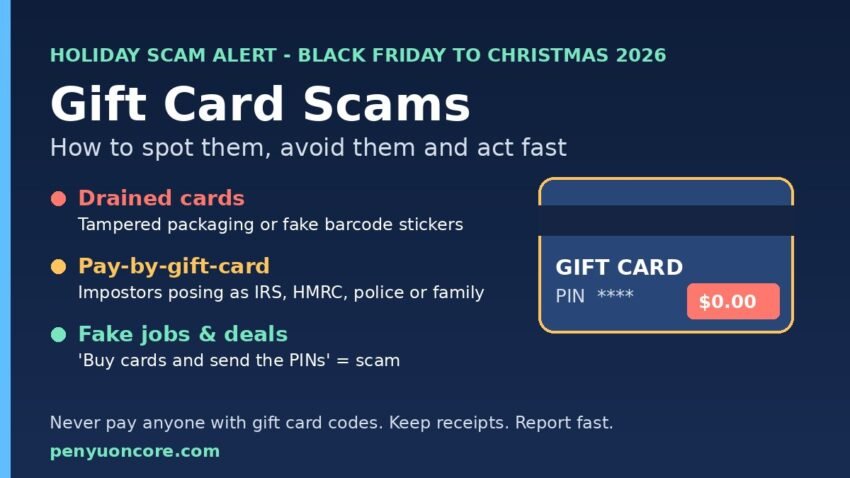
Gift card scams peak around Black Friday (27 November 2026), Cyber Monday and Christmas, when millions of people buy cards as last-minute presents and scammers know it. They come in two main forms: cards tampered with on the store rack so your money is “drained” the moment you load it, and con artists who talk you into buying cards and reading out the numbers. Both are hard to reverse, so prevention matters most.
Quick answer: No real business, government agency or employer will ever ask you to pay with a gift card, so anyone who does is running a scam. When you buy a card in a store, check the packaging and barcode for tampering and keep the receipt. If you’ve been hit, contact the card issuer straight away, ask them to freeze the balance and refund you, then report it (ReportFraud.ftc.gov in the US, Report Fraud in the UK).
Why gift card scams spike during the holidays
Gift cards work a lot like cash. They’re easy to buy, hard to trace and quick to spend or resell. In the UK, the BBC reported in December 2025 that Report Fraud logged 9,386 reports of gift card fraud in 2023-24, with more than £18.5m lost, and that most reports arrive around January, after the festive season. On 23 November 2026, Report Fraud launched its “Have a Fraud Free Xmas” campaign ahead of Black Friday, warning shoppers about fake websites, fraudulent adverts and phishing messages.
In the US, recent cases show how organised the in-store version has become. On 4 November 2026, federal prosecutors in St. Louis said a man pleaded guilty after being arrested with 134 compromised gift cards worth a potential $58,300 if shoppers had loaded them. He had removed the strips covering serial numbers, recorded the numbers and put the cards back on racks in Colorado, Iowa and Missouri. All of those cards were recovered before anyone bought them. On 12 November, NBC Connecticut reported that Wilton police found a van outside a CVS with tampered gift cards and tools to open packaging, scrape off foil and reseal it.
The most common types of gift card scams
1. Gift card draining (tampered cards in stores)
Thieves take cards off the rack, copy the card number and PIN (or scan them), then reseal the packaging and put the card back. Once you pay and the card is activated, they spend the balance before your recipient ever uses it. A variation uses a fake barcode sticker. The FBI explains that when the cashier scans the sticker, your money goes onto the scammer’s card instead, “leaving you with a zero balance.” The Better Business Bureau adds that some criminals use handheld scanners and then keep checking the balance by calling the retailer’s phone line.
2. “Pay me in gift cards” impostor scams
Someone calls, texts or emails pretending to be the IRS or HMRC, the police, a utility company, tech support or a relative in trouble. Their message is urgent, and they tell you which card to buy and where. Florida’s consumer agency, which republishes FTC guidance, notes that scammers sometimes stay on the phone while the victim goes to the store, and may send you to several stores so cashiers don’t get suspicious. Apple says its cards can only be used to buy from Apple, not to pay bills, taxes or government fees.
3. Fake jobs, mystery shopping and side-hustle offers
This one hits people looking for extra holiday income. Which? has warned about sham mystery shopper jobs where the “recruiter” asks you to buy supermarket gift cards and share the PINs. It’s closely related to the task scam, where you’re asked to pay in before you can withdraw “earnings”. A genuine employer pays you. It never asks you to buy gift cards.
4. Fake balance checkers, giveaways and discount cards
The BBB warns that some websites claiming to check your gift card balance exist only to collect the card number and PIN so the money can be drained. Social media posts offering free or heavily discounted cards often lead to phishing sites. Check your balance only on the retailer’s own website or app, or on the phone number printed on the card.
5. Buyers who want to pay you with gift cards
If you sell items online, be wary of a buyer who offers gift cards or sends a cheque for more than the price and asks you to return the difference on a gift card. The FTC-based guidance says that cheque will turn out to be fake. Our guide to Facebook Marketplace scams for sellers covers the overpayment trick in detail.
How to avoid gift card scams when you buy a card
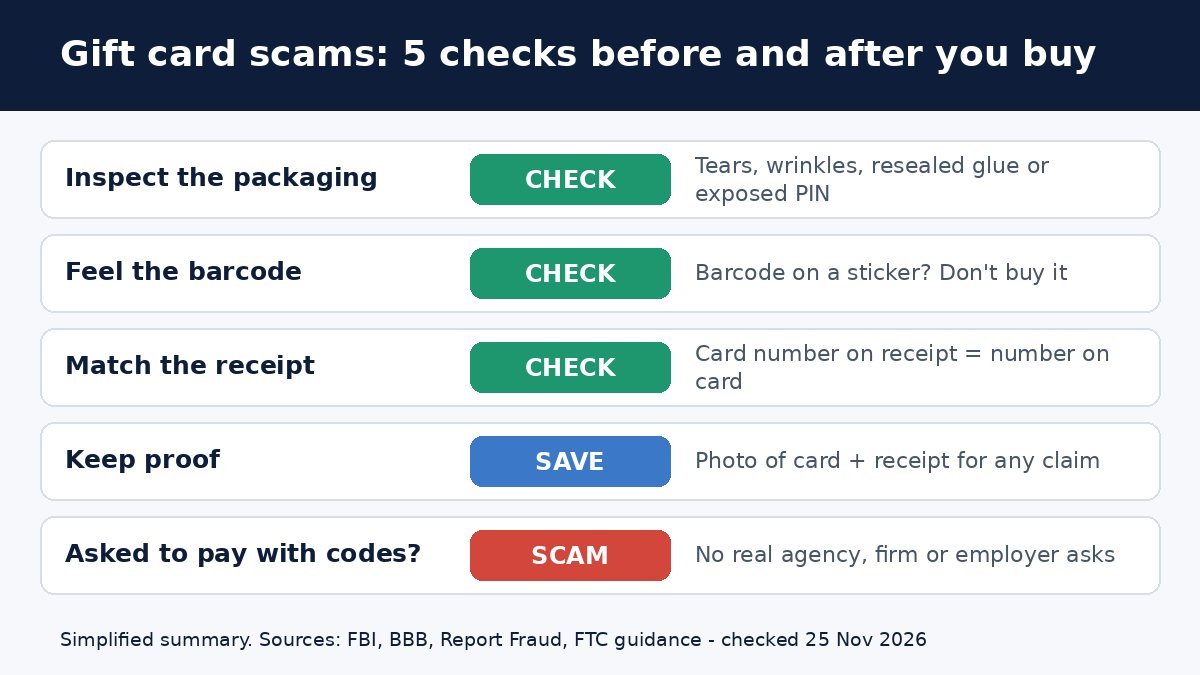
- Inspect the packaging. Walk away from any card with tears, wrinkles, loose glue or an exposed PIN, and hand it to staff.
- Run a finger over the barcode. The FBI says not to buy if the barcode is on a sticker, and to check that the barcode number visible through the window matches the number printed on the packaging.
- Take a card from the back of the rack rather than the front, but inspect it anyway. The FBI notes this is no guarantee.
- Watch the till screen when the card is scanned, and check that the number on your receipt matches the card. One victim quoted by the BBC urged shoppers to do exactly this.
- Keep the receipt and photograph the card. You’ll need both if you have to file a claim.
- Consider a digital card bought directly from the retailer’s own site, and register the card or change the PIN if the issuer allows it.
- Tell your recipient to use the card soon, so any problem shows up while the receipt is still to hand.
What to do if you’ve been hit by a gift card scam
Move fast. Unspent money can sometimes be frozen, but once a scammer has spent the balance it’s usually gone.
In the US
- Contact the card issuer straight away, using the number on the card or the company’s official website, not a number from a search ad or from the scammer. Tell them the card was compromised and ask whether the balance can be frozen. Apple, for example, says to call 800-275-2273 and say “gift cards”.
- Ask for your money back. The FTC-based guidance says some companies will refund you, and that you should report it no matter how long ago it happened.
- Report it at ReportFraud.ftc.gov. Online crime can also be reported to the FBI’s IC3. If you bought the card in a store, tell the store too.
In the UK
- Contact the gift card provider and ask them to block the card. Bromley Trading Standards notes that providers may be able to freeze the funds.
- Call your bank if you paid by card or bank transfer. You can reach it on 159 or the number on the back of your card.
- Report it to Report Fraud (the new name for Action Fraud) online or on 0300 123 2040. In Scotland, call Police Scotland on 101. Forward scam emails to report@phishing.gov.uk.
Gift card scam red flags at a glance
| Red flag | What it usually means | What to do |
|---|---|---|
| Barcode is on a sticker or packaging looks resealed | Card has been tampered with for draining | Don’t buy it; hand it to staff |
| Caller demands payment in gift cards | Impostor scam | Hang up; contact the organisation using its official number |
| “Job” asks you to buy cards and send PINs | Fake job or task scam | Stop contact; never send codes |
| Site asks for card number and PIN to “check balance” | Phishing to drain the card | Use only the issuer’s own site or app |
| Buyer overpays and wants change on a gift card | Fake cheque or payment scam | Decline; wait for real funds to clear |
If you sell over payment apps as well, it’s worth knowing how protection works on PayPal Friends and Family payments. Scammers often pivot from gift cards to app payments that can’t be reversed.
FAQ
Can I get my money back after a gift card scam?
Sometimes. If the balance hasn’t been spent, some issuers can freeze it and refund you. Contact them as soon as possible with the card and receipt. Refunds aren’t guaranteed.
Is it safe to buy gift cards at all?
Most cards are sold without problems. Checking for tampering, keeping the receipt and buying digital cards directly from the retailer all reduce the risk.
Will the IRS, HMRC or a utility company ever take gift cards?
No. Government agencies and utilities don’t accept gift cards as payment. Anyone who demands them is a scammer.
Why do scammers ask for a photo of the back of the card?
The card number and PIN are all they need to spend the balance, even if you still have the physical card.
Disclaimer: This article is general information for US and UK readers, not legal or financial advice. Issuer refund policies vary and can change, so check with your card issuer, bank or the relevant authority for your situation.