

The SALT cap 2026 is $40,400 for single filers, heads of household and married couples filing jointly, and $20,200 if you’re married filing separately. The cap shrinks by 30% of your modified adjusted gross income (MAGI) above $505,000 ($252,500 if married filing separately), but it can’t fall below $10,000 ($5,000 married filing separately). You only benefit if you itemize, and only taxes you actually pay by December 31, 2026 count for this year.
Those figures come straight from the IRS’s correction notice for the 2026 Form 1040-ES and match the limits written into 26 U.S.C. §164(b)(7). With about a month left in the year, here’s what counts toward the cap, how the income phase-down works, and which year-end moves can actually change your 2026 deduction.
SALT cap 2026 at a glance
The cap jumped from $10,000 to $40,000 for 2025 and rose 1% for 2026. The 2025 figures are from the IRS 2025 Instructions for Schedule A.
| Item | Tax year 2025 | Tax year 2026 |
|---|---|---|
| Cap (single, head of household, married filing jointly) | $40,000 | $40,400 |
| Cap (married filing separately) | $20,000 | $20,200 |
| Phase-down starts above MAGI of | $500,000 ($250,000 MFS) | $505,000 ($252,500 MFS) |
| Phase-down rate | 30% of MAGI over the threshold | 30% of MAGI over the threshold |
| Floor (cap never drops below) | $10,000 ($5,000 MFS) | $10,000 ($5,000 MFS) |
One detail surprises a lot of couples: the cap is the same $40,400 whether you file single or jointly. Only married filing separately gets half. Two single homeowners living together can each claim up to $40,400, while a married couple filing jointly shares one $40,400 cap.
What counts toward the SALT deduction
SALT is one combined bucket on Schedule A, lines 5a through 5c. According to IRS Topic No. 503, it can include:
- State and local income taxes, or general sales taxes, but not both. Income taxes include amounts withheld from your paychecks, estimated payments made during the year, and prior-year state tax you paid during the year (for example, a balance due with your 2025 state return paid in April 2026).
- State and local real estate taxes on property you own, if they’re assessed uniformly and used for general public purposes.
- State and local personal property taxes that are based on value, such as the value-based part of some car registration fees.
If your mortgage servicer pays property tax from escrow, IRS Publication 530 says you can deduct only what the lender actually paid to the taxing authority during the year, not what you deposited into escrow. Your annual escrow statement or Form 1098 is the place to check.
How the SALT cap 2026 phase-down works
For SALT purposes, MAGI is your adjusted gross income plus any foreign earned income or U.S. territory income you excluded under sections 911, 931 or 933. For most people it is simply AGI from Form 1040. If that number is above $505,000, the cap drops by 30 cents for every dollar over the line. The IRS worksheet in the Schedule A instructions does the math in three steps: subtract the threshold, multiply the excess by 30%, and subtract the result from the cap, with $10,000 as the minimum.
Illustrative example: a couple filing jointly with 2026 MAGI of $555,000 is $50,000 over the threshold. Thirty percent of $50,000 is $15,000, so their cap becomes $40,400 minus $15,000, or $25,400. Above roughly $606,333 of MAGI, the cap sits at the $10,000 floor no matter how high income goes.
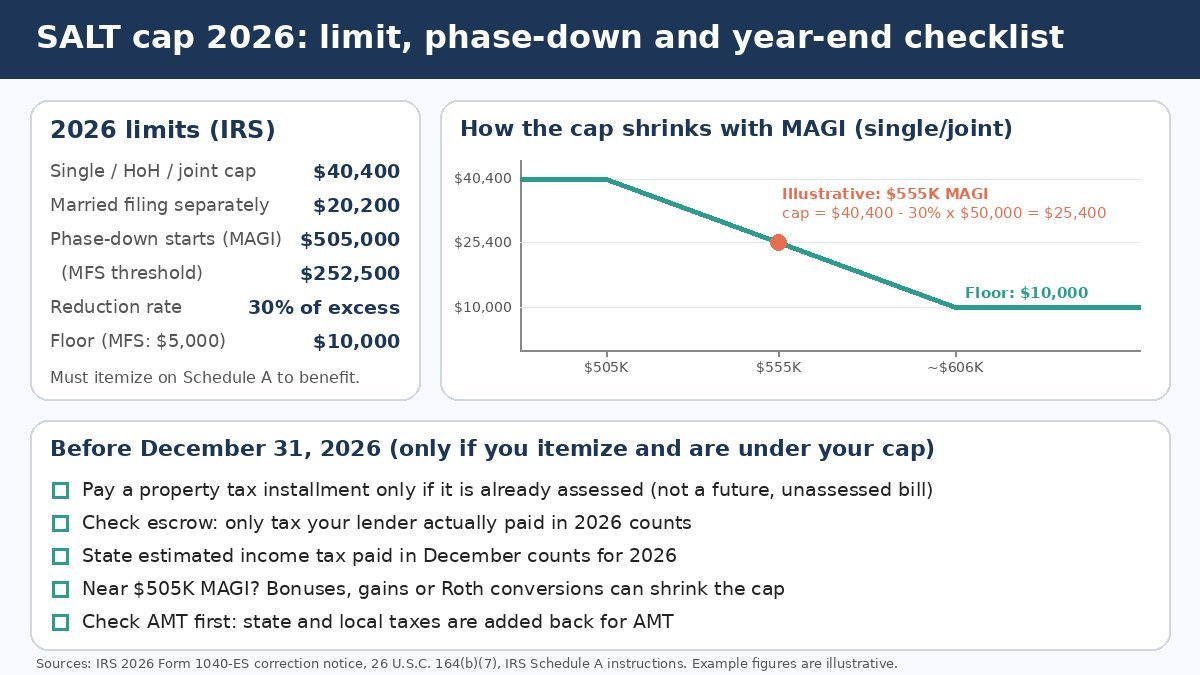
Inside that $505,000 to about $606,333 band, extra income does double duty: it’s taxed itself and it shrinks your SALT deduction by $300 for every additional $1,000, assuming your state and local taxes exceed the reduced cap. CNBC notes this creates an artificially high marginal tax rate for people in that range.
Will the higher cap actually help you?
The SALT deduction only matters if your total itemized deductions beat the standard deduction. For 2026, the IRS set the standard deduction at $16,100 for single filers, $32,200 for married couples filing jointly and $24,150 for heads of household. Add up your allowable SALT (after the cap), mortgage interest, charitable gifts and any deductible medical costs. If the total is below your standard deduction, the bigger cap doesn’t change your tax bill. Our guide to the standard deduction for 2027 shows where that bar moves next year.
If you’re taking the standard deduction, the new break for charitable gifts without itemizing may be more relevant than SALT planning.
Year-end SALT moves to make before December 31, 2026
The deduction follows the year you pay, so December is the last chance to shift deductible taxes into 2026. These moves only help if you itemize and you still have room under your SALT cap 2026 limit. If your state income tax alone already exceeds $40,400, paying more property tax early won’t add anything for 2026.
Pay an already-assessed property tax installment
Under the IRS rule in the Schedule A instructions, property tax counts for a year only if you pay it that year and it has been assessed by the end of that year. State or local law decides when a tax is assessed. The IRS explained this in its 2017 advisory on prepaid property taxes: paying a later installment of an assessed bill early can be deductible, but prepaying a future year’s tax that hasn’t been assessed yet is not. Check your bill or your county’s website before writing the check, and make sure your servicer isn’t also paying the same installment from escrow.
Make your last state estimated payment in December
State estimated income tax payments are deductible in the year you make them, per Topic No. 503. If you’re self-employed or have investment income and owe a final 2026 state estimate, paying it by December 31 instead of in January moves that deduction into 2026. Pay only what you reasonably expect to owe; a large state overpayment can come back as a refund that may be taxable on next year’s federal return.
Watch income that pushes MAGI past $505,000
If you’re close to the phase-down, timing matters. A large bonus, capital gain or Roth conversion can shrink your SALT deduction on top of the tax on the income itself. If you’re weighing a conversion, our article on the Roth conversion deadline covers the December 31 cutoff. If you’re 70½ or older, a qualified charitable distribution sent straight from your IRA isn’t included in income, which can help keep AGI lower.
Run the alternative minimum tax check
State and local taxes are added back when you figure the alternative minimum tax. The Form 6251 instructions start line 2a with all taxes from Schedule A. For 2026, the IRS says the AMT exemption begins phasing out at $500,000 for unmarried filers and $1,000,000 for joint filers. If you could owe AMT, prepaying SALT may save less than you expect, so model it in tax software or with a preparer first.
What happens to the SALT cap after 2026
Under §164(b)(7), the cap and the $505,000 threshold each rise to 101% of the prior year’s amount for 2027, 2028 and 2029. For 2030 and later, the cap goes back to a flat $10,000. That makes the current window temporary, which is one reason to check each year whether itemizing still makes sense rather than assuming last year’s answer holds.
FAQ
Is the SALT cap 2026 different for married filing jointly?
No. It’s $40,400 for single, head of household and married filing jointly. Only married filing separately is halved, to $20,200.
Can I deduct both state income tax and sales tax?
No. You choose one or the other each year on Schedule A line 5a, then add real estate and personal property taxes.
Can I prepay my 2027 property taxes in December 2026?
Only if the tax has already been assessed by December 31, 2026 and you pay it by then. Prepaying an unassessed future bill isn’t deductible for 2026.
Does the SALT deduction lower my MAGI for the phase-down?
No. It’s an itemized deduction taken after AGI, so it doesn’t reduce the MAGI used to calculate the phase-down.
This article is general information, not tax or financial advice. Figures were checked against IRS publications and the U.S. Code on 28 November 2026. Your situation may differ, so confirm with IRS.gov or a qualified tax professional before making year-end payments.