
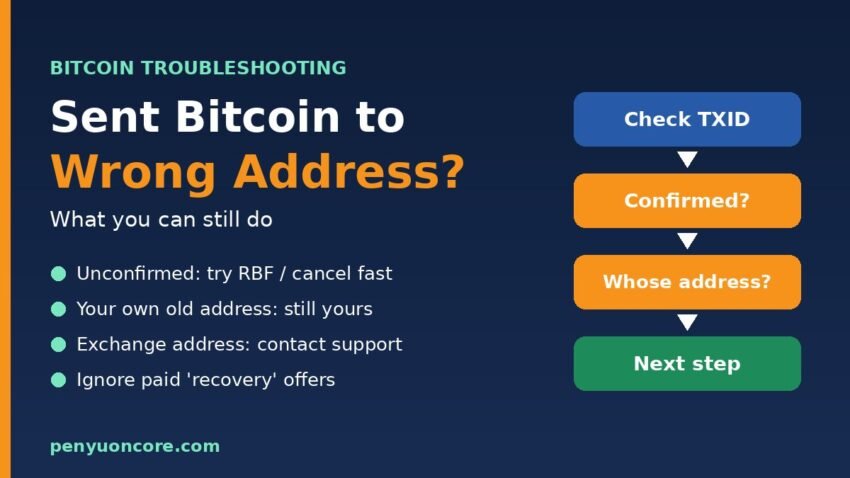
Sent Bitcoin to wrong address by mistake? What happens next depends on three things: whether the transaction has confirmed, who controls the receiving address, and which network it went over. Once a Bitcoin payment confirms, nobody can reverse it, but you may still get the coins back if the address turns out to be yours, belongs to an exchange, or belongs to someone who agrees to return them.
Here’s a calm, step-by-step way to work out which situation you’re in, what you can realistically do, and how to avoid the “recovery” scammers who target people in this position.
Sent Bitcoin to wrong address: the short answer
Bitcoin has no chargeback button and no central support desk. The Bitcoin.org FAQ says confirmed transactions are irreversible and “can only be refunded by the person receiving the funds.” If the address is valid but nobody controls it, the coins are permanently inaccessible. Coinbase says the same thing in its wrong-address help page: you need the receiving party to cooperate, and if you don’t know who owns the address, there’s nothing anyone can do.
That sounds bleak, but plenty of “wrong address” panics end well, because the address was the sender’s own or belonged to a platform that could help. So check the following before you assume the worst.
Step 1: Check the transaction status first
Copy the transaction ID (TXID) from your wallet or exchange history and paste it into a public block explorer such as mempool.space. You’ll see whether the payment is still unconfirmed or already in a block, along with the exact receiving address and amount.
If it’s still unconfirmed
An unconfirmed transaction can sometimes be replaced. Since Bitcoin Core 28.0 (October 2024), nodes running the default settings accept replace-by-fee (RBF) replacements even when the original transaction didn’t signal RBF. If your wallet offers a “cancel” or “bump fee” option that sends the same coins back to an address you control with a higher fee, using it quickly gives you a chance. It’s not guaranteed: a miner can still confirm the original first, and many custodial apps and exchanges don’t offer the option. For more on stuck and replaced payments, see our guides to a Bitcoin transaction dropped from the mempool and child pays for parent (CPFP).
If it’s already confirmed
Then the transaction itself can’t be undone. Your options now depend entirely on who controls the address the coins went to.
Step 2: Work out who controls the address
It might be your own address
This is more common than people think. Most wallets generate a fresh receive address for every payment, and the Bitcoin.org FAQ notes that funds sent to older addresses “are still yours.” Open each wallet you own, go to Receive, and check its address list or history against the receiving address character by character. If it matches, your coins are safe; they just landed in a different wallet or account than you expected. If a wallet you restored shows nothing, our guide to a restored Bitcoin wallet showing a zero balance covers derivation paths and address types.
It belongs to an exchange or service
If you pasted the wrong deposit address, or an old one for an exchange account, contact that platform’s support with the TXID, the amount, the receiving address and proof that you sent it. Policies vary and recovery isn’t promised, but a regulated business can at least check whether the address is theirs.
It belongs to a person you know
If you copied the address from an old chat, invoice or contact, the owner may simply send it back. Ask politely and give them a fresh address from your own wallet.
Nobody you can identify
If the address came from nowhere you recognise, or it doesn’t match anything you copied, the funds are almost certainly gone. A block explorer shows the address’s history, but not who owns it.
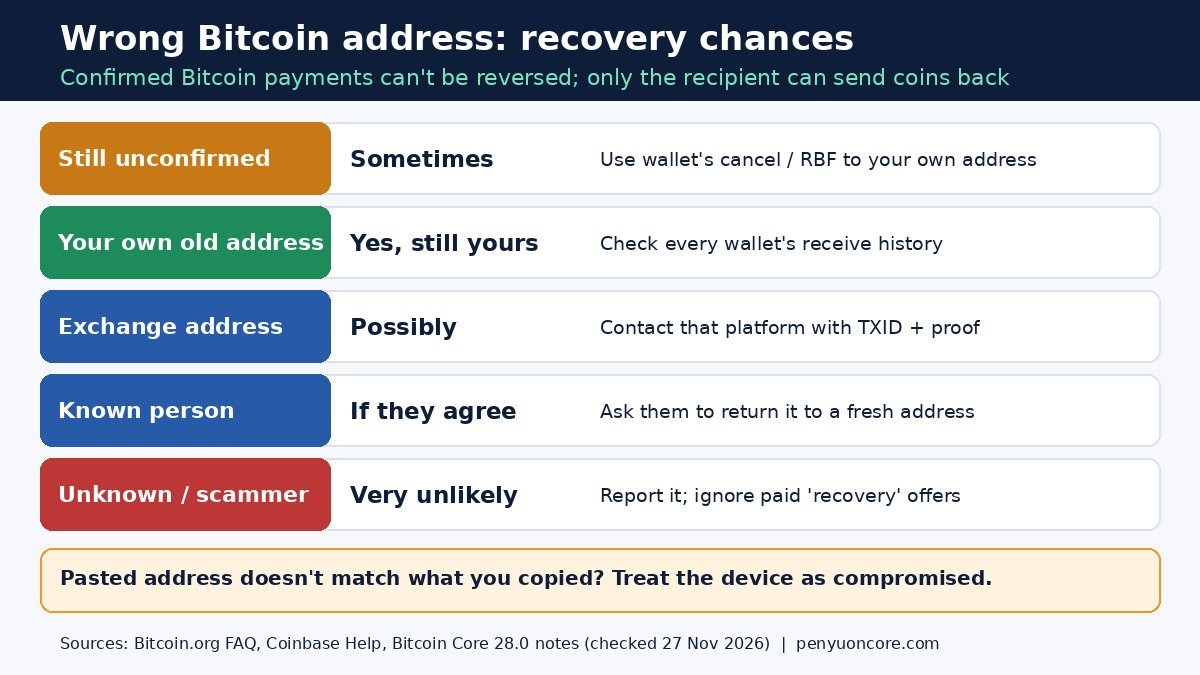
Recovery chances by scenario
| Situation | Can you get it back? | What to do |
|---|---|---|
| Still unconfirmed | Sometimes | Try your wallet’s cancel or RBF option at once, redirecting to your own address. |
| Sent to your own old address | Yes, it’s still yours | Find the wallet that generated it and check its history. |
| Sent to an exchange address | Possibly | Contact that platform’s support with the TXID and proof of sending. |
| Sent to a known person | If they agree | Ask them to return it to a fresh address you control. |
| Unknown owner or scammer | Very unlikely | Report it, secure your devices, and ignore “recovery” offers. |
Sent on the wrong network or to an unsupported deposit
A normal Bitcoin wallet won’t accept an address in a different blockchain’s format. Problems usually start on exchanges that let you withdraw “BTC” over more than one network. Coinbase’s multi-network guide says the sender and recipient must use the same network, and that it “cannot recover funds that are lost from being sent or received using an incorrect network.”
There is one narrow exception. If you sent an unsupported asset to a Coinbase address, Coinbase’s asset recovery service can return certain eligible assets on eligible networks to a self-custody wallet. You’ll pay a 5% fee on the amount over $100, plus network fees. Ineligible assets can’t be recovered. Other exchanges have their own policies, so check the receiving platform’s help centre directly rather than trusting a third party.
Find out how it happened
Typos are rarely the cause. Modern bc1 addresses use the Bech32 format, and BIP 173 says its checksum guarantees detection of any error affecting up to four characters, so wallets usually reject a mistyped address. The more likely causes are pasting from the wrong place, scanning the wrong QR code, or malware.
Clipboard-hijacking “clipper” malware is a real, current threat. In June 2026, Microsoft reported a Windows clipper that had been infecting devices since February 2026. It replaced copied wallet addresses with attacker-controlled ones and also hunted for seed phrases and private keys. If the address you pasted isn’t the one you copied, treat that device as compromised. Stop using it for crypto, scan it or reinstall it, and consider moving your remaining coins to a new wallet created on a clean device.
Beware of “crypto recovery” services
People who post about a lost transfer are quickly approached by “recovery experts.” The CFTC describes recovery scams as advance-fee fraud aimed at people who have already lost money. The FBI has warned about fake law firms and people impersonating IC3 staff who promise to get crypto back. IC3 says it will never ask for payment to recover funds. Never pay upfront, and never share your seed phrase.
If you were tricked into sending the Bitcoin, report it. In the US, use ic3.gov. In England, Wales and Northern Ireland, Report Fraud replaced Action Fraud on 4 December 2025 (reportfraud.police.uk or 0300 123 2040). In Scotland, call Police Scotland on 101. We cover a related trap in our Bitcoin ATM scam guide.
How to avoid sending to the wrong address next time
- Check the whole address. Bitcoin.org specifically warns against checking only the first and last characters.
- Send a small test first for large or first-time transfers, as both Bitcoin.org and Coinbase recommend.
- Use saved contacts or exchange allowlists for addresses you send to regularly.
- Confirm on a hardware wallet screen if you use one, since that display is separate from your computer’s clipboard.
- Match the network on both the sending and receiving side before you hit send.
FAQ
Can a Bitcoin transaction be reversed?
Not once it confirms. Only the recipient can send the coins back. Before confirmation, your wallet’s RBF or cancel option may let you replace it, but that isn’t guaranteed.
What happens if I send Bitcoin to an old address of mine?
Nothing is lost. Older addresses from your wallet stay valid, so the coins appear in whichever wallet generated that address.
Can Bitcoin “support” or miners return my coins?
No. Bitcoin has no company that controls payments, and miners can’t move coins they don’t hold the keys for. Anyone claiming otherwise is likely running a scam.
Can I find out who owns the address?
A block explorer shows the address’s transactions, but usually not its owner. Your best lead is wherever you copied the address from.
Disclaimer: This article is for general information only and isn’t financial, legal or tax advice. Exchange policies change, so check your platform’s current help pages and get professional advice for your situation.