
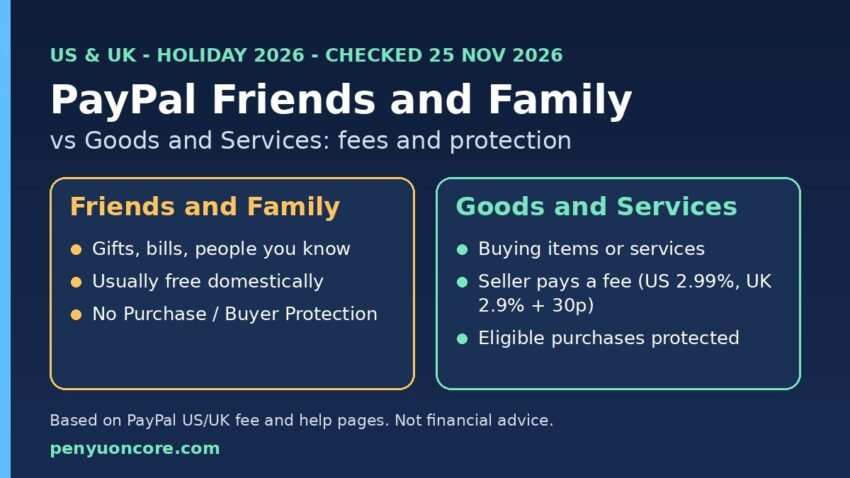
PayPal friends and family payments are for personal money, such as gifts, splitting a bill or paying a relative back. They’re usually free domestically, but they aren’t covered by PayPal’s Purchase Protection (US) or Buyer Protection (UK). If you’re buying something, especially from someone you don’t know, use Goods and Services instead. The seller pays a small fee, and eligible purchases can be protected if the item never arrives or isn’t as described.
That choice matters more than usual this week, with people sending holiday gift money, selling items for extra cash and buying Black Friday deals from strangers. Below, we compare fees, protection and tax reporting in the US and UK. All details were checked against PayPal, IRS and UK police sources on 25 November 2026.
PayPal friends and family vs goods and services: the quick answer
When you send money, PayPal asks you to pick a payment type. On its help page on the two payment types, PayPal calls them “Sending to a friend” (a personal payment) and “Paying for an item or service” (a purchase). In the app, the same choice appears as Friends and Family or Goods and Services.
| Question | Friends and Family | Goods and Services |
|---|---|---|
| What it’s for | Gifts, splitting bills, shared living costs, paying back people you know | Buying items or paying for a service, including from individuals |
| Who pays a fee (domestic) | Usually nobody. In the US, the sender pays a fee if the payment is funded by a card | The seller (recipient) |
| Purchase/Buyer Protection | No | Yes, for eligible purchases |
| Counts toward US Form 1099-K | No | Yes, if the reporting threshold is met |
| Can the type be changed later? | No | No (but PayPal may refund the fee if a payment was tagged by mistake) |
The rule: choose the type that matches what’s actually happening.
PayPal fees for each payment type (US and UK)
United States
According to PayPal’s US consumer fees page, sending a domestic personal payment is free from your PayPal balance or a bank account. If you pay with a debit or credit card, the fee is 2.90% plus a fixed fee, and PayPal’s send money page puts that fixed fee at $0.30. Receiving a personal payment is free when no currency conversion is involved. Sending abroad adds an international fee of 5% (minimum $0.99, maximum $4.99).
For Goods and Services, the buyer pays nothing in the same currency. The seller pays to receive the money. PayPal’s US merchant fees page lists 2.99% for “Send/Receive Money for Goods and Services”. PayPal Checkout on a website is priced differently, at 3.49% plus a fixed fee.
United Kingdom
PayPal’s UK consumer fees page shows no fee for sending or receiving domestic personal payments when no currency conversion is involved. Sending a personal payment abroad costs 5% (minimum £0.99, maximum £2.99). For sales, the UK merchant fees page puts most commercial transactions at 2.9% plus a fixed fee, which PayPal’s UK pricing page shows as £0.30.
| Payment | US | UK |
|---|---|---|
| Friends and Family, from balance or bank | Free | Free |
| Friends and Family, funded by card | 2.90% + $0.30 (sender pays) | No domestic fee listed |
| Goods and Services (seller pays) | 2.99% | 2.9% + £0.30 |
| Personal payment sent abroad | +5% (min $0.99, max $4.99) | 5% (min £0.99, max £2.99) |
Fees change, so check the current pages before selling anything big. Currency conversion costs are extra.
Why the label decides your protection
US: Purchase Protection
PayPal’s Purchase Protection program can cover the full purchase price plus original shipping when an item doesn’t arrive (“Item Not Received”) or is “Significantly Not as Described”. Examples include a completely different item, a counterfeit or an undisclosed defect. PayPal decides whether each claim is eligible, and you may have to return the item. Personal payments are not covered. If you pay a stranger for concert tickets or a console as Friends and Family, there’s no claim to open if they disappear.
UK: Buyer Protection and the APP fraud rules
In the UK, PayPal’s equivalent is Buyer Protection, and it doesn’t cover personal payments either. Some people assume the UK’s 2024 authorised push payment (APP) fraud reimbursement rules will rescue them. PayPal’s APP fraud help page explains that those rules cover Faster Payments and CHAPS, up to £85,000 per claim. They don’t cover payments from one PayPal account to another. If you send a friends and family payment to a scammer, PayPal says you’re not entitled to a refund under the APP rules or under Buyer Protection.
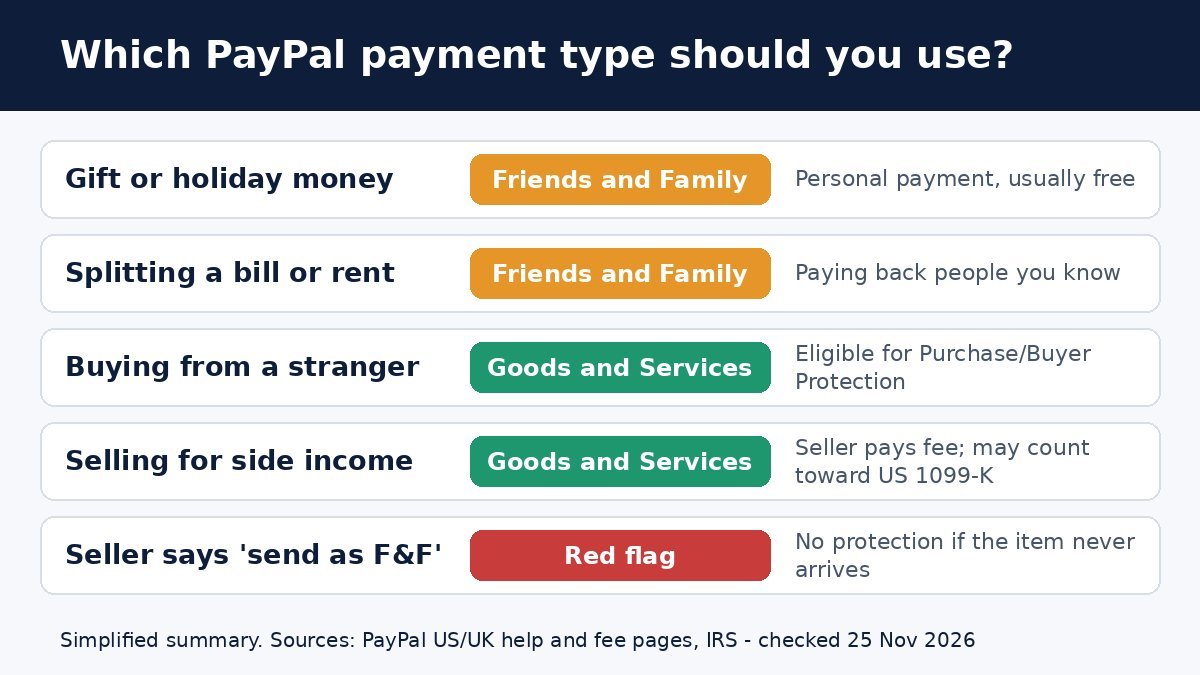
The holiday timing makes this important. On 23 November 2026, the UK’s Report Fraud service said it received more than 14,000 online shopping fraud reports between 1 November 2025 and 31 January 2026, with £18.3 million lost. That’s an average of £1,278 per victim who reported. In the US, a Washington Post holiday scams guide cites a 2025 Pew Research Center survey in which more than a third of US adults said they had bought something online that never arrived or turned out to be fake, and weren’t refunded.
Selling for side income? Take Goods and Services
If you’re clearing out the closet or selling crafts before Christmas, a buyer may offer to pay as friends and family “to save you the fee”. It can look like a good deal, but there are three reasons to say no:
- Seller Protection. PayPal says eligible Goods and Services payments include protection that can cover sellers against unauthorized-transaction and item-not-received claims. Personal payments don’t get that cover. Ship with tracking either way. Our guide to Facebook Marketplace scams for sellers covers the tricks fake buyers use.
- Business accounts can’t take it. Since July 28, 2022, US Business accounts can no longer receive friends and family payments from US senders. PayPal says the change was made partly to protect purchases and help businesses track commercial income.
- Holds are not a reason to switch. New sellers often see Goods and Services money held for a while. Our explainer on PayPal holding funds shows how to get it released properly.
What about taxes and Form 1099-K?
The IRS says payment apps must issue Form 1099-K when goods-and-services payments total over $20,000 in more than 200 transactions in a year. Gifts and repaid personal expenses from friends and family shouldn’t be reported on a 1099-K, and they aren’t taxable income. The IRS also says you must report income from selling goods or services whether or not you get a form. PayPal’s 1099-K help page adds lower state thresholds: $600 for Maryland, Massachusetts, Vermont and Virginia, and over $1,000 with four or more transactions for Illinois. It also warns that a payment is reportable whenever the sender tags it as goods and services, even by mistake. So ask friends to tag gifts correctly. For marketplace sellers, our eBay 1099-K threshold guide walks through the same rules.
Red flags: when someone insists on friends and family
Real friends sending real gifts are fine. Be careful when a purchase is dressed up as a personal payment:
- A seller you’ve never met asks for friends and family “to avoid fees” or because “goods and services is broken”.
- The price is far below market for a sought-after item, such as tickets, consoles or designer goods, and there’s pressure to pay fast.
- The seller won’t meet, won’t use a marketplace’s own checkout, or moves the chat off the platform.
- Someone “accidentally” sends you money and asks for it back by friends and family. Our Venmo Purchase Protection guide explains the same cover gap on Venmo.
If any of these happen, use Goods and Services, a marketplace’s protected checkout, or a credit card. Otherwise, walk away.
Sent the wrong payment type? What you can do
- Tagged a personal payment as goods and services: PayPal says it can’t recategorize the payment, but contact PayPal support. It may be able to return the fee for payments tagged in error.
- Paid a seller as friends and family and the item never came: report the account to PayPal straight away and keep every message and receipt. Recovery isn’t guaranteed, because personal payments fall outside Purchase and Buyer Protection.
- Report the scam: in the US, file at ReportFraud.ftc.gov. In England, Wales and Northern Ireland, use Report Fraud (0300 123 2040). In Scotland, call Police Scotland on 101.
FAQ
Is PayPal friends and family free?
Domestically, it’s free from your PayPal balance or bank account in the US and free in the UK when no currency conversion is involved. In the US, paying by card costs 2.90% + $0.30. International payments cost extra.
Can I get a refund on a PayPal friends and family payment?
Not through Purchase Protection (US) or Buyer Protection (UK), because personal payments aren’t covered. A separate claim may be possible if someone used your account without permission.
Who pays the goods and services fee?
The seller. The buyer normally pays nothing unless a currency conversion applies.
Is it safe to use friends and family with strangers?
It’s risky. Without purchase protection, you have little recourse if the item never arrives. Use Goods and Services for any purchase.
Is money received through friends and family taxable?
In the US, the IRS says genuine gifts and repaid personal expenses aren’t taxable income and shouldn’t appear on a 1099-K. Money from selling goods or services is still reportable, however it was sent.
This article is general information, not financial, legal or tax advice. PayPal fees and policies vary by country and can change. Check PayPal’s current terms, the IRS or HMRC, or a qualified adviser for your situation. Sources checked 25 November 2026.