
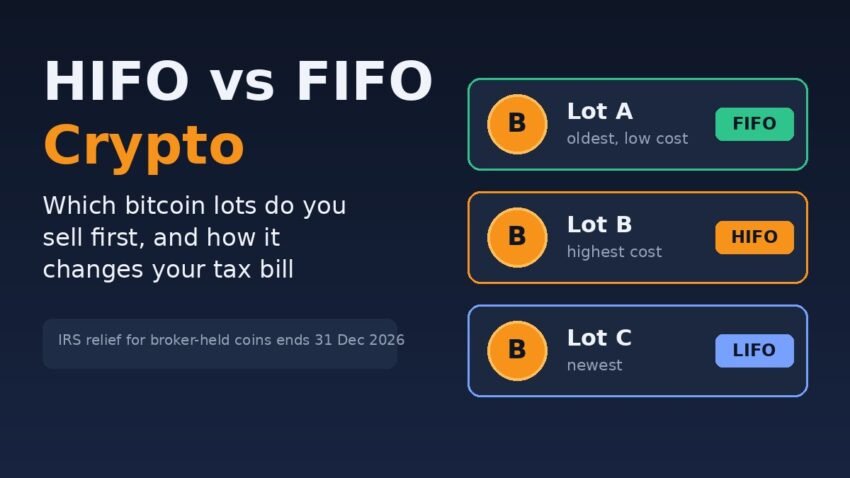
HIFO vs FIFO crypto is a choice about which coins the IRS treats as sold when you sell only part of your bitcoin. FIFO (first in, first out) sells your oldest coins first and is the default if you don’t identify anything; HIFO (highest in, first out) sells your most expensive coins first, which usually means a smaller taxable gain or a bigger loss. HIFO is only allowed if you make a valid specific identification, and the easier way to do that for coins held on an exchange runs out on 31 December 2026.
With bitcoin down about 24% in November and trading below $60,000 this week, according to Investing.com and CoinDesk, plenty of US holders are thinking about selling before year-end. Which lots you sell can matter as much as how much you sell. The rules below come from IRS guidance checked on 26 November 2026.
HIFO vs FIFO crypto: the short version
- FIFO treats the earliest coins you bought as sold first. The IRS says that if you don’t identify specific units, they are treated as sold “on a first in, first out (FIFO) basis.”
- HIFO isn’t a separate IRS method. It’s a way of using specific identification: you pick the units with the highest cost basis. IRS Notice 2026-20 lists “the highest basis” alongside “the earliest acquired” and “the latest acquired” as examples of ways to specifically identify units.
- LIFO (last in, first out) works the same way: it’s specific identification of your newest units.
In a falling market, your oldest coins often have the lowest cost, so FIFO can produce a taxable gain even when your recent purchases are underwater. HIFO picks the expensive lots first, so it tends to shrink the gain or create a loss.
How the choice changes your tax bill: a worked example
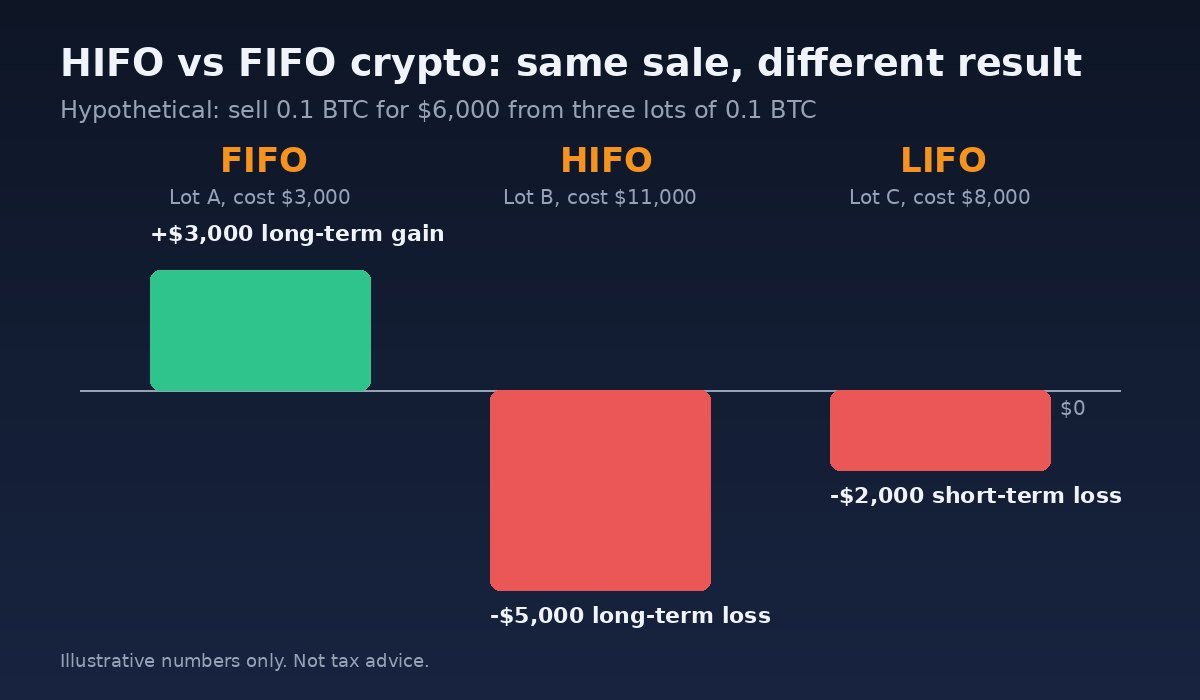
The numbers below are hypothetical, chosen only to show how the methods work. Say you hold 0.3 BTC bought in three equal lots, and you sell 0.1 BTC for $6,000 (a price of $60,000 per BTC).
| Lot | Bought | Cost basis (0.1 BTC) | Result if this lot is sold for $6,000 |
|---|---|---|---|
| Lot A (oldest) | More than a year ago | $3,000 | $3,000 long-term gain (FIFO picks this) |
| Lot B | More than a year ago | $11,000 | $5,000 long-term loss (HIFO picks this) |
| Lot C (newest) | Four months ago | $8,000 | $2,000 short-term loss (LIFO picks this) |
Same sale, same price, three very different results: a $3,000 gain, a $5,000 loss or a $2,000 loss. Under IRS Topic 409, assets held for more than one year produce long-term gains or losses, and if your capital losses exceed your gains you can deduct up to $3,000 a year ($1,500 if married filing separately) against other income and carry the rest forward.
HIFO isn’t automatically the best choice
HIFO lowers this year’s tax, but the cheap coins you keep still carry a low basis, so the gain is pushed into a future sale rather than erased. It can also be worth comparing holding periods: net short-term gains are taxed at ordinary income rates, according to Topic 409, so a “highest basis” lot isn’t always the best lot. Some people choose lots one sale at a time rather than sticking to one rule. If you have large gains elsewhere, carried-forward losses or a big sale planned, run the numbers with a tax professional.
What the IRS requires before you can use HIFO
You can’t decide at tax time that you “used HIFO.” The identification has to happen no later than the date and time of the sale. The rules depend on where your coins are held.
Coins on an exchange or other custodial broker
Under the final regulations at 26 CFR 1.1012-1(j), you normally make the identification by telling your broker which units to sell, or by giving it a standing order (for example, “highest basis first”). If you don’t, units in that broker account are treated as sold FIFO. Notice 2025-7 explains that if a broker offers only one specific identification method, that method is treated as your standing order.
Because many exchanges weren’t ready to accept those instructions, the IRS granted temporary relief. Notice 2026-20 extended it through 31 December 2026. During that period you can instead:
- record in your own books and records, no later than the date and time of the sale, the particular units being sold (by purchase date and time or purchase price, for example), or
- record a standing order in your own records, such as “sell highest-basis units first”, before the sales it covers.
The notice says the relief can’t be relied on for sales made after the relief period ends. Unless the IRS extends it again, sales from 1 January 2027 will need the identification communicated to the broker under the main rule, or FIFO applies. Check now whether your exchange lets you set a cost basis method in its settings.
Coins in your own wallet
For coins not held by a broker, such as in a hardware or other unhosted wallet, the regulation says you make a specific identification on your books and records, no later than the date and time of the sale, and only if you keep adequate records showing the unit left the wallet. Otherwise the earliest-acquired units are treated as sold first. The relief in Notice 2026-20 doesn’t apply to self-custodied coins, but the main rule already lets you identify units in your own records.
The IRS FAQ (A40) says your records should show when each unit was acquired, your basis and its fair market value at that time, when it was sold, and what you received for it. If you move coins between your own wallets, keep that history intact. Our guide to consolidating bitcoin UTXOs covers the on-chain side of moving coins around.
Basis is tracked wallet by wallet
Since 1 January 2025, the ordering rules apply to all acquisitions and disposals of digital assets, and basis is tracked wallet by wallet or account by account rather than across all your holdings. Rev. Proc. 2024-28 provided a safe harbor for moving to that system. In practice, you can only pick HIFO lots from the coins actually in the wallet or account you’re selling from.
Why your Form 1099-DA may not match your HIFO choice
The 2026 Form 1099-DA instructions define a covered security as a digital asset acquired after 2025 and held in the same custodial account until the broker sells it. Brokers report cost basis for those. Notice 2026-20 warns that, for 2026 transactions, the acquisition date and basis on the broker’s form “may not match” the lots identified in your own records. If you made a valid identification in your records, the units you identified are the ones that count for federal tax purposes.
So if you use HIFO through your own records this year, expect to report your figures on Form 8949 and keep the evidence. If your form shows no basis at all, see what to do when a 1099-DA is missing cost basis.
Year-end checklist before you sell
- List every lot in the wallet or account you’ll sell from: date, amount, cost and fees.
- Decide which lots to sell and write it down, with a timestamp, before placing the order. A standing order counts if it’s recorded before the sale.
- Check your exchange’s settings for a cost basis method, and plan for 2027 when the record-keeping relief is due to end.
- Consider short-term vs long-term treatment, not only the highest basis.
- If you plan to buy back after selling at a loss, read our explainer on the bitcoin wash sale rule and the pending bill that could change it.
UK readers: no HIFO or FIFO choice
In the UK, HMRC’s Cryptoassets Manual (CRYPTO22200) says tokens of the same type normally go into a “section 104 pool” with a single pooled allowable cost. Same-day and 30-day matching rules apply first. You can’t pick high-cost lots, so HIFO planning doesn’t apply.
FAQ
Is HIFO allowed by the IRS for crypto?
Yes, as a form of specific identification. IRS FAQ A39 says you may choose which units are sold if you can specifically identify them and substantiate their basis. Notice 2026-20 gives “the highest basis” as an example.
What happens if I don’t choose a method?
Units are treated as sold first in, first out, both for coins with a broker and for coins in your own wallet.
Can I use HIFO on coins I already sold?
No. The identification has to be made no later than the date and time of the sale. You can’t go back and relabel a sale at tax time.
Does the 31 December 2026 deadline mean I must sell by then?
No. It’s when the temporary relief for recording identifications in your own books (for coins held with a broker) is due to end. After that, you’d generally need to give the instruction to the broker.
Disclaimer: This article is general information, not financial, tax or investment advice. Crypto prices are volatile and tax rules can change. Speak to a qualified tax professional about your own situation.