
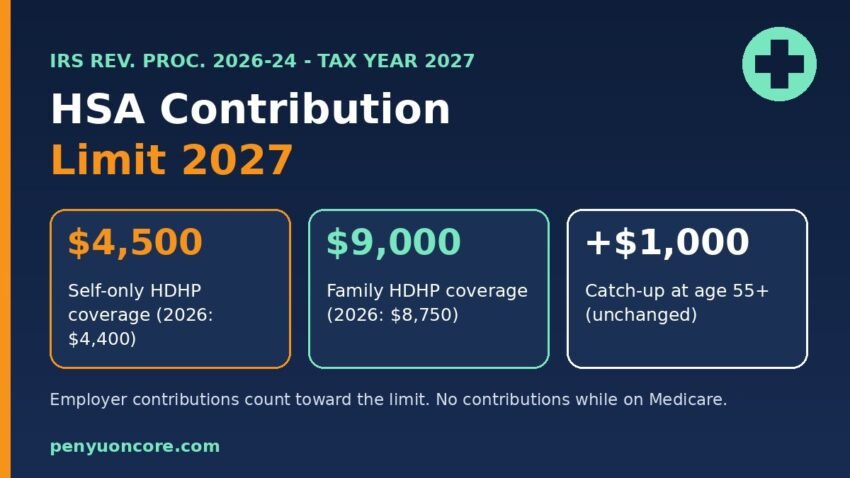
The HSA contribution limit 2027 is $4,500 for self-only coverage and $9,000 for family coverage, up from $4,400 and $8,750 in 2026, according to IRS Revenue Procedure 2026-24. If you are 55 or older, you can add another $1,000. With workplace open enrollment wrapping up and the HealthCare.gov deadline for January 1 coverage on December 15, now is when most people lock in next year’s HSA payroll election.
Quick answer: For 2027 you can put up to $4,500 into a health savings account with self-only high-deductible coverage, or $9,000 with family coverage, plus a $1,000 catch-up at age 55+. Employer contributions count toward those caps, and you can’t contribute at all for any month you are enrolled in Medicare.
HSA contribution limit 2027 vs 2026 at a glance
The IRS released the 2027 HSA figures early, on May 29, 2026, as benefits consultancy NFP noted. The self-only limit rises by $100 and the family limit by $250. The catch-up amount stays at $1,000 because it is a fixed amount in the tax code and is not adjusted for inflation. The 2026 comparison figures below come from IRS Publication 969 and a Groom Law Group summary of the IRS releases.
| Item | 2026 | 2027 |
|---|---|---|
| HSA limit, self-only coverage | $4,400 | $4,500 |
| HSA limit, family coverage | $8,750 | $9,000 |
| Catch-up contribution (age 55+) | $1,000 | $1,000 |
| HDHP minimum deductible (self-only / family) | $1,700 / $3,400 | $1,750 / $3,500 |
| HDHP out-of-pocket maximum (self-only / family) | $8,500 / $17,000 | $8,700 / $17,400 |
“Family coverage” means any HDHP coverage other than self-only, so self-plus-spouse and self-plus-children tiers also get the $9,000 limit. The out-of-pocket maximum counts deductibles, copays and coinsurance but not premiums.
Who can contribute to an HSA in 2027
The dollar limit only matters if you are an “eligible individual.” Under Publication 969, for any given month you must:
- Be covered by an HSA-qualified high-deductible health plan (HDHP) on the first day of the month.
- Have no other disqualifying health coverage. A general-purpose health FSA or HRA usually counts, but a limited-purpose (dental/vision) FSA does not.
- Not be enrolled in Medicare.
- Not be claimable as a dependent on someone else’s tax return.
If you are weighing an HSA against a flexible spending account at work, our HSA vs FSA guide explains how the two interact, and the FSA limit 2027 article covers the new $3,500 health FSA cap.
New: bronze, catastrophic and direct primary care plans
The 2025 tax law (the One, Big, Beautiful Bill Act) widened who qualifies. According to the IRS (IR-2025-119) and Notice 2026-05:
- Bronze and catastrophic plans available as individual coverage through an Exchange are treated as HSA-compatible from January 1, 2026, even if they don’t meet the usual HDHP deductible rules. The IRS says the plan does not have to be bought through the Exchange to qualify.
- Direct primary care (DPC) arrangements no longer disqualify you, as long as total monthly fees don’t exceed a cap. For 2027 the cap stays at $150 a month for one person or $300 if the arrangement covers more than one person, per Rev. Proc. 2026-24. You can also pay those DPC fees from your HSA tax-free.
- Telehealth before you meet your deductible is now permanently allowed without losing HSA eligibility.
If you are shopping on HealthCare.gov, open enrollment runs to January 15, but you must pick a plan by December 15 for coverage that starts January 1.
How the 2027 HSA limit works in real life
Employer contributions count toward the cap
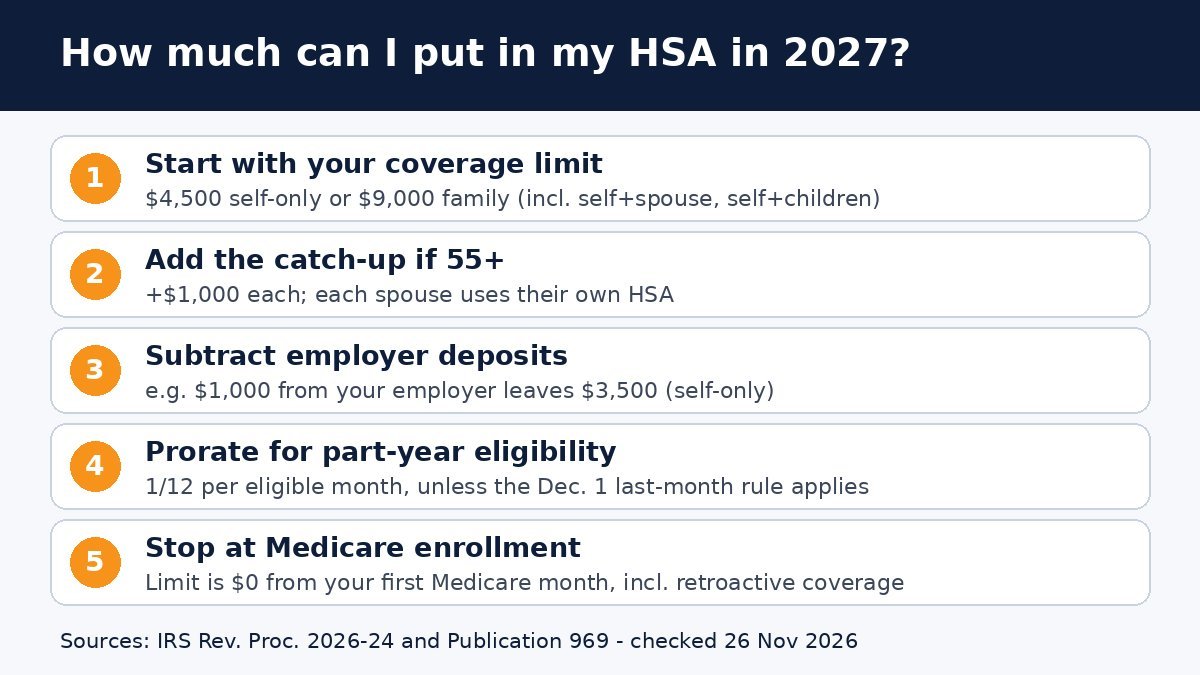
Publication 969 says you must reduce what you (or anyone else) can contribute by any excludable contributions your employer makes, including money that goes in through a cafeteria plan. If your employer deposits $1,000 into your account and you have self-only coverage, your own 2027 payroll election should top out at $3,500, not $4,500.
The age-55 catch-up
Once you reach 55 and are not on Medicare, your limit rises by $1,000, to $5,500 for self-only or $10,000 for family coverage in 2027. For married couples, each spouse must put their own catch-up into their own HSA. There’s no such thing as a joint HSA.
Rules for married couples
If either spouse has family HDHP coverage, the IRS treats both as having family coverage. The couple then shares one family limit ($9,000 for 2027), split equally unless you agree on a different division. Catch-ups are added on top for each spouse who qualifies.
Part-year eligibility and the last-month rule
If you are only eligible for part of the year, your limit is generally prorated by month (one-twelfth of the annual limit for each eligible month). There is an exception. Under the last-month rule, if you are eligible on December 1, you can contribute the full annual amount. The catch is that you must then stay eligible through a testing period that runs until December 31 of the following year. If you don’t, Publication 969 says the extra contributions are added to your income and hit with a 10% additional tax (death and disability are exceptions).
Turning 65 and Medicare
Your contribution limit becomes zero starting with the first month you are enrolled in Medicare. The IRS warns that this also applies to retroactive Medicare coverage. If your enrollment is backdated, HSA contributions made during the backdated months become excess contributions. Anyone close to 65 should plan contributions carefully. Our Medicare Part B premium 2027 guide covers the other costs that start at that point.
Deadlines and penalties to know
- Contribution deadline: HSA contributions for a tax year can generally be made up to that year’s federal filing deadline the following April. Pub. 969 gives the example that 2025 contributions could be made through April 15, 2026. If your employer makes a prior-year contribution in that window, it must tell you and your HSA trustee which year it applies to.
- Excess contributions: Amounts over the limit generally face a 6% excise tax for every year they stay in the account. You can avoid it by withdrawing the excess plus any earnings by your tax-return due date, including extensions.
- Non-medical withdrawals: Money you don’t spend on qualified medical expenses is taxable and generally hit with an extra 20% tax. The 20% does not apply after you reach 65, become disabled or die.
Is maxing out your HSA worth it?
An HSA comes with what advisors call a “triple tax advantage”: contributions go in pre-tax or are deductible, growth isn’t taxed while the money stays in the account, and withdrawals for qualified medical costs are tax-free. As CNBC reported on Nov. 5, 2026, payroll contributions through an employer’s Section 125 cafeteria plan generally also skip Social Security and Medicare taxes. If you contribute on your own and deduct it later, you generally don’t get that break.
The account is only part of the decision, though. An HSA-eligible plan has a higher deductible, so ask whether you could pay that deductible tomorrow if you had to. If not, building cash first may matter more (see how much emergency fund you need). Unused balances roll over and can be invested. Some people pay current bills out of pocket and reimburse themselves years later, but that only works if you keep good receipts. Investing HSA money carries market risk like any other investment. For the rest of your 2027 savings plan, see the 401(k) contribution limit 2027.
FAQ
What is the HSA family limit for 2027?
$9,000 for anyone with family (anything other than self-only) HDHP coverage, plus $1,000 for each account holder aged 55 or older.
Does my employer’s HSA contribution count toward the limit?
Yes. Excludable employer contributions, including those made through a cafeteria plan, reduce how much you can add yourself.
Can I contribute to an HSA after I start Medicare?
No. Your limit is zero for each month you are enrolled in Medicare, and that includes retroactive coverage. You can still spend money that’s already in the HSA on qualified expenses.
When is the deadline for 2027 HSA contributions?
Generally the federal tax-filing deadline in April 2028. Check the IRS’s official date for that year before relying on it.
Disclaimer: This article is for general information only and is not financial, tax or investment advice. HSA rules depend on your specific health plan and situation. Confirm details with your plan administrator, the IRS or a qualified tax professional.