
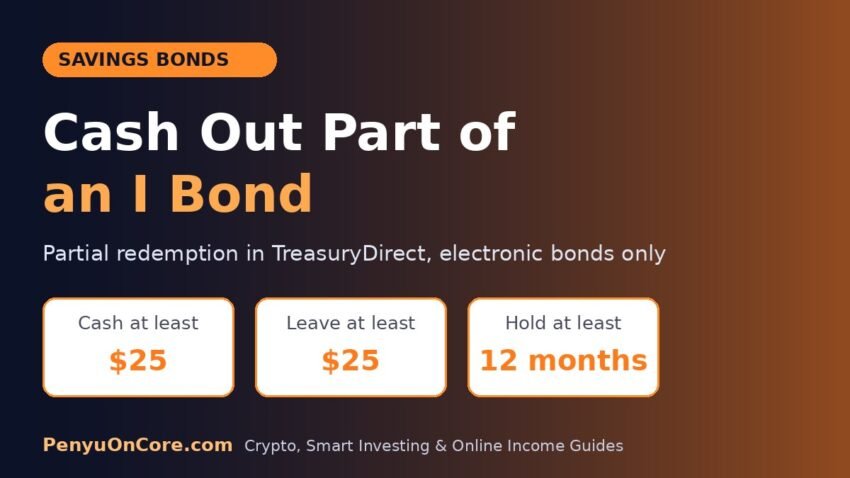
Need some cash but don’t want to cash in your whole I bond? If your bonds are electronic and sit in TreasuryDirect, you don’t have to. TreasuryDirect lets you cash out part of a single bond and leave the rest earning interest. You just have to follow two $25 rules and remember how the early-redemption penalty works.
Quick answer: To partially redeem an I bond, log in to TreasuryDirect, go to ManageDirect, click “Redeem securities”, select one bond, choose “Redeem partial amount” and enter how much you want. You must cash at least $25 and leave at least $25 in the bond, and the bond must be at least 12 months old. You receive principal plus a proportionate share of the interest, and only that interest is reported as taxable for the year.
The partial redemption rules at a glance
The rules come straight from TreasuryDirect’s Cash EE or I savings bonds page and the TreasuryDirect regulations at 31 CFR Part 363, Subpart C:
- Minimum you can cash: $25, then any amount to the penny ($25.01, $347.63 and so on). Under 31 CFR 363.57, “Redemptions will be comprised of principal and proportionate interest.”
- Minimum you must leave: each bond must keep a redemption value of at least $25. Under 31 CFR 363.54, if a request would drop a bond below $25, TreasuryDirect won’t allow it.
- Holding period: I bonds issued on or after February 1, 2003 can’t be cashed, in full or in part, until 12 months after the issue date (31 CFR 359.6).
- Electronic bonds only: TreasuryDirect states plainly that “You cannot cash part of a paper savings bond.” A paper bond has to be cashed for its entire value.
- One bond at a time: if you select several bonds in one redemption, they’re cashed in full. The partial option only appears when you’ve selected a single bond.
The same mechanics apply to electronic Series EE bonds, since TreasuryDirect’s cashing page covers both series.
How to partially cash out an I bond in TreasuryDirect
These steps follow TreasuryDirect’s own “How Do I…?” help page. Menu names can change, so if something looks different, use that page as the reference.
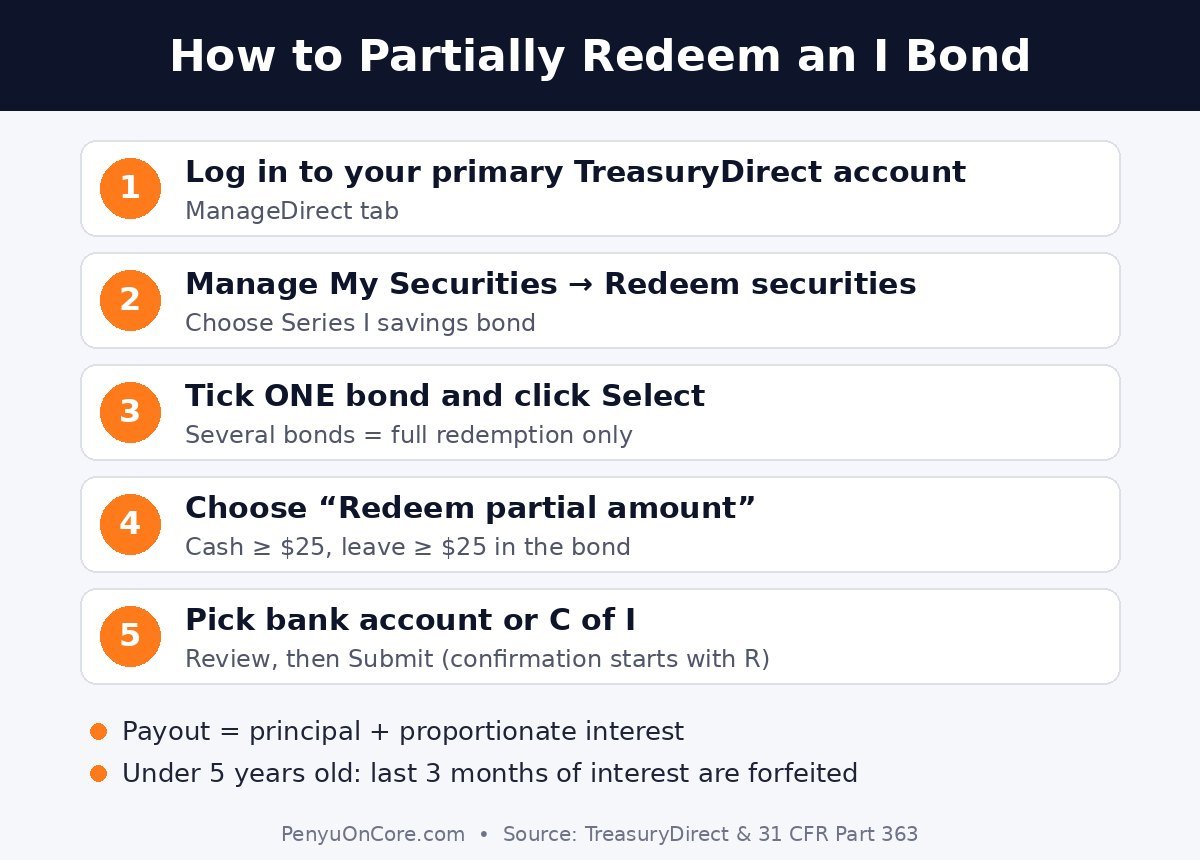
- Log in to your primary TreasuryDirect account.
- Click the ManageDirect tab at the top of the page.
- Under Manage My Securities, click Redeem securities.
- Choose the security type (Series I savings bond) and click Submit.
- On the Summary page, tick the box beside one bond and click Select. Only bonds that are already eligible for redemption appear here.
- On the Redemption Request page, switch from the default “Redeem full amount” to Redeem partial amount and type the dollar amount.
- Pick where the money goes from the drop-down: one of your linked bank accounts or your Certificate of Indebtedness (C of I), TreasuryDirect’s zero-interest holding balance.
- Click Review, check the details, then click Submit.
- Save or print the confirmation. According to the TreasuryDirect user guide, redemption confirmation numbers start with “R”, and after a partial redemption the page shows the bond’s remaining balance.
What you actually receive: principal plus proportionate interest
A partial redemption doesn’t let you pull out “just the interest” or “just the principal”. Every dollar you cash out is a slice of both, in the same proportion as the whole bond. TreasuryDirect puts it simply: “If you cash only part of what a bond is worth, you only get the interest on the part you cash.”
Simplified, hypothetical example: say a bond you bought for $1,000 now shows a value of $1,200, so $200 of it is interest. Cash out $600, which is half the value, and you receive roughly $500 of principal and $100 of interest. The other half stays in the bond and keeps earning at that bond’s rate. TreasuryDirect’s actual figures are calculated by its own formulas, so treat this only as an illustration of the proportion.
The 3-month penalty still applies under 5 years
If the bond is less than five years old, you lose the last three months of interest. TreasuryDirect’s example: cash in after 18 months and you get the first 15 months of interest. The value TreasuryDirect shows for bonds under five years old already leaves out those last three months, so the number on screen is what you can actually cash out (I bonds interest rates). Under 31 CFR 359.7, the penalty never reduces the value below what you paid.
Partial vs full redemption
| Question | Partial redemption | Full redemption |
|---|---|---|
| Bonds per transaction | One bond only | Up to 50 bonds at once |
| Minimum amounts | Cash at least $25 and leave at least $25 | Entire value of each selected bond |
| Interest taxed this year | Only the interest in the cashed portion | All interest the bond has earned (unless already reported) |
| What keeps earning | The remaining balance, at the same fixed rate | Nothing; the bond is closed |
| Paper bonds | Not allowed | Allowed (bank or FS Form 1522) |
Timing: cash out early in the month
Under 31 CFR 359.16, I bond interest “accrues on the first day of each month”, meaning a month’s interest is added to the bond’s value at the start of the next month. So within a calendar month the value doesn’t change. Cashing on the 2nd or the 28th gets you the same amount, and cashing early simply gets you the money sooner. Cashing near the end of a month leaves your money sitting there for weeks without earning any extra I bond interest.
Your bond’s rate also resets every six months from its own issue month, not on the May 1 and November 1 announcement dates. The interest rates page has a table showing which months your bond resets. For bonds issued November 1, 2026 through April 30, 2027, TreasuryDirect lists a composite rate of 5.51%, including a 1.40% fixed rate. TreasuryDirect notes that the fixed rate never changes for the life of the bond. If you hold several bonds, compare their fixed rates before you decide which one to trim.
Taxes on a partial redemption
According to TreasuryDirect’s tax information page, I bond interest is subject to federal income tax but not state or local income tax. Most owners defer reporting until they cash in. When you cash in, your 1099-INT shows up in your TreasuryDirect account (ManageDirect, then “Manage My Taxes”) by January 31 of the following year. The “Taxable Transaction Summary” is not the 1099 itself.
Because a partial redemption only releases a proportionate share of the interest, some owners spread redemptions across several tax years instead of taking all the interest at once. Whether that helps depends on your tax bracket, so check with a tax professional if the amounts are large. If you put the money toward qualified higher education costs, see TreasuryDirect’s page on using bonds for higher education, which has its own eligibility rules.
The state-tax exemption is the same one that makes Treasuries attractive in high-tax states. Our guide to whether money market fund dividends are state tax exempt explains how that works for funds.
Where the money can (and can’t) go
Redemption proceeds go to a linked bank account or your C of I. You can’t move I bonds themselves to a brokerage. Unlike marketable Treasuries, savings bonds are non-marketable, and FS Form 5511’s brokerage-transfer section doesn’t apply to them. Our walkthrough on transferring T-bills from TreasuryDirect to a brokerage covers the securities that can move. If you’re freeing up cash for short-term needs, our comparison of SGOV vs a high-yield savings account looks at liquid alternatives.
FAQ
Can I partially redeem a gift bond that’s still in my Gift Box?
No. An undelivered gift bond belongs to the person named on it, so it can’t be cashed until it’s delivered and has been held 12 months. See our guide to the I bond gift box.
Why is the partial redemption option missing?
Usually because you selected more than one bond (multiple bonds are cashed in full), the bond is under 12 months old, or the amount would leave less than $25 in the bond.
Does a partial redemption reset the bond’s rate or issue date?
No. The remaining balance stays the same bond. It keeps its issue date, its fixed rate and its six-month rate schedule.
Can I cash part of a paper I bond?
No. Paper bonds must be cashed for their full value. If you convert paper bonds to electronic in TreasuryDirect, the converted bonds fall under the same book-entry rules in 31 CFR Part 363, Subpart C.
Does partial redemption count against my $10,000 annual purchase limit?
No. The $10,000-per-calendar-year limit on electronic I bonds applies to how much you buy (31 CFR 363.52). Cashing out doesn’t give you back purchase room for that year.
Disclaimer: This article is for general educational purposes only and is not financial, tax or legal advice. Rules and rates can change, so check TreasuryDirect and consult a qualified professional before making decisions about your savings bonds.