
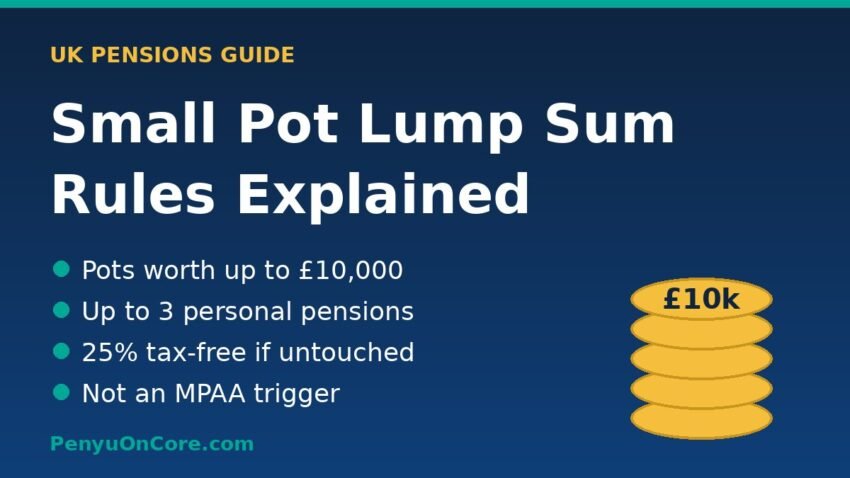
A small pot lump sum lets you cash in a UK pension worth £10,000 or less in one go, usually once you reach minimum pension age (55 now, rising to 57 from 6 April 2028). According to GOV.UK, you can usually take up to three of these from personal pensions (including most SIPPs) and an unlimited number from workplace pensions. If the pot hasn’t been touched yet, 25% is tax-free and the rest is taxed as income.
The headline rule is simple, but a few details catch people out: the £10,000 test applies on the day the money is actually paid, “three” counts arrangements rather than providers, and the tax your provider takes off is often wrong. This guide goes through each of those using HMRC’s own guidance.
How the small pot lump sum rule works
HMRC’s Pensions Tax Manual (PTM063700) covers these “small lump sums”. For personal pensions, which HMRC calls schemes that are not occupational or public service schemes, the payment is made under regulation 11A. The main conditions are:
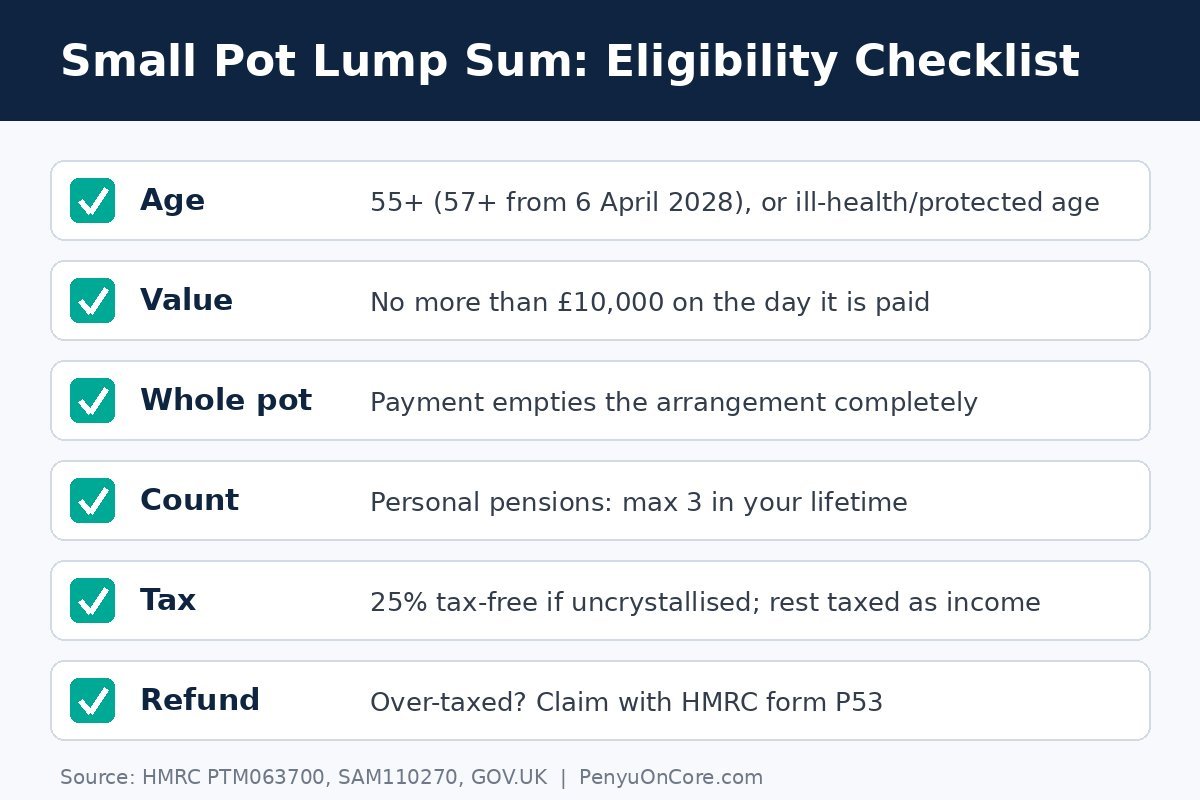
- You’ve reached age 55 (57 from 6 April 2028), or you qualify earlier through the ill-health condition or a protected pension age.
- The payment is no more than £10,000.
- The payment extinguishes your entitlement under that arrangement, so the whole pot has to go. You can’t leave a balance behind.
- You haven’t already had more than two payments under regulation 11A. That’s where the limit of three comes from.
The pot can be uncrystallised (never accessed) or crystallised (already in payment, for example drawdown). That affects the tax, which is covered below.
Personal vs workplace pensions at a glance
| Feature | Personal pensions / SIPPs | Workplace (occupational) pensions |
|---|---|---|
| Maximum per payment | £10,000 | £10,000 |
| How many you can take | Up to 3 in your lifetime | No overall limit (one per scheme) |
| What must be emptied | The arrangement | Your entitlement under the paying scheme |
| Minimum age | 55 (57 from 6 April 2028) | 55 (57 from 6 April 2028) |
Workplace schemes have their own extra conditions in PTM063700, for example about your relationship with the sponsoring employer and about earlier transfers. Your scheme administrator will check these for you.
“Three pots” means arrangements, not providers
This is where sources disagree a little. GOV.UK says you can usually get up to three small pot lump sums “from different personal pensions”. HMRC’s manual goes further: regulation 11A “applies at arrangement level rather than at scheme level”. That means the payments can come from two or three separate schemes, or from different arrangements within the same scheme. HMRC also says you can take a small lump sum from one arrangement while still holding benefits in another arrangement in the same scheme.
In practice, whether your provider treats your pots as separate arrangements depends on how it set them up and on the scheme rules. Ask your provider directly before you assume a second pot with the same company counts separately. The rule is HMRC’s, but the scheme rules decide whether a provider will actually offer it.
The £10,000 limit is tested on the payment date
HMRC says the limit “applies to the actual lump sum paid”. Any investment growth or contributions between asking for the payment and receiving it count towards it. HMRC’s own example: a £9,990 lump sum offered on 6 June 2014 can’t be paid under regulation 11A if growth takes the fund to £10,010 by 6 July 2014.
If your pot is only a little under £10,000, rising markets could push it over before the payment goes through. Some people ask their provider whether the pot can be moved into cash first so the value stays put, but whether that’s possible depends on your scheme.
How a small pot lump sum is taxed
PTM063700 says these payments are taxed the same way as a trivial commutation lump sum:
- Uncrystallised pot: 25% is free of Income Tax and the other 75% is taxed as pension income.
- Crystallised pot (already in drawdown or payment): all of it is taxable.
- Mixed pot: only 25% of the uncrystallised part is tax-free.
HMRC also notes that these small lump sums are not “relevant benefit crystallisation events”, so they don’t use up any of your lump sum allowance or lump sum and death benefit allowance.
Why you may get too much tax taken off
The provider has to deduct tax through PAYE. HMRC’s guidance (SAM110270) says that since 6 April 2013, new small pensions taken as lump sums that aren’t already in payment are taxed at basic rate (BR) on a non-cumulative basis. Pensions already in payment use the tax code that’s already in place. HMRC accepts that the deduction “may exceed the actual liability”, especially for people with little other income.
Here’s a simple worked example (it ignores your other income): on an untouched £8,000 pot, £2,000 is tax-free and £6,000 is taxable. A flat 20% BR deduction on that £6,000 is £1,200. If your total income for the year stays under your Personal Allowance (usually £12,570, according to GOV.UK), you might owe nothing and be able to claim that money back.
Claiming tax back: form P53
HMRC’s pension refund page lists P53 as the form for “when you’ve taken a small pension lump sum”. The P50Z and P53Z forms are for flexibly accessed pensions, and HMRC warns that using the wrong form can delay your refund. P53 asks for your expected income for the whole tax year, and you need to attach parts 2 and 3 of the P45 your pension provider gives you. If you don’t claim during the year, HMRC normally reviews your position after the tax year ends.
Does it trigger the Money Purchase Annual Allowance?
Going by HMRC’s list, no. HMRC’s list of MPAA trigger events (PTM056520) includes taking an uncrystallised funds pension lump sum (UFPLS) and the first income from flexi-access drawdown, but small lump sums aren’t on it. That matters if you’re still working and paying into a pension. Triggering the MPAA cuts the money purchase allowance to £10,000 a year from 2023-24. Cashing out the same pot through UFPLS would trigger it. So if your pot qualifies, make sure your provider is paying it as a small pot lump sum and not as UFPLS. The two can look similar on a withdrawal form.
Before you cash out: quick checks
- Confirm the payment type in writing: small lump sum (regulation 11A, or regulation 11/12 for workplace schemes), not UFPLS.
- Check how many personal-pension small pots you’ve already used. Only three are allowed in your lifetime.
- Think about timing within the tax year. The taxable 75% counts as income for that year.
- Watch out for scams. Check any firm offering to “release” pension cash on the FCA Register first.
- Have a plan for the money. Money taken out of a pension is outside its tax wrapper. Depending on your goals, an ISA could be an option (see our guide on opening two Stocks and Shares ISAs in the same tax year). If you also hold a Lifetime ISA, read about what happens to a Lifetime ISA at 50.
If markets have recently fallen, it’s worth reading how to think about retirement savings during a market sell-off before you sell investments to take cash.
FAQ
Can I take a small pot lump sum from a SIPP?
Usually yes, if the SIPP arrangement is worth £10,000 or less when it’s paid, you meet the age condition and the scheme rules allow it. A SIPP is a personal pension, so it counts towards your three.
Can I split a £15,000 pot into two small pots?
HMRC says splitting funds out of a single arrangement into new ones means setting up new arrangements. That can affect people with enhanced or fixed protection, and whether it’s allowed at all depends on the scheme. Ask your provider and consider regulated advice.
Is the first 25% always tax-free?
Only if the pot is uncrystallised. If the pot is already in payment, the whole lump sum is taxable.
Where can I get free guidance?
MoneyHelper, which is government-backed, offers free, impartial pension guidance.
Disclaimer: This article is general information based on HMRC and GOV.UK guidance checked in November 2026. It is not financial or tax advice. Rules and scheme terms vary, so check with your pension provider, HMRC or a regulated adviser before acting.