
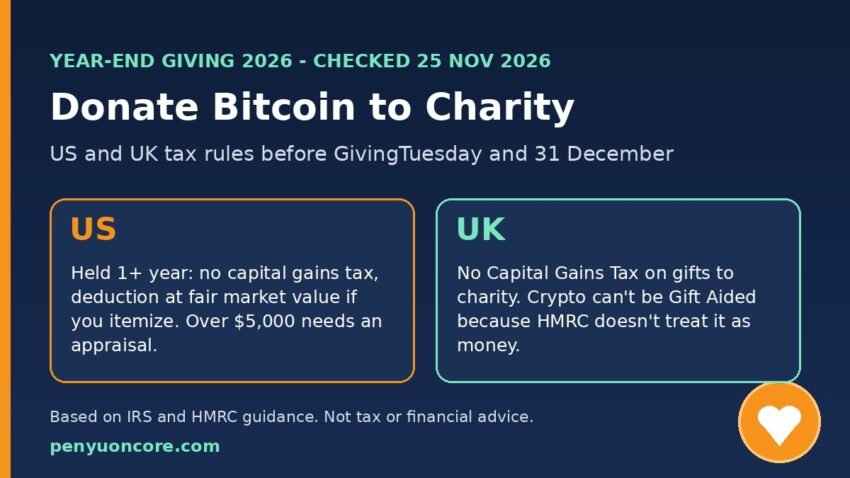
Yes, you can donate bitcoin to charity, and if you’re in the US and have held it for more than a year, giving the coins directly is usually more tax-efficient than selling first. You don’t pay capital gains tax on the donated bitcoin, and if you itemize you can generally deduct its fair market value. The catch: a deduction above $5,000 needs a qualified appraisal, and the exchange price alone won’t do.
This is a good week to get the details right. GivingTuesday falls on 1 December 2026, the 31 December deadline for 2026 gifts is five weeks away, and new US charitable deduction rules apply for the first time to gifts made this year. Here’s how it works in the US and the UK, using IRS and HMRC guidance checked on 25 November 2026.
How the IRS treats it when you donate bitcoin to charity
The IRS treats bitcoin as property, so a donation follows the rules for donated property rather than cash. Its virtual currency FAQ says two things that matter most:
- No gain on the transfer. If you donate virtual currency to a qualifying charity (one described in Internal Revenue Code section 170(c)), “you will not recognize income, gain, or loss from the donation” (FAQ 34).
- The deduction depends on how long you held it. Held for more than one year, the deduction is generally the fair market value at the time of the gift. Held for one year or less, it’s the lower of your cost basis or the fair market value (FAQ 35).
That’s why long-held bitcoin is the classic case. If you sell coins that have gone up in value and then donate the cash, you owe tax on the gain first, so there’s less left to give. Donate the coins directly and the charity, which is tax-exempt, can sell them without that tax.
When donating bitcoin directly doesn’t help
If your bitcoin is worth less than you paid, the maths flips. Donating it gets you a deduction for the lower market value and you never claim the loss. Selling first realises a capital loss you may be able to use, and you can then donate the cash. Coins held for a year or less don’t get the fair-market-value benefit either, because the deduction is capped at your basis. If you’re weighing a year-end sale, our guide to the bitcoin wash sale rule covers where that rule stands.
What changed for 2026 gifts
Three changes from the 2025 budget law (Public Law 119-21) apply to gifts made in 2026, which you’ll report on returns filed in 2027.
1. You still need to itemize to deduct bitcoin
From tax year 2026, people who take the standard deduction can deduct up to $1,000 of charitable gifts ($2,000 for married couples filing jointly). But the IRS reminder issued on 10 November 2026 is clear that “only qualifying cash contributions are eligible” and that “noncash contributions do not qualify”. Gifts to donor-advised funds don’t qualify either. So a bitcoin gift only reduces your federal tax if you itemize. Our standard deduction explainer can help you judge whether itemizing is likely for you.
2. A 0.5% of AGI floor for itemizers
Itemized charitable gifts now count only to the extent they exceed 0.5% of your contribution base, which is generally your adjusted gross income (AGI), as summarised by CASE and Thomson Reuters Checkpoint. On a $200,000 AGI, for example, the first $1,000 of the year’s gifts gives no deduction. Some donors respond by “bunching” several years of gifts into one year.
3. A 35% cap for top-bracket taxpayers
If you’re in the 37% bracket, a new “2/37ths” limitation trims itemized deductions so each deducted dollar saves you about 35 cents, not 37, according to the Congressional Research Service.
The older limits still apply. Under IRS Publication 526, deductions for capital gain property (which includes long-held bitcoin) given to public charities are generally limited to 30% of AGI. Anything over the limit can be carried forward for up to five years.
The $5,000 appraisal rule that catches crypto donors
This is where many crypto gifts go wrong. Publicly traded stock is exempt from the appraisal requirement, but bitcoin isn’t. In Chief Counsel Advice 202302012, the IRS concluded that a donor claiming more than $5,000 for donated cryptocurrency needs a qualified appraisal. It also said that relying on an exchange’s quoted price doesn’t count as reasonable cause, so the deduction can be disallowed entirely. The memo can’t be cited as precedent, but it shows how the IRS approaches the question.
The paperwork, per the Form 8283 instructions and Publication 526:
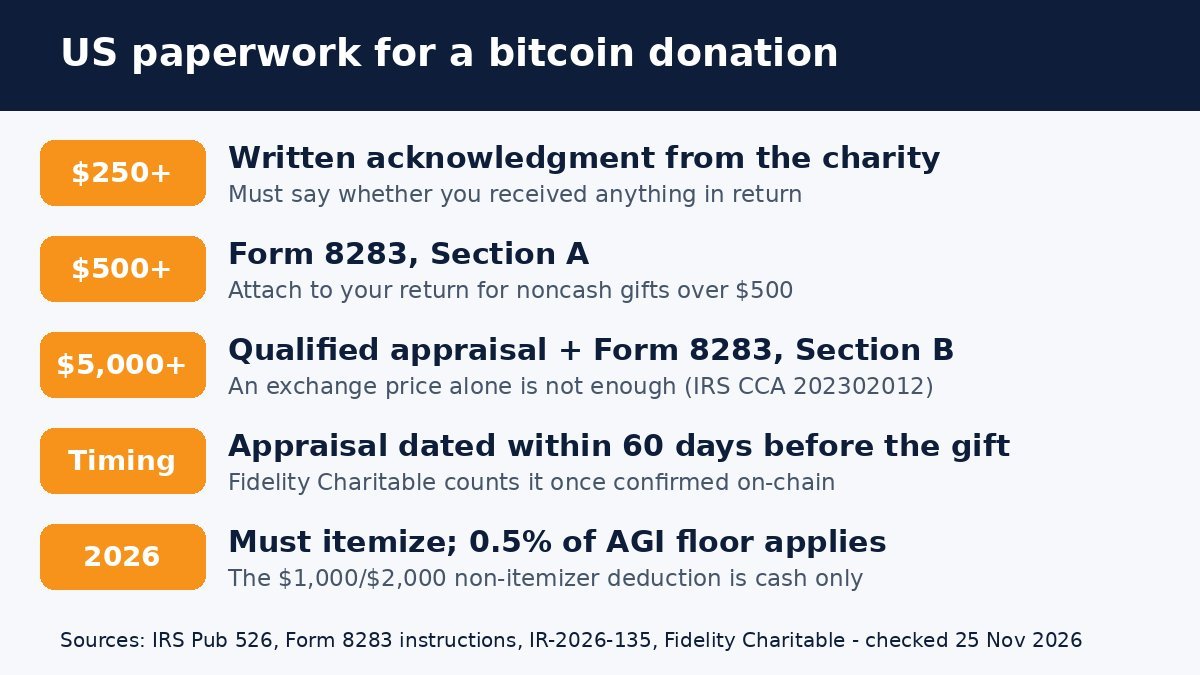
| Deduction claimed | What you need |
|---|---|
| $250 or more | A contemporaneous written acknowledgment from the charity |
| Over $500 up to $5,000 | Form 8283, Section A, attached to your return |
| Over $5,000 | A qualified appraisal plus Form 8283, Section B, signed by the charity and the appraiser |
Timing matters too. The appraisal must be signed and dated no earlier than 60 days before you make the gift, and you must receive it before your return’s due date (including extensions). Thomson Reuters notes that the acknowledgment for gifts of $250 or more is the other requirement “a lot of people miss”. It needs to state whether you got anything in return.
Could Congress drop the appraisal rule?
Possibly, but it hasn’t yet. The Digital Asset Tax Certainty Act (H.R. 10357), introduced on 14 September 2026 and approved 38-5 by the House Ways and Means Committee two days later, would exempt “widely traded” digital assets from the appraisal requirement for tax years beginning after 2026, Thomson Reuters reported on 11 November. Even if it passes, that start date wouldn’t cover 2026 gifts. So plan as though the appraisal is required.
How to donate bitcoin to charity step by step
- Check the charity accepts bitcoin. Many don’t hold crypto themselves. A donor-advised fund (DAF) is one alternative: Fidelity Charitable, for example, says it accepts bitcoin, ether, litecoin and solana, sells them, and lets you recommend grants later.
- Confirm the organisation qualifies. Gifts to individuals aren’t deductible, per Publication 526. A private foundation generally limits a crypto deduction to your cost basis, according to the attorney quoted by Thomson Reuters.
- Use the exact address and network you’re given. Fidelity Charitable says to send bitcoin only on the Bitcoin main network, never via a layer 2, and suggests a small test transaction first. A gift sent to the wrong address or network may be lost for good.
- Leave time before 31 December. Fidelity Charitable treats a crypto gift as received only once it’s confirmed on the blockchain. Don’t send at the last minute with a low fee. If a transaction gets stuck, see our guide to bitcoin transactions dropped from the mempool.
- Keep records. Save your purchase date and cost basis, the transaction ID, the time of the gift, the charity’s acknowledgment and the appraisal. The charity or DAF usually won’t value the coins for you. Fidelity Charitable states it “will not provide FMV for cryptocurrency donations”.
Donating bitcoin to charity in the UK
The UK rules work differently, and the main benefit is on the Capital Gains Tax side:
- No CGT on the gift. HMRC’s Cryptoassets Manual says that if you donate tokens to charity you won’t pay CGT on them. That doesn’t apply to a “tainted donation” (broadly, one meant to get a financial advantage from the charity), or if the charity pays you more than your acquisition cost.
- No Gift Aid on crypto. HMRC’s Gift Aid guidance for charities says it doesn’t consider cryptoassets to be money, so crypto donations aren’t eligible. You could sell first and Gift Aid the cash, but the sale may trigger CGT.
- No income tax relief like shares get. GOV.UK lists tax relief on donations through Gift Aid, payroll giving, wills, and gifts of land, property or shares. Bitcoin isn’t in those categories.
Giving bitcoin to a person rather than a charity is a different matter. In the UK that usually counts as a disposal for CGT. Our explainer on whether gifting bitcoin is taxable covers both countries.
FAQ
Is donating bitcoin tax deductible?
In the US, generally yes if you give to a qualifying charity and itemize. Bitcoin held for more than a year is usually deductible at fair market value, subject to the 0.5% floor and AGI limits. In the UK there’s no income tax relief or Gift Aid, but the gift is free of CGT.
Do I need an appraisal to donate bitcoin?
In the US, you need a qualified appraisal if you claim a deduction of more than $5,000. An exchange price isn’t enough, according to IRS Chief Counsel Advice 202302012.
Can I claim the new $1,000 non-itemizer deduction for bitcoin?
No. The IRS says it covers only qualifying cash contributions. Noncash gifts like bitcoin, and gifts to donor-advised funds, don’t qualify.
What if my bitcoin is worth less than I paid?
Donating it directly means you never claim the loss. Selling first and donating the cash is often worth comparing with a tax adviser.
This article is general information, not tax, legal or financial advice, and it isn’t a recommendation to buy, sell or donate any cryptoasset. Tax rules depend on your circumstances and can change, so check with a qualified tax professional before making a large gift. Sources checked 25 November 2026.