
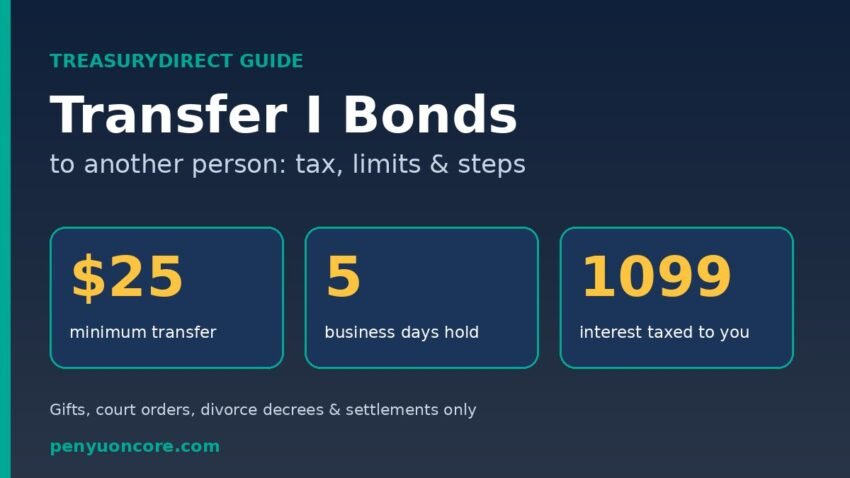
You can transfer I bonds to another person, but only electronically, only between TreasuryDirect accounts, and only as a gift or because of a court order, divorce decree or property settlement. The part most people miss is tax: when an electronic bond leaves your name, TreasuryDirect issues you a 1099-INT for all the interest it has earned so far.
Short answer: sign in to TreasuryDirect, go to ManageDirect → Transfer securities, pick the bond, and enter the recipient’s TreasuryDirect account number and Social Security Number. You must have held the bond for at least five business days, move at least $25, and accept that the transfer is irrevocable. You owe federal tax on the interest earned up to the transfer, and the bond counts toward the recipient’s $10,000 annual purchase limit.
This guide is based on TreasuryDirect’s help pages, the federal rules in 31 CFR Part 363, and IRS Publication 550. All were checked on 23 November 2026.
Transfer I bonds: the rules at a glance
| Rule | What the official sources say |
|---|---|
| Allowed reasons | A gift, or a final judgment, court order, divorce decree or property settlement agreement. You can’t sell a bond to someone. |
| Recipient | Must have their own TreasuryDirect account (an individual or an entity account) |
| Holding period | At least 5 business days after the purchase date |
| Minimum amount | $25; a partial transfer must also leave at least $25 in the bond |
| Fees | None |
| Can it be reversed? | No. A gift transfer is irrevocable. |
| Tax on interest earned so far | Reported on a 1099-INT in your name and SSN for the year of the transfer |
| Recipient’s purchase limit | The transferred amount counts toward their $10,000-per-year I bond limit for the year it arrives |
Sources: 31 CFR 363.55, 363.97 and 363.99, the TreasuryDirect FAQ and TreasuryDirect’s tax information for EE and I bonds.
Gift Box delivery vs transferring a bond you own
TreasuryDirect has two routes for moving savings bonds to someone else, and they work differently for tax.
- Gift Box delivery. You buy the bond as a gift, with the recipient registered as owner from the start. It sits in your Gift Box until you deliver it. You never owned it, so no interest is reported in your name when it moves. We cover that route in our I bond Gift Box guide.
- Transfer. You move a bond that is registered in your name to another person’s account. TreasuryDirect reissues it in the recipient’s name. Because you give up ownership, the interest earned up to that date becomes taxable to you.
If you’re still planning a gift and haven’t bought the bond yet, the Gift Box is usually simpler. A transfer is for bonds you already own.
How to transfer I bonds in TreasuryDirect, step by step
These steps follow TreasuryDirect’s “How do I…?” help page.
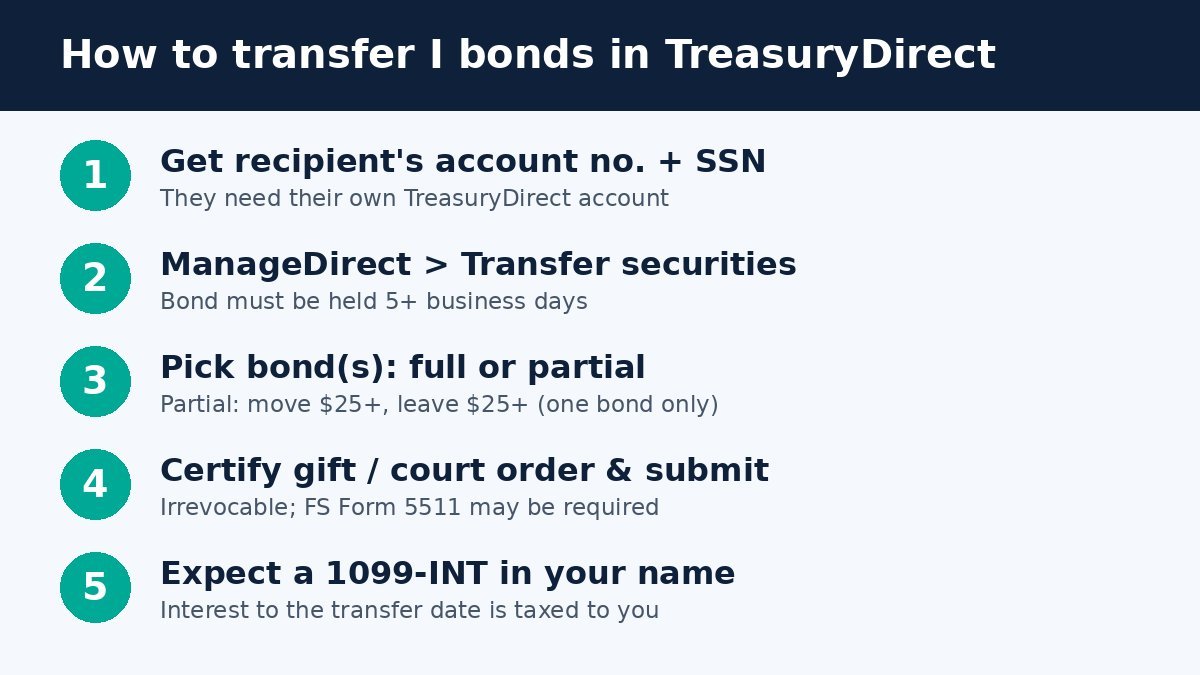
- Get the recipient’s details. You need their TreasuryDirect account number and their Social Security Number (or other taxpayer ID). If they don’t have an account, they must open one first.
- Sign in to your primary TreasuryDirect account and open the ManageDirect tab.
- Under Manage My Securities, click Transfer securities.
- Choose the security type (Series I savings bonds) and click Submit.
- Select the bond or bonds. You can pick up to 50 in one go. If you choose more than one, each one is transferred in full to a single recipient.
- Choose full or partial (one bond only). A partial transfer must be at least $25 and must leave at least $25 in the bond. A partial transfer includes principal plus a proportionate share of the interest.
- Enter the recipient’s taxpayer ID and account number, review the details, read the certification statement and submit.
- Save the confirmation page. TreasuryDirect emails the recipient to say a security has been moved into their account.
When TreasuryDirect asks for a paper form
Sometimes a page appears with a link to FS Form 5511 (Transfer Request) instead of letting you finish online. TreasuryDirect says this happens “in certain instances” to protect your account. You then have to print the form, sign it in front of an authorized certifying official at a financial institution (a notary public is not accepted) and mail it in. The transfer is not processed until TreasuryDirect receives and approves the form.
A small conflict on splitting bonds
The online help pages and 31 CFR 363.55 allow a partial transfer of a single bond (minimum $25). However, the current FS Form 5511 (revised March 2026) says Series EE and I savings bonds “may not be split” and must be transferred in their entirety. Our reading is that the online tool allows partial transfers but the paper form route does not. If you are pushed to the paper form and want to transfer only part of a bond, contact TreasuryDirect before you mail anything.
Who pays tax when you transfer I bonds?
I bond interest is subject to federal income tax but not state or local income tax. Ownership changes are where it gets complicated.
| Person | Interest they report | When |
|---|---|---|
| You (previous owner) | All interest earned from the issue date to the transfer date that you haven’t already reported | Tax year of the transfer; TreasuryDirect issues a 1099-INT in your name |
| Recipient (new owner) | Only interest earned after the bond was reissued to them | When they cash the bond or it matures |
Source: TreasuryDirect’s tax information page. Your TreasuryDirect 1099 appears in your account like any other year’s form.
For example, if you bought $5,000 of I bonds that are now worth $6,000, transferring them all to your adult child means about $1,000 of interest shows up on your return for that year. Your child is taxed only on growth after the transfer.
Transfers to a spouse or in a divorce
Moving a bond to your spouse doesn’t avoid this. IRS Publication 550 says the same rule applies when bonds (other than community property) are transferred between spouses or as part of a divorce. Its example: if you transfer EE bonds to a former spouse under a divorce agreement, you include the deferred interest up to the transfer date in your income for that year. Your former spouse reports interest from the transfer onwards.
Transfers to a trust
Trusts are the exception. On FS Form 5511 you can certify that you will still be treated as owner of the part of the trust that holds the deferred interest (typically a grantor trust). If you do, the transfer is not reported as interest income. We explain this in I bonds in a trust.
Gift tax
A transfer is a gift, so the federal gift tax rules apply too. The IRS annual exclusion is $19,000 per recipient for 2026. Gifts to one person (other than your spouse) above that amount in a year generally mean filing Form 709. Filing doesn’t by itself mean tax is due, since the 2026 basic exclusion is $15,000,000.
What happens to the bond after the transfer
- Same issue date. TreasuryDirect says reissuing a bond doesn’t change its issue date. The bond keeps earning on its original schedule and still matures 30 years from issue.
- Single-owner registration. Under 31 CFR 363.55(c), a bond transferred to an individual arrives in single-owner form. The recipient can add a second owner or beneficiary afterwards.
- Purchase limit. The TreasuryDirect user guide says the purchase amount of a transferred bond counts toward the recipient’s annual limit in the year it is delivered. If they already bought $10,000 of I bonds this calendar year, plan for that before you transfer.
- Cash-out timing. Because the issue date stays the same, the minimum holding period and early-redemption penalty are counted from the original issue date. See how long to cash out I bonds.
Common reasons a transfer is blocked
- The bond is too new. TreasuryDirect requires five business days after purchase so the payment can clear.
- Not enough value. A partial transfer has to move $25 and leave $25.
- Wrong account details. The recipient’s account number and SSN must match. TreasuryDirect’s form warns that wrong details can lead to rejection or delays, as can a request submitted just before a closed book period.
- It’s actually a sale. Savings bonds can’t be transferred “for consideration”. If someone is paying you for the bond, it isn’t allowed.
FAQ
Can I transfer I bonds to my child’s TreasuryDirect account?
The regulations allow transfers to “the TreasuryDirect account of another person”, and children under 18 hold bonds through a minor account linked to a parent’s account. TreasuryDirect’s help pages don’t spell out how a transfer into a linked minor account works, so contact TreasuryDirect before you rely on it. Remember that the interest earned up to the transfer is still taxed to you.
Can I move only part of an I bond?
Online, yes, if you transfer at least $25 and leave at least $25.
Can I undo a transfer?
No. Under 31 CFR 363.97, a gift transfer is irrevocable once it’s made.
Can I transfer paper I bonds?
Not directly. TreasuryDirect reissues EE and I bonds in electronic form only, and the new owner must have a TreasuryDirect account. Paper bonds generally have to be converted or reissued first.
Disclaimer: This article is general information, not tax, legal or financial advice. TreasuryDirect procedures and IRS figures can change. Check the linked official pages, or speak to a tax professional, before transferring bonds.