
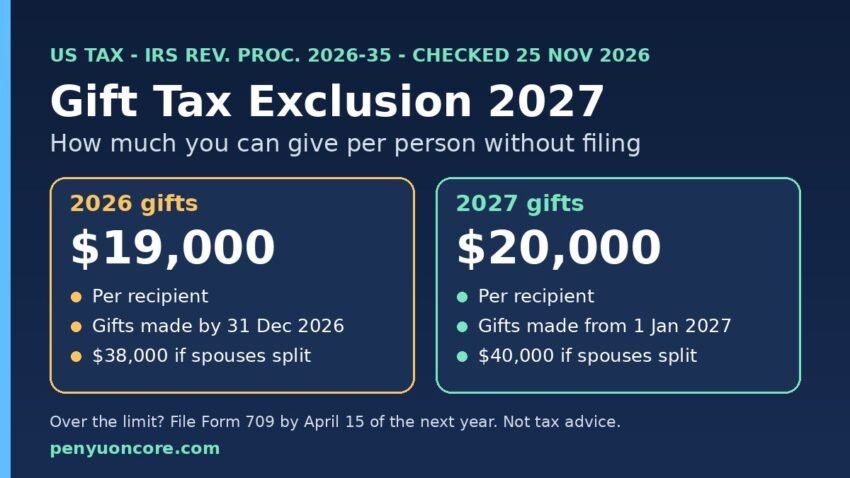
The gift tax exclusion 2027 amount is $20,000 per recipient, up from $19,000 in 2026, according to the IRS inflation adjustments announced on 5 November 2026. That means you can give up to $20,000 to as many people as you like in calendar year 2027 without filing a gift tax return. A married couple can give $40,000 to each person if they agree to split gifts.
The timing matters for holiday and year-end giving. A gift you make on or before 31 December 2026 still uses the $19,000 limit. A gift made on or after 1 January 2027 uses the $20,000 limit. Below you’ll find the new numbers, when you have to file Form 709, the gifts that don’t count at all, and a short section for UK readers, whose rules work very differently.
Gift tax exclusion 2027 at a glance
The figures come from Revenue Procedure 2026-35 (section 3.46), the IRS release IR-2026-133 and the IRS gift tax FAQ.
| Item | 2026 | 2027 |
|---|---|---|
| Annual exclusion per recipient | $19,000 | $20,000 |
| Married couple splitting gifts (per recipient) | $38,000 | $40,000 |
| Annual exclusion for gifts to a non-US-citizen spouse | $194,000 | $201,000 |
| Basic exclusion amount (lifetime, estate and gift) | $15,000,000 | $15,480,000 |
The annual exclusion applies per recipient, not per giver in total. The IRS FAQ gives the example of a parent who gives each of their children $19,000 in 2026: the exclusion covers each gift separately. In 2027 the same works at $20,000 per child, grandchild, friend or anyone else.
Do you have to file Form 709?
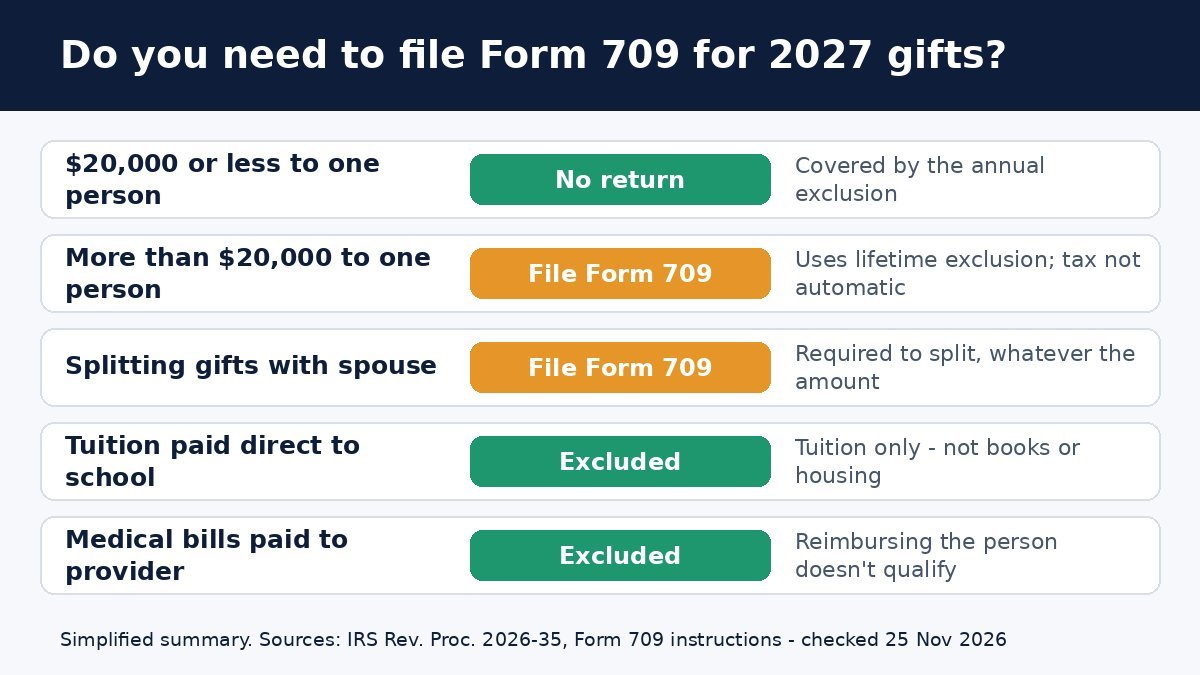
According to the Instructions for Form 709, a US citizen or resident generally must file a gift tax return if gifts to any one person (other than a spouse) go over the annual exclusion for that year. For 2027 gifts, that means more than $20,000 to one person.
Filing a return does not automatically mean you owe tax. Gifts above the annual exclusion are reported, and they use up part of your lifetime basic exclusion amount ($15,480,000 for 2027). The IRS FAQ also notes that the giver (the donor), not the person who gets the gift, is generally responsible for any gift tax.
Other situations that require Form 709
- Gift splitting with your spouse: you must file to split gifts, whatever the amount. Spouses can’t file a joint gift tax return, so each spouse files their own.
- Future interests: some gifts, such as certain transfers into trusts where the recipient can’t use the money now, don’t qualify for the annual exclusion. A return can be needed even under the limit.
- 529 plan “superfunding”: if you put more than the annual exclusion into a 529 plan for one person, you can elect to spread the contribution over 5 years. For 2025, the instructions put that ceiling at $95,000 (5 × $19,000). You make the election on Form 709.
The Form 709 deadline
Form 709 is an annual return. It is due by 15 April of the year after the gift (or the next business day if that date falls on a weekend or holiday). So 2026 gifts are reported in spring 2027, and 2027 gifts in spring 2028. If you extend your income tax return with Form 4868, that also extends the gift tax return, and Form 8892 is available otherwise. An extension of time to file is not an extension of time to pay. The IRS says Form 709 can now be e-filed.
Gifts that don’t count toward the limit
Per the IRS FAQ and the Form 709 instructions, these are generally not taxable gifts:
- Tuition paid directly to a school. The payment has to go straight to a qualifying educational organization and only covers tuition, not books, supplies or room and board. Money for those extra costs is a normal gift that can use the annual exclusion.
- Medical expenses paid directly to the provider. This includes medical insurance paid on someone’s behalf. Reimbursing the person instead of paying the provider doesn’t qualify.
- Gifts to your spouse. No return is needed for gifts to a US-citizen spouse (with limited exceptions for certain terminable interests). For a spouse who isn’t a US citizen, the special annual exclusion is $201,000 for 2027.
- Gifts to qualifying charities are deductible from the value of gifts. If charitable gifts are the only gifts you made and you gave your entire interest, you generally don’t need to file. If you give crypto, see our guide to donating Bitcoin to charity.
- Gifts to political organizations for their use.
Timing: 2026 vs 2027 limits
The annual exclusion is based on the calendar year of the gift, not the tax year you file in. That creates a simple planning point for anyone giving large holiday gifts:
- A gift completed by 31 December 2026 can use the 2026 exclusion of $19,000 for that person.
- A second gift to the same person in January 2027 starts a fresh $20,000 exclusion.
- Unused exclusion doesn’t carry forward. If you give $5,000 in 2026, the rest of that year’s $19,000 is simply gone.
For checks or bank transfers sent right around New Year, ask a tax adviser which date counts as the date of the gift. Gifts of property are valued at fair market value, which the IRS describes as the price between a willing buyer and a willing seller. This applies to shares, crypto and savings bonds too. Our guides on whether gifting Bitcoin is taxable and the I bond gift box cover those cases.
What the recipient should know
In most cases a gift isn’t income for the person who receives it, and you can’t deduct it on your own income tax return (except qualifying charitable gifts). If they later sell property you gave them, their cost basis is generally the same as yours. The IRS example is shares bought at $10 and sold at $100: the recipient pays tax on a $90 gain per share.
UK readers: there’s no $20,000 equivalent
The UK has no gift tax return like Form 709. Instead, some gifts can face Inheritance Tax if you die within 7 years of giving them. The GOV.UK rules on gifts list these allowances each tax year (6 April to 5 April):
| UK allowance | Amount | Key condition |
|---|---|---|
| Annual exemption | £3,000 in total | Unused amount can carry forward one tax year only |
| Small gifts | Up to £250 per person | Not if you used another allowance on that person |
| Wedding or civil partnership gifts | £5,000 child / £2,500 grandchild / £1,000 anyone else | Can combine with other allowances except small gifts |
| Normal expenditure out of income | No set limit | Regular, from income, and you can still afford your usual living costs |
| Spouse, civil partner or charity | Exempt | Spouse must live in the UK permanently |
GOV.UK also says birthday or Christmas gifts you give from your regular income are exempt. The Budget 2026 rates and allowances annex keeps the nil-rate band at £325,000 and the residence nil-rate band at £175,000 for 2027 to 2028. Law firm Kingsley Napley notes that the Budget added no lifetime gifting caps and left the gifts-out-of-surplus-income rules unchanged.
Quick checklist before you give
- Add up everything you plan to give each person in the calendar year, including cash, shares, crypto and 529 contributions.
- Compare it with the right year’s limit: $19,000 for 2026 and $20,000 for 2027 (double for split gifts).
- Pay tuition or medical bills directly to the provider if you want them excluded.
- Keep records: date, value, recipient and how you worked out fair market value.
- If you go over, put Form 709 in your diary for 15 April. For wider 2027 planning, see our 2027 tax brackets guide.
FAQ
What is the gift tax exclusion for 2027?
$20,000 per recipient for gifts made in calendar year 2027, up from $19,000 in 2026, according to IRS Revenue Procedure 2026-35.
Can my spouse and I give $40,000 to one person in 2027?
Yes, if you elect to split gifts. Each spouse gets a $20,000 exclusion, but you must file Form 709 to split gifts, even if no tax is due.
Do I pay tax if I give more than $20,000?
Not necessarily. You generally file Form 709, and the excess counts against your lifetime basic exclusion amount ($15,480,000 for 2027) before any gift tax is due.
Does the recipient have to report the gift?
Generally no for US gifts from US persons. The donor handles any Form 709. Separate reporting rules can apply to large gifts received from foreign persons.
Is there a UK version of the $20,000 limit?
No. The main UK allowance is a £3,000 annual exemption for Inheritance Tax, alongside small-gift, wedding and regular-income exemptions and the 7-year rule.
This article is general information, not tax, legal or financial advice. Rules depend on your circumstances. For large gifts, trusts or cross-border situations, speak to a qualified tax professional.