
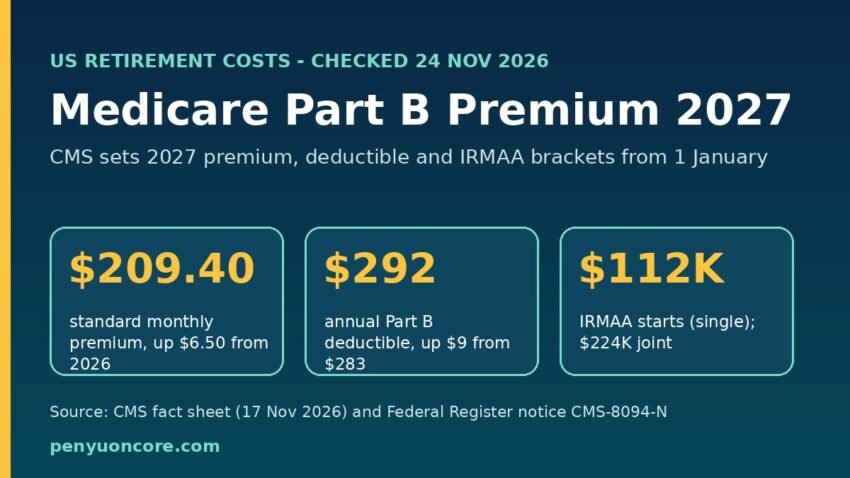
The Medicare Part B premium 2027 standard amount is $209.40 a month, up $6.50 from $202.90 in 2026, and the annual Part B deductible rises from $283 to $292. CMS announced the figures on 17 November 2026, and they take effect on 1 January 2027. If your income is above $112,000 (single) or $224,000 (married filing jointly), you’ll pay more through income-related surcharges known as IRMAA.
Short answer: Most people on Medicare will pay $209.40 a month for Part B in 2027. Higher earners pay between $293.10 and $711.80 a month, depending on the modified adjusted gross income (MAGI) on their tax return from two years earlier. For most retirees, the 3.6% Social Security increase for 2027 more than covers the higher premium.
The CMS, Federal Register, SSA and Medicare.gov pages linked below were checked on 24 November 2026.
Medicare Part B premium 2027 vs 2026 at a glance
The figures below come from the CMS fact sheet 2027 Medicare Parts A & B Premiums and Deductibles and the official Federal Register notice published on 19 November 2026.
| Item | 2026 | 2027 | Change |
|---|---|---|---|
| Standard Part B premium (monthly) | $202.90 | $209.40 | +$6.50 (3.2%) |
| Part B annual deductible | $283 | $292 | +$9 |
| Part A inpatient hospital deductible | $1,736 | $1,776 | +$40 |
| Part A premium (30-39 quarters of coverage) | $311 | $328 | +$17 |
| Part A premium (under 30 quarters) | $565 | $597 | +$32 |
CMS says the increase “is mainly due to projected increases in healthcare spending.” About 99% of people on Medicare don’t pay a Part A premium because they have at least 40 quarters of Medicare-covered work. For them, the Part B premium is the main fixed cost that changes in January.
Medicare.gov’s costs page already shows the 2027 amounts. After you meet the deductible, you usually pay 20% of the Medicare-approved amount for most Part B services.
2027 IRMAA brackets: what higher earners pay
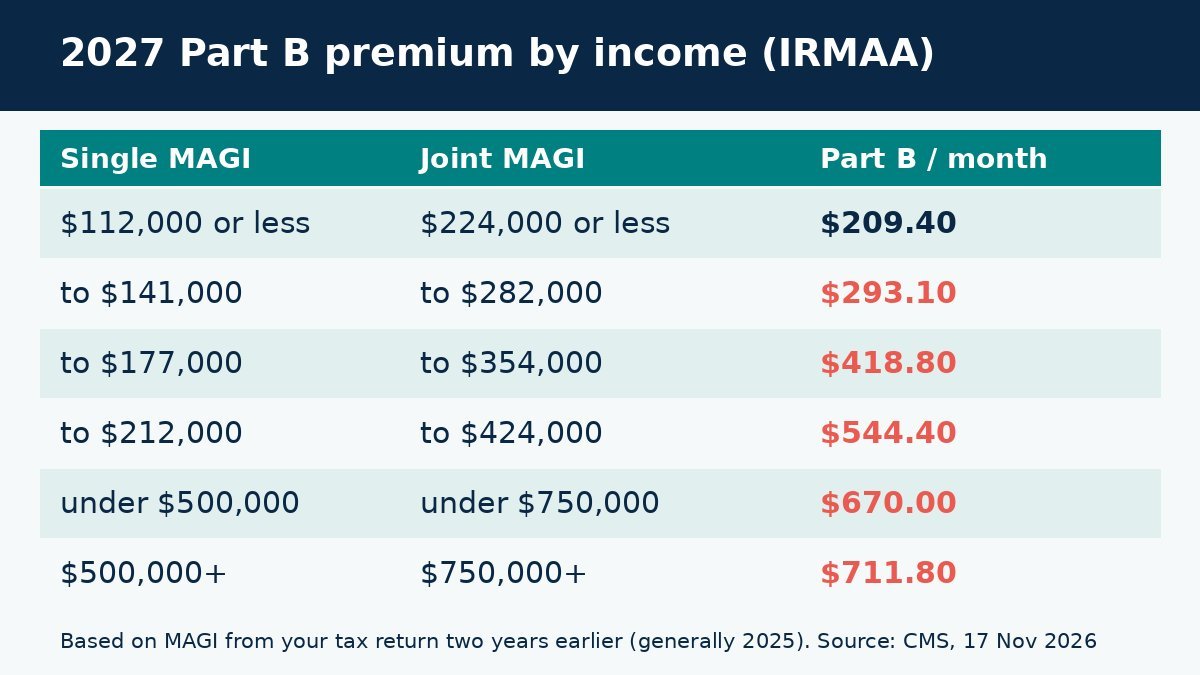
Roughly 9% of people with Part B pay an income-related monthly adjustment amount (IRMAA) on top of the standard premium. For 2027, the surcharge starts when MAGI is above $112,000 on an individual return or $224,000 on a joint return. In 2026 those thresholds were $109,000 and $218,000, according to the Social Security Administration.
| Individual return MAGI | Joint return MAGI | Part B total monthly premium | Part D IRMAA (added to plan premium) |
|---|---|---|---|
| $112,000 or less | $224,000 or less | $209.40 | $0.00 |
| Over $112,000 up to $141,000 | Over $224,000 up to $282,000 | $293.10 | $15.40 |
| Over $141,000 up to $177,000 | Over $282,000 up to $354,000 | $418.80 | $39.70 |
| Over $177,000 up to $212,000 | Over $354,000 up to $424,000 | $544.40 | $64.00 |
| Over $212,000 and under $500,000 | Over $424,000 and under $750,000 | $670.00 | $88.30 |
| $500,000 or more | $750,000 or more | $711.80 | $96.40 |
If you’re married, lived with your spouse at any time during the year and file separately, there are only two surcharge tiers: $670.00 a month for MAGI above $112,000 and below $388,000, and $711.80 at $388,000 or more. These amounts apply per person, so if both spouses have Part B, each pays the premium for their bracket.
IRMAA works like a cliff, not a gradual scale. A single filer with MAGI of $112,001 pays $83.70 a month more for Part B than someone at $112,000, which adds up to $1,004.40 over the year before any Part D surcharge.
Which tax year sets your 2027 premium?
SSA uses “the most recent federal tax return the IRS provides to us.” Its guidance for 2026 says that generally means the return for tax year 2024. Under the same two-year lookback, your 2027 Part B premium will generally be based on your 2025 return, which you filed this year.
SSA defines MAGI for this purpose as your adjusted gross income plus tax-exempt interest. That means municipal bond interest counts even though it isn’t taxed. It also means one-off income spikes from two years ago can raise your premium now, such as a large Roth conversion, a big capital gain or a home sale above the exclusion. If you’re weighing a conversion, our Roth vs traditional IRA guide explains the trade-offs.
Will the 3.6% COLA cover the increase?
For most retirees, yes. SSA announced on 14 October 2026 a 3.6% cost-of-living adjustment starting with January 2027 payments, and says retirement benefits will rise by an average of $75 a month. That’s much more than the $6.50 premium increase.
As an illustration, a $2,000 monthly benefit rises by about $72 with a 3.6% COLA. After the extra $6.50 for Part B, the net monthly payment goes up by roughly $65.50. Your own figure depends on your benefit and any other deductions, such as a Part D premium taken from your check.
The Federal Register notice also explains the “hold-harmless” provision. If your Part B premium is deducted from your Social Security payment, the premium increase can be reduced so that your net payment doesn’t go down. The notice states that this protection “does not apply to beneficiaries who are required to pay an income-related monthly adjustment amount.” SSA says people with a my Social Security account can see their COLA notice online starting in late November.
How to lower IRMAA if your income has dropped
If you’ve retired or your income has fallen since the tax year SSA used, you don’t have to wait two years for your premium to catch up. SSA lets you request a lower IRMAA using Form SSA-44 after a life-changing event. Qualifying events include:
- marriage, divorce or the death of a spouse
- you or your spouse stopped working or cut back your hours
- loss of income-producing property because of a disaster or another event outside your control
- the scheduled end, termination or reorganization of an employer pension plan
- a settlement from an employer because of its closure, bankruptcy or reorganization
You’ll need documents that show both the event and the drop in income, such as a letter from your employer about your retirement. If you think SSA has used the wrong figures, you can appeal. If you filed an amended tax return, call SSA on 1-800-772-1213.
What to do before the end of 2026
- Review your plan by 7 December. Medicare’s Open Enrollment Period runs from 15 October to 7 December. According to Medicare.gov, changes made in that window take effect on 1 January 2027. Your local State Health Insurance Assistance Program (SHIP) offers free, unbiased counseling.
- Watch your 2026 income. Under the two-year lookback, income you take in 2026 will generally affect your 2028 premiums. Year-end Roth conversions, fund distributions and gains from selling investments all count toward MAGI.
- Don’t skip required distributions to stay under a bracket. The IRS penalty can cost far more than an IRMAA tier. If you’ve already missed one, see our guide to the missed RMD penalty.
- Plan your HSA contributions before Medicare starts. A CMS guide says you can’t contribute to a Health Savings Account once you have Medicare. Our HSA vs FSA explainer covers how each account works.
- Budget for the new deductible. Expect to pay the first $292 of Part B-covered costs yourself in 2027 before Original Medicare starts paying its share, unless you have supplemental coverage.
FAQ
How much is the Medicare Part B premium in 2027?
The standard monthly premium is $209.40, up from $202.90 in 2026. Higher earners pay between $293.10 and $711.80 a month.
When does the 2027 premium start?
On 1 January 2027. If your premium is deducted from Social Security, the new amount usually comes out of your January payment.
What income triggers IRMAA in 2027?
MAGI above $112,000 on an individual return or above $224,000 on a joint return, generally based on your 2025 tax return.
What is the Part B deductible for 2027?
It’s $292 for the year, up $9 from $283 in 2026.
Can I appeal a higher premium?
Yes. If your income dropped because of a life-changing event, file Form SSA-44. If you think SSA used the wrong information, you can appeal its decision.
Disclaimer: This article is general information, not financial, tax or medical-insurance advice. Medicare costs depend on your circumstances and coverage choices. Check Medicare.gov or SSA, or speak to a SHIP counselor or qualified adviser, before making decisions.